Centre for Childhood and Youth Studies

News
Tradwives as a ‘symptom’? (Winter/Spring 2026/2027) (course taught in German)
Current debates in the context of gender relations, social media and far-right ideologies (ZKJF event series)
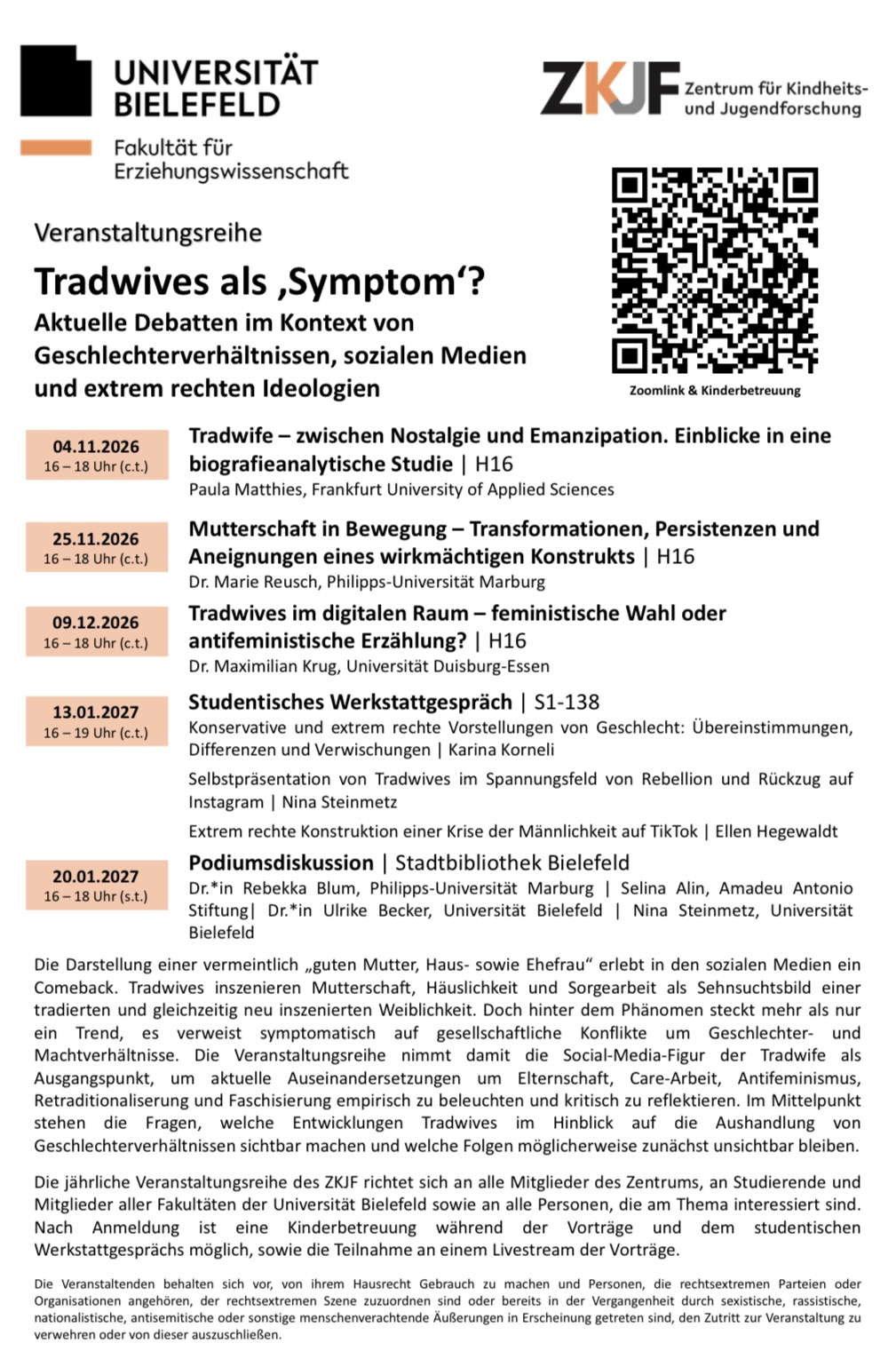
The portrayal of a supposedly ‘good mother, housewife and wife’ is making a comeback on social media. ‘Tradwives’ present motherhood, domesticity and care work as an idealised image of a femininity that is both traditional and, at the same time, reimagined. Yet there is more to this phenomenon than just a trend; it is symptomatic of wider societal conflicts surrounding gender and power relations. This series of events therefore takes the social media figure of the ‘tradwife’ as its starting point to empirically examine and critically reflect on current debates concerning parenthood, care work, anti-feminism, retraditionalisation and fascistisation. The focus is on the questions of which developments ‘Tradwives’ bring to light with regard to the negotiation of gender relations, and which consequences may initially remain invisible.
The series of events will take place in person at Bielefeld University. Once you have registered, the three lectures (4 November 2026, 25 November 2026 and 9 December 2026) can also be followed via a livestream. To do so, simply follow the registration link. On the day before the event, you will receive a Zoom link by email once you have registered. The concluding panel discussion will take place in the event hall (SO2) of Bielefeld City Library.
Childcare is also available during the lectures and the student workshop discussion. If you require childcare, we ask that you register your interest in advance for organisational reasons. On the day, you will need to complete a Family Services form with your contact details and some additional information (allergies, medical conditions), etc.
We look forward to the following talks and consultants:
- 04.11.2026 | Tradwife – zwischen Nostalgie und Emanzipation. Einblicke in eine biografieanalytische Studie | Paula Matthies (Frankfurt University of Applied Sciences) – Raum H16
- 25.11.2026 | Mutterschaft in Bewegung – Transformationen, Persistenzen und Aneignungen eines wirkmächtigen Konstrukts | Dr. Marie Reusch (Philipps-Universität Marburg) – Raum H16
- 09.12.2026 | Tradwives im digitalen Raum – feministische Wahl oder antifeministische Erzählung? | Dr. Maximilian Krug (Universität Duisburg-Essen) – Raum H16
- 13.01.2027 | Studentisches Werkstattgespräch | Raum S1-138
- Konservative und extrem rechte Vorstellungen von Geschlecht: Übereinstimmungen, Differenzen und Verwischungen | Karina Korneli
- Selbstpräsentation von Tradwives im Spannungsfeld von Rebellion und Rückzug auf Instagram | Nina Steinmetz
- Extrem rechte Konstruktion einer Krise der Männlichkeit auf TikTok | Ellen Hegewaldt - 20.01.2027 | Podiumsdiskussion (Stadtbibliothek Bielefeld) | Dr.*in Rebekka Blum (Philipps-Universität Marburg) | Selina Alin (Amadeu Antonio Stiftung)| Dr.*in Ulrike Becker (Universität Bielefeld) | Nina Steinmetz (Universität Bielefeld) – Stadtbibliothek Bielefeld
The organisers reserve the right to exercise their right to admit or exclude persons and to refuse entry to or exclude from the event any individuals who belong to far-right parties or organisations, are associated with the far-right scene, or have previously made sexist, racist, nationalist, anti-Semitic or other inhuman remarks.
- Lectures Winter 2025/2026
Regulation of Childhood and Youth (Lecture Series ZKJF) (Winter 2025/2026)
German Lecture Series

© Bielefeld University Childhood and adolescence are highly regulated phases of life. In these phases of life, regulation takes place, for example, on the part of the welfare state, the education and care system, the family and the peer group or legally, e.g. on the basis of the Eighth Social Code (SGB VIII).
The lecture series centres on the questions of how children and young people are constructed in different contexts as those in need of protection, unreasonable, sources of danger or potentially permanently at risk and what scope for action is attributed to them as independent actors. Since the UN Convention on the Rights of the Child of 1989, their rights have been discussed in the field of tension between protection, promotion and participation rights. The restructuring of the investment-based welfare state and the current reforms of Book VIII of the Social Code with a view to inclusion are also bringing children and young people into focus as central addressees - especially in places of institutional regulation such as day-care centres, schools, child and youth welfare or juvenile criminal law.
The speakers will use empirical analyses and theoretical reflections to shed light on the diverse forms and effects of the regulation of childhood and youth.The lecture series by the Centre for Childhood and Youth Studies is aimed at students and staff of all faculties and subject areas as well as anyone interested in the topic.
- Lectures Winter 2024/2025
- 20.01.2025, 18.15 - 19.45 Uhr (CET/UTC +1) (registration until 19.01.2025) Ursina Jaeger: "Kindheit jenseits öffentlicher Institutionen. Die Diversität pädagogischer Alternativität und ihre Implikationen für die Kindheitsforschung" [German Lecture, 'Childhood beyond public institutions. The Diversity of Pedagogical Alternativity and its Implications for Childhood Research']
- 27.01.2025, 18.15 - 19.45 Uhr (CET/UTC +1) (registration until 26.01.2025) Wiebke Hiemesch:"Von Straßenbahnen, Hafenbecken und dem Turmbau zu Babel. Zeichnungen jüdischer Kinder aus dem Hamburg der 1930er Jahre als Quellen einer Kindheitsgeschichte" [German lecture, 'Of trams, harbour basins and the Tower of Babel. Drawings by Jewish children from Hamburg in the 1930s as sources of a childhood story']
- Lectures Summer 2024


