Mathematics studies

Master’s in mathematical economics (enrolment until summer term 2025)
Description of the programme structure
You must choose one of the following three specialisms: Financial Mathematics, Mathematics, Economics
Profiles
- Financial mathematics
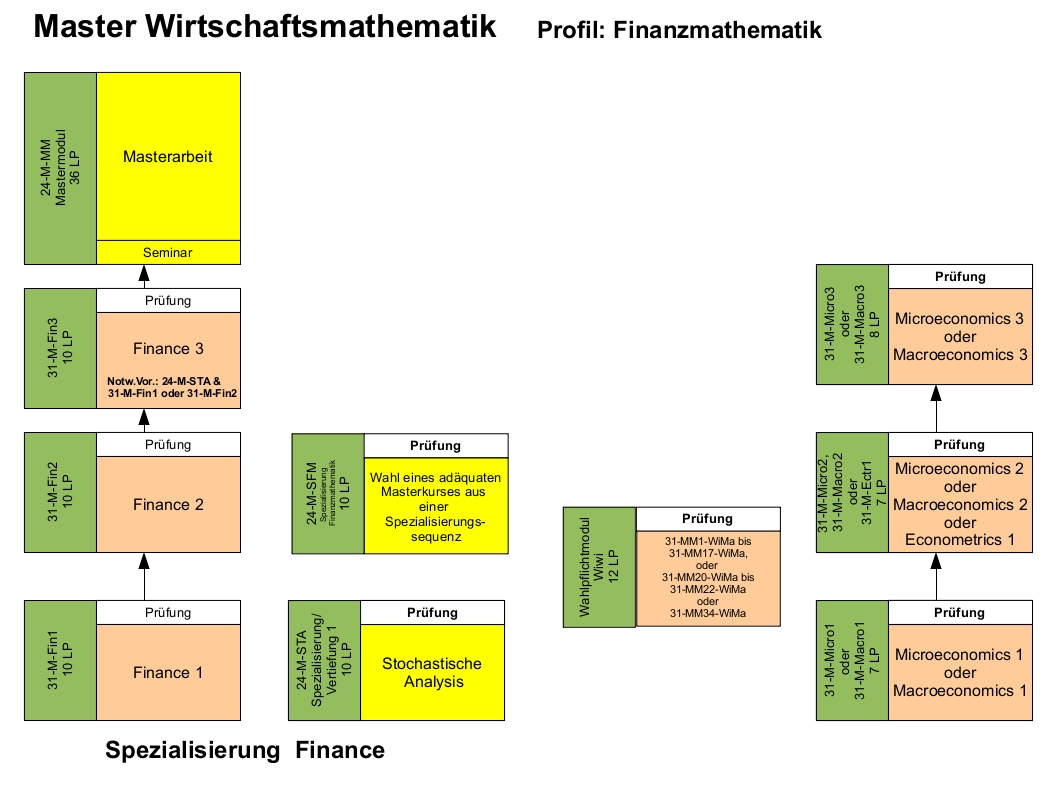
The Financial Mathematics programme consists of a specialisation in Finance (30 LP) with a complementary compulsory-optional module in Mathematics (20 LP) and a final Master’s module (36 LP), as well as a complementary compulsory-optional module in Economics (34 LP).
- The specialisation in Finance comprises the sequential foundation modules ‘Finance 1’ and ‘Finance 2’ (4+2 contact hours each, 10 LP) with a compulsory seminar, and the thematic module ‘Finance 3’ (10 LP). The specialisation culminates in a Master’s thesis and is supplemented by a course in Stochastic Analysis (10 LP) and a further specialisation in Mathematics (24-M-SFM, 10 LP). The latter opens up further topics for Master’s theses. Admission to the Finance 3 module requires the successful completion of module 24-M-STA (Stochastic Analysis) and one of the modules 31-M-Fin1 (Finance 1) or 31-M-Fin2 (Finance 2).
- In the compulsory-elective area of economics, students must choose either a specialisation in microeconomics or in macroeconomics. For the specialisation, students must take three consecutive core modules (Microeconomics 1, 2 and 3 or Macroeconomics 1, 2 and 3, totalling 7 + 7 + 8 credit points). One of the second basic modules may be replaced by the module Econometrics 1. Furthermore, one module from the Master’s programme in Economics without a tutorial (in connection with lecture/seminar) must be completed.
- The Master’s module consists of the Master’s thesis (30 LP) and a preparatory Master’s seminar (6 LP), in which short presentations on current research findings are given in very small groups.
Prerequisites for the Financial Mathematics specialisation
In order to study the ‘Financial Mathematics’ specialisation within the master course in Mathematical Economics, a fundamental understanding of probability theory based on measure and integration theory is required.
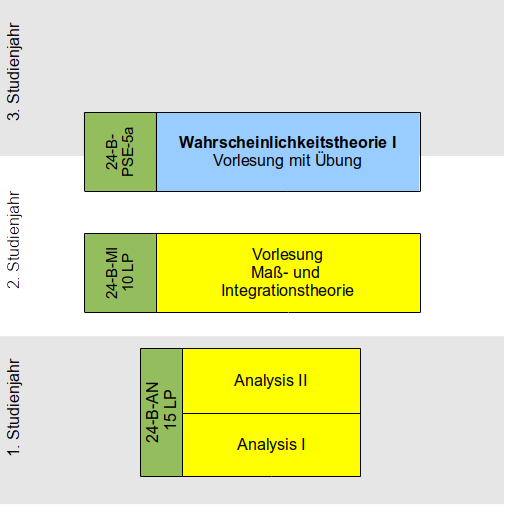
This knowledge can be acquired in the Bachelor’s programme in Mathematical Economics through the following recommended sequence: As a rule, the ‘Probability Theory I’ lecture is taken in the 4th or 5th subject related semester and counts towards the supplementary module 24-B-PSE-5.
- Mathematics
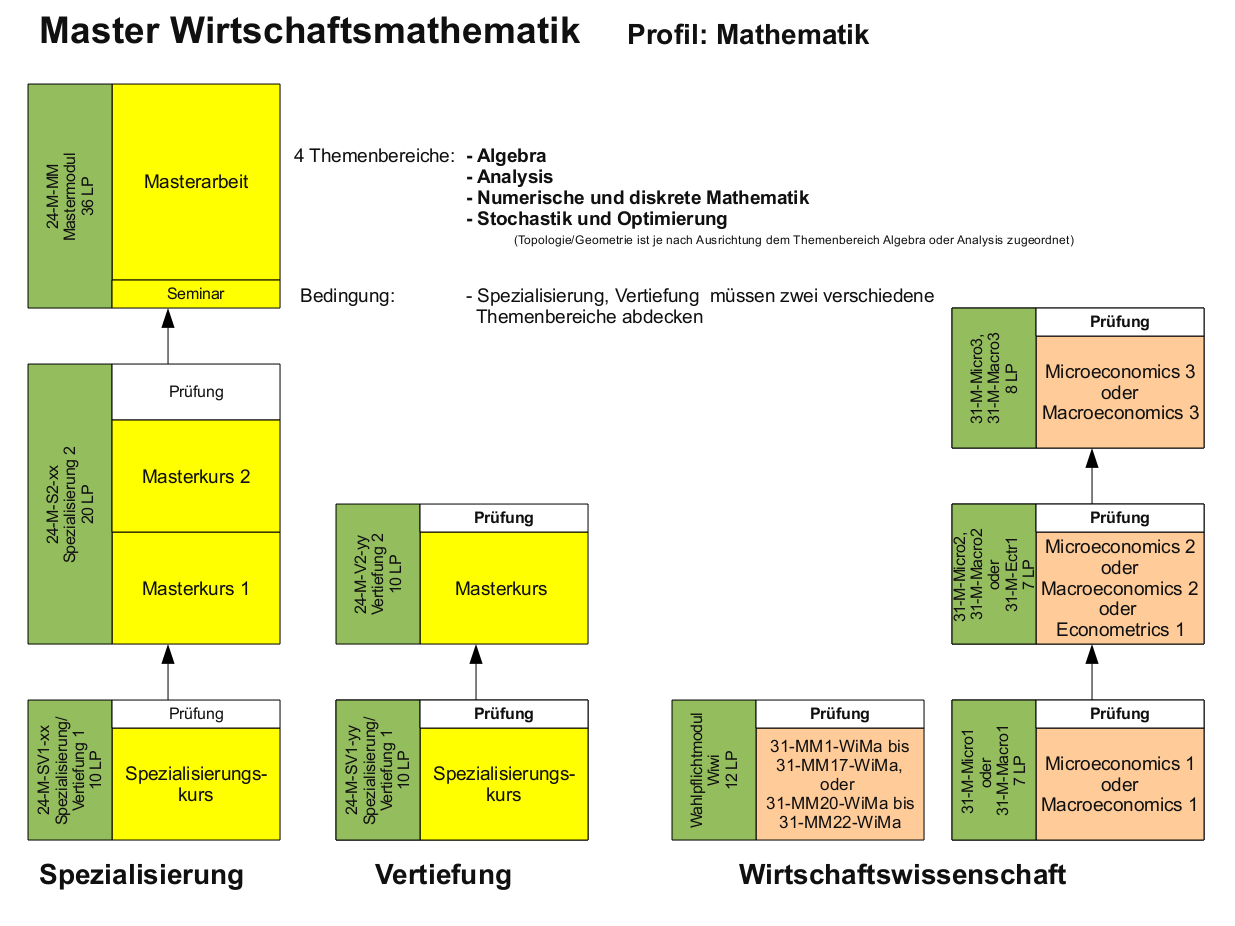
The Mathematics programme comprises a compulsory-elective module in mathematics (50 LP) culminating in a Master’s module (36 LP), as well as a supplementary compulsory-elective module in economics (34 LP).
The mathematics modules are organised into four subject areas:
- Algebra (AL)
- Analysis (AN)
- Numerical and Discrete Mathematics (ND)
- Stochastics and Optimisation (SO)
The Mathematics programme consists of a specialisation and an in-depth study module (see Master’s in Mathematics):
- In the specialisation, you choose a sequence from one of the four subject areas. A specialisation comprises a module 24-M-SV1-xx in the first subject related semester and a follow-up module 24-M-S2-xx from the same subject area xx in the second and third subject related semesters (where xx = AL, AN, ND or SO), totalling 30 LP. The course format in the first semester is a specialisation course (lecture with tutorials (in connection with lecture/seminar) with approx. 20 participants, 4+2 SWS, with an examination); in the second and third subject related semesters, it takes the form of a new type of course known as a ‘Master’s course’, which corresponds in scope to a project seminar comprising 6 SWS. A Master’s course can take a variety of forms: two small (3 and 4 SWS) or one large (6 SWS) lectures, each with an integrated tutorial (in connection with lecture/seminar) and a high proportion of discussion; or a small lecture (4 SWS) and a seminar (2 SWS); or a seminar involving a public presentation, a written report and a project assignment. Each Master’s course comprises 7 LP. The two Master’s courses, which build on one another, are assessed jointly (specialisation examination, 6 LP). The Master’s thesis is developed from these.
- The plans for specialisation sequences in Mathematics for the current and forthcoming semesters can be found here.
- For the specialisation, a further subject area yy must be chosen. A specialisation consists of the modules 24-M-SV1-yy and 24-M-V2-yy in subject area yy, which build on one another, and thus comprises 20 LP. In module 24-M-V2-yy, students undertake the first Master’s course in a specialisation sequence.
- In the compulsory-elective area of economics, students must choose either a specialisation in microeconomics or in macroeconomics. For the specialisation, students must take three consecutive core modules (Microeconomics 1, 2 and 3 or Macroeconomics 1, 2 and 3, totalling 7 + 7 + 8 LP). One of the second basic modules may be replaced by the module Econometrics 1. Furthermore, one module from the Master’s programme in Economics without a tutorial (in connection with lecture/seminar) must be completed.
- The Master’s module consists of the Master’s thesis (30 LP) and a preparatory Master’s seminar (6 LP), in which short presentations on current research findings are given in very small groups.
- Economics
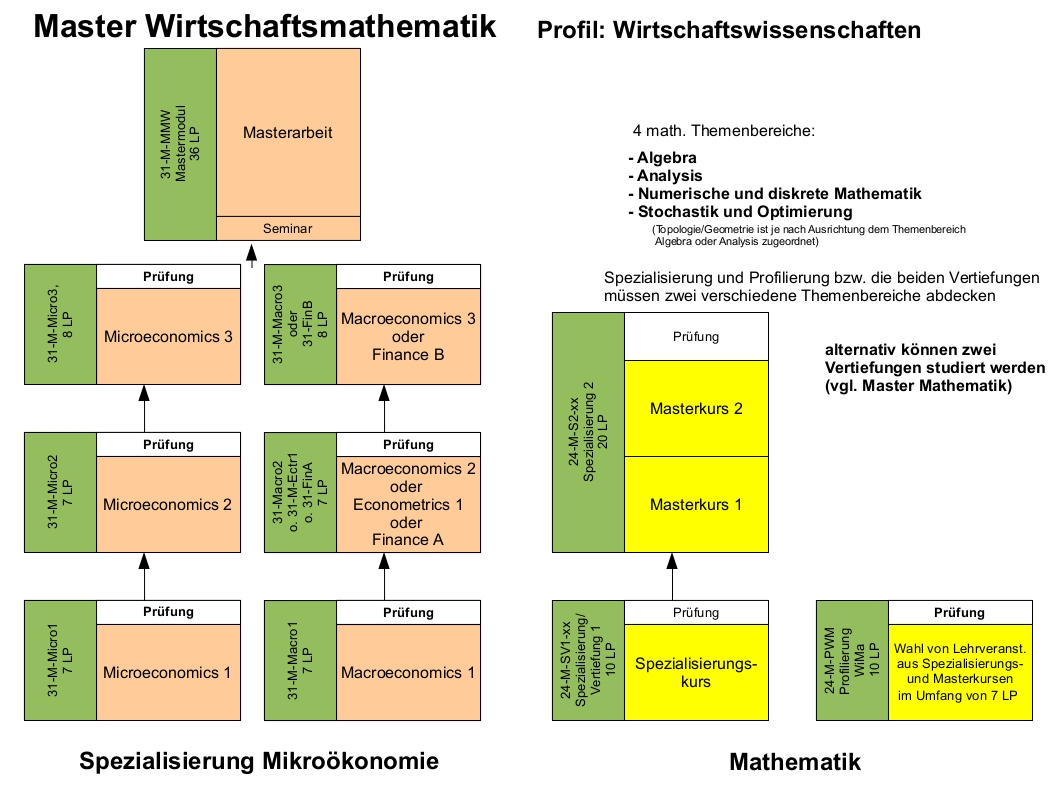
The Economics programme comprises a compulsory component in economics (44 LP) culminating in a Master’s module (36 LP), as well as a supplementary compulsory-elective component in mathematics (40 LP).
Within the compulsory economics component, students must specialise in both microeconomics and macroeconomics. For these specialisations, students must take three consecutive foundation modules (Microeconomics 1, 2 and 3, and Macroeconomics 1, 2 and 3). One of the specialisation sequences must, as a rule, be completed in full; in the other sequence, the second part may alternatively be replaced by Econometrics 1 or Finance A, or the third part by Finance B. Finance A and B correspond to the modules Finance 1 and 2, but without the coursework required for those modules. The Master’s thesis is based on the specialisations.
The mathematics degree programme consists of a specialisation and a profile:
The mathematics modules are organised into four mathematical subject areas:- Algebra (AL)
- Analysis (AN)
- Numerical and Discrete Mathematics (ND)
- Stochastics and Optimisation (SO)
- In your specialisation, you choose a sequence from one of the four subject areas. A specialisation consists of a module 24-M-SV1-xx in the first subject related semester and a follow-up module 24-M-S2-xx from the same subject area xx in the second and third subject related semesters (where xx = AL, AN, ND or SO) and comprises 30 LP. The course format in the first semester is a specialisation course (lecture with tutorials (in connection with lecture/seminar), with approx. 20 participants, 4+2 SWS, with an examination), whilst in the second and third subject related semesters it takes the form of a new type of course known as a ‘Master’s course’, which corresponds in scope to a project seminar comprising 6 SWS. A Master’s course can take a variety of forms: two small lectures (3 and 4 SWS) or one large lecture (6 SWS), each with an integrated tutorial (in connection with lecture/seminar) and a high proportion of discussion; or a small lecture (4 SWS) and a seminar (2 SWS); or a seminar involving a public presentation, a written paper and a project. Each Master’s course comprises 7 LP. The two Master’s courses, which build on one another, are assessed jointly (specialisation examination, 6 LP). Alternatively, the 40 LP in Mathematics may also be completed in the form of two specialisations in two of the subject areas.A specialisation consists of the modules 24-M-SV1-yy and 24-M-V2-yy, which build on one another within subject area yy, and thus comprises 20 LP. In module 24-M-V2-yy, students undertake the first Master’s course in a specialisation sequence (see Master’s in Mathematics).
- Modules 24-M-STA and 24-M-SFM can together replace a module of the type 24-M-S2-xx.
- The plans for specialisation sequences in Mathematics for the current and forthcoming semesters can be found here.
- The specialisation consists of module 24-M-PWM. Within the specialisation area, students are free to choose courses from the Master’s in Mathematics totalling 7 LP. The specialisation area serves to supplement students’ subject knowledge on an individual basis; in other words, suitable courses that do not feature in the specialisation or advanced study areas may be offered for this purpose. The courses in the specialisation module are assessed jointly (3 LP).
- The Master’s module consists of the Master’s thesis (30 LP) and a preparatory Master’s seminar (6 LP).