Research / Forschung

Research / Forschung
- What I work on: Areas and Topics
I typically work on issues that are located at the intersection of the philosophy of language, epistemology, metaphysics, and meta-philosophy.
Topics of interest to me include predicates and rigidity, Kripkeanism, two-dimensional semantics, modal epistemology, thought experiments and conceptual analysis, metaphysical modality, armchair methods of philosophical inquiry, conceptual engineering, descriptive philosophical methodology, and the like.
- To learn about my publications and current work in progress, see my publications page.
- For research conducted in our „research group in theoretical philosophy“, see the group's website.
- For workshops and events, past and present, also see the group's website.
You find more on my research when you look at the different projects I pursue below.
- Research Projects within CRC 1646: Open Texture // Concepts of Creativity
Project: Open Texture as a Source of Linguistic Creativity
This project figures as sub-project B05 in the CRC 1646 "Linguistic Creativity in Communication" which you find here. I pursue this project together with Julia Zakkou (HHU Düsseldorf) and in collaboration with Steffen Koch (Bielefeld).
Open texture is the indeterminacy we often find when we consider whether a predicate applies to a new (or newly considered) object: Does ‘sandwich’ apply to burritos (Ludlow 2014), or does ‘money’ apply to bitcoin (Vecht 2020)? There seems to be no fact of the matter. Nothing in the established meaning of these predicates or the properties of these objects settles the issue one way or the other.
If this is right, then our language is beset by a widespread indeterminacy besides vagueness, and we should inquire into its nature, its grounds, and its wider consequences - such as its foundational role in the emergence of linguistic creativity. Combining approaches from semantics, pragmatics, and meta-semantics, this is precisely what our project does.
- areas: semantics, meta-semantics, pragmatics, linguistics
- status: well under way
Project: Concepts of Creativity
The CRC 1646 inquires into "Linguistic Creativity in Communication". But what is creativity? How are we to understand the respective concept?
Inspired by the theoretical debate within our CRC, I have taken a close look at the general debate on creativity with a focus on publications in philosophy. This has led to the paper "Conceptual Pluralism About Creativity Defended" (Mss 12/2025), which I have presented in two talks at Bielefeld (12/2025) and at Riga (12/2025). Here is the abstract:
"Conceptual pluralism about creativity holds that we use multiple, systematically related concepts of creativity rather than a single one. I make a case for conceptual pluralism based on linguistic variability. Both in our linguistic practice and in word semantics, ‘creative’ systematically varies in meaning: (1) we need different definitional clauses for agents, objects, and processes; (2) we employ weakened uses, including a current-state use for objects and a performance use for processes; and (3) as a gradable adjective, ‘creative’ enlists different types of good-making properties, yielding diverging application conditions. I explain how the resulting pluralism solves some obvious and some not-so-obvious puzzles about creativity, and our debate about it."
- Research Project: Philosophical Methodology & Philosophical Methodologies (with Steffen Koch)
In this joint project, Steffen Koch and I develop and defend an answer to the question "What is a philosophical methodology?", and put it to work within the methodology of philosophy.
Our aim is descriptive. We want to capture methodological dynamics. We want to trace how new programs, methods, or concerns change philosophy. We want to answer questions such as "In which ways, if any, is conceptual engineering apt change how philosophers think of and do philosophy?".
Our approach combines four ideas.
- First idea: The AMC-model of philosophical projects. What is a philosophical project? In its simplest form, a philosophical project <A,M,C> combines a proximal philosophical aim A (= what the project is designed to proximally achieve) with a philosophical method M (= how someone is meant to realize the proximal aim) and a philosophical concern C (= for which theoretial or practical ends someone engages in the project).
- Second idea: The AMC-model of philosophical methodologies (in the plural). A philosophical methodology is a type of philosophical project <A#,M#,C#> combining a type of aim A# with a type of method M# and a type of concern C#.
- Third idea: Zetetic Contextualism.The operative criteria of sameness for types of aims, methods, and concerns vary with the zetetic context - there are no context-invariant principles to be had.
- Fourth idea: Going plural. We can trace dynamics by tracing changes in the methodologies (in the plural) that figure in our collective methodological repertoire. These changes concern both new wholesale types of projects as well as marked changes in the aims, methods, or concerns that figure within entrenched types of philosophical projects.
- areas: philosophical methodology, descriptive meta-philosophy
- status: three papers written, two submitted, a contribution to the "Handbuch Metaphilosophie" published, see my publications. Here is a [link]
- Research Project: Conceptual Engineering
Conceptual analysis aims to solve philosophical problems by uncovering what key terms actually mean. Conceptual engineering rather focusses on ameliorating the meanings of these terms. Such an amelioration can concern diverse dimensions of evaluation – it can e.g. be representational, cognitive, practical, moral, and/or political.
Understood as a technique, conceptual engineering raises analytical issues, such as: What determines the meaning of a concept ‘F’, how can we tell how good ‘F’ fares along some pertinent dimension(s) of evaluation, how, if at all, can we intentionally change the meaning of a term already in use, and how can we justifiably balance representational goodness against political or moral aptness.
Understood as a methodology, conceptual engineering raises normative questions about the aims and methods of philosophy. Revisionist conceptual engineers insist that we move from philosophy understood as an essentially descriptivist venture inquiring “What is our concept of F?” to philosophy understood as a normative undertaking asking “What should our concept of F be?”.
My project mainly explores the possibility, means and mechanisms of an intentional change in meaning. The main line of research, however, concerns the normative force and the methodological implications of conceptual engineering understood as a philosophical methodology, especially the ideas that theorists are obliged to ameliorate their concepts, and the revisionist idea that conceptual engineering supports a general shift from descriptive to normative questions when it comes to conceptual dealings in philosophy.
-
areas: metaphilosophy, normative methodology
-
status: One paper published with Inquiry. One paper published in Synthese. More to come. See my publications.
-
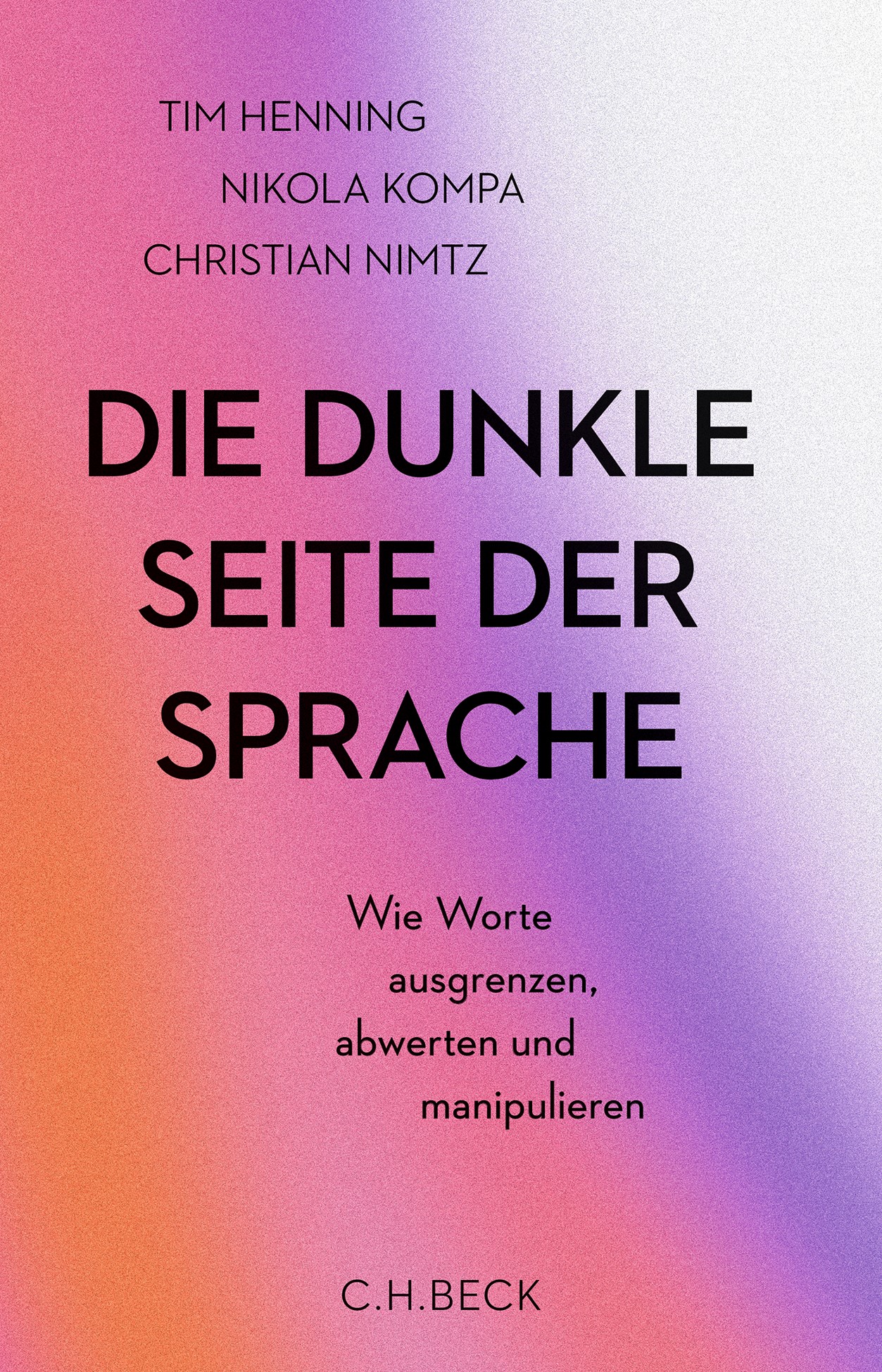
- Buchprojekt: Die Dunkle Seite der Sprache

Unser Buch "Die dunkle Seite der Sprache. Wie Worte ausgrenzen, abwerten und manipulieren", geschrieben von Nikola Kompa, Tim Henning und mir, ist im März 2025 bei C.H.Beck erschienen.
Im Buch nehmen wir uns sechs sprachliche Phänomene vor - nämlich: Metaphern, generische Aussagen, Herabsetzungswörter, kommunkative Entmächtigung, Akkommodation, Lügen & Bullshitting - und erkunden die zugrundeliegenden Mechanismen in ihrer hellen und vor allem in ihrer dunklen Spielart.
Hier ein wenig Presseecho zum Buch. Viel Spaß!
- Kurzinterview zum Buch auf radioeins (rbb)
- Rezension in der taz.
- Gruppeninterview auf der Buchmessen im taz-Streaming.
- Research Project: Paradigm Term Semantics
This project is an ongoing concern of mine since about 2016. I deem it important: seeing that certain expressions are paradigm terms tells us much of how they work, and how we should treat them.
Paradigm terms are expressions whose application is governed by a specific relation and anchored in specific actual items or ‘paradigm(s)’. For illustration, think of how ‘is one meter long’ was set to apply to anything bearing is of the same length as to the actual prototype du metre, a metal bar stored in Paris. The semantics of a paradigm predicate ‘F’ is captured by its value structure <R, O@>, combining a relation R and a set of actual paradigms O@. A paradigm term ‘F’ with the value structure <R, O@> will apply to anything x anywhere bearing R to the F-paradigms in O@.
The research programme systematically explores the role and import of paradigm terms and their deceptively simple (meta-)semantics for vernacular and scientific language. Paradigm term semantics devises a novel way to realize the externalist conviction that linguistic meaning is regularly fixed by the world. It provides a unifying scheme for expressions as diverse as ‘is one meter long’, ‘is gold’ , ‘is a star’, ‘has been Tom-Sawyered’, and ‘is a revolution’, and it thereby brings out that the proper linguistic taxon is the category of paradigm terms, rather than the usually consider class of natural kind expressions. At the same time, paradigm term semantics solves classic problems for externalism, and it avoids committing to metaphysical essentialism in its semantic format.
This research has far reaching implications for a variety of intersecting issues across multiple areas of philosophy such as e.g. the philosophy of language (predicate meaning, rigidity, Kripkeanism, what form a two-dimensional semantics should take), epistemology (modal knowledge, conceptual knowledge, the interplay of conceptual and worldy factors in inquiry), and the philosophy of science (natural kind terms, scientific essentialism, conceptual structure in scientific theories).
- areas: philosophy of language, epistemology, philosophy of science, metaphilosophy.#
- status: three papers published in the Australasian Journal of Philosophy, Philosophical Quarterly and Erkenntnis. One paper in a volume on Epistemology of Modality and Philosophical Methodology. - See my publications for details.
- >> Research Group Theoretical Philosophy
Bielefeld is an active and lively environment for theoretical philosophy. For other workshops and events, past and present, see the website of our "research group theoretical philosophy" here.
Workshops / Tagungen
- Workshop: Open Texture II - November 2026
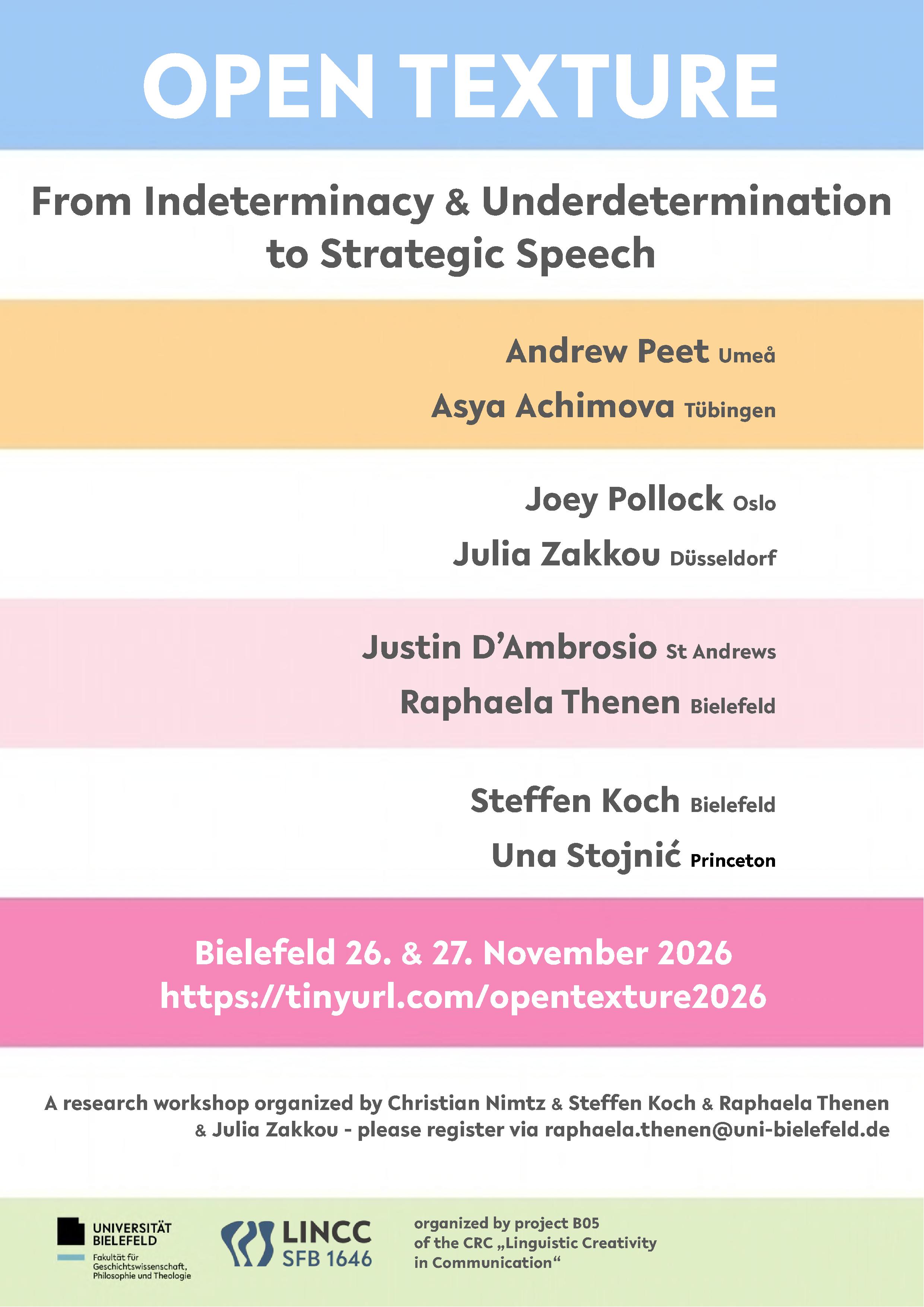
Open Texture
From indeterminacy & underdetermination to strategic speech // Bielefeld, November 26 and 27 2026
organized by Christian Nimtz, Julia Zakkou, Raphaela Thenen & Steffen Koch
This workshop broadens our picture of open texture. Taking its cue from the analysis of open texture as a specific semantic indeterminacy, it relates open texture to indeterminacy and underdetermination more generally, and connects it to issues in strategic speech.
With contributions by:
- Andrew Peet, Umeå
- Asya Achimova, Tübingen
- Joey Pollock, Oslo
- Julia Zakkou, Düsseldorf
- Justin D’Ambrosio, St Andrews & Steffen Koch, Bielefeld
- Raphaela Thenen, Bielefeld
- Una Stojnić, Princeton
You will eventually find the programme here.
For registration and inquires, contact raphaela.thenen@uni-bielefeld.de.
The workshop is organized by project B05 of the CRC 1646 "Linguistic Creativity in Communication" - see here.
- Workshop: Open Texture - September 2025
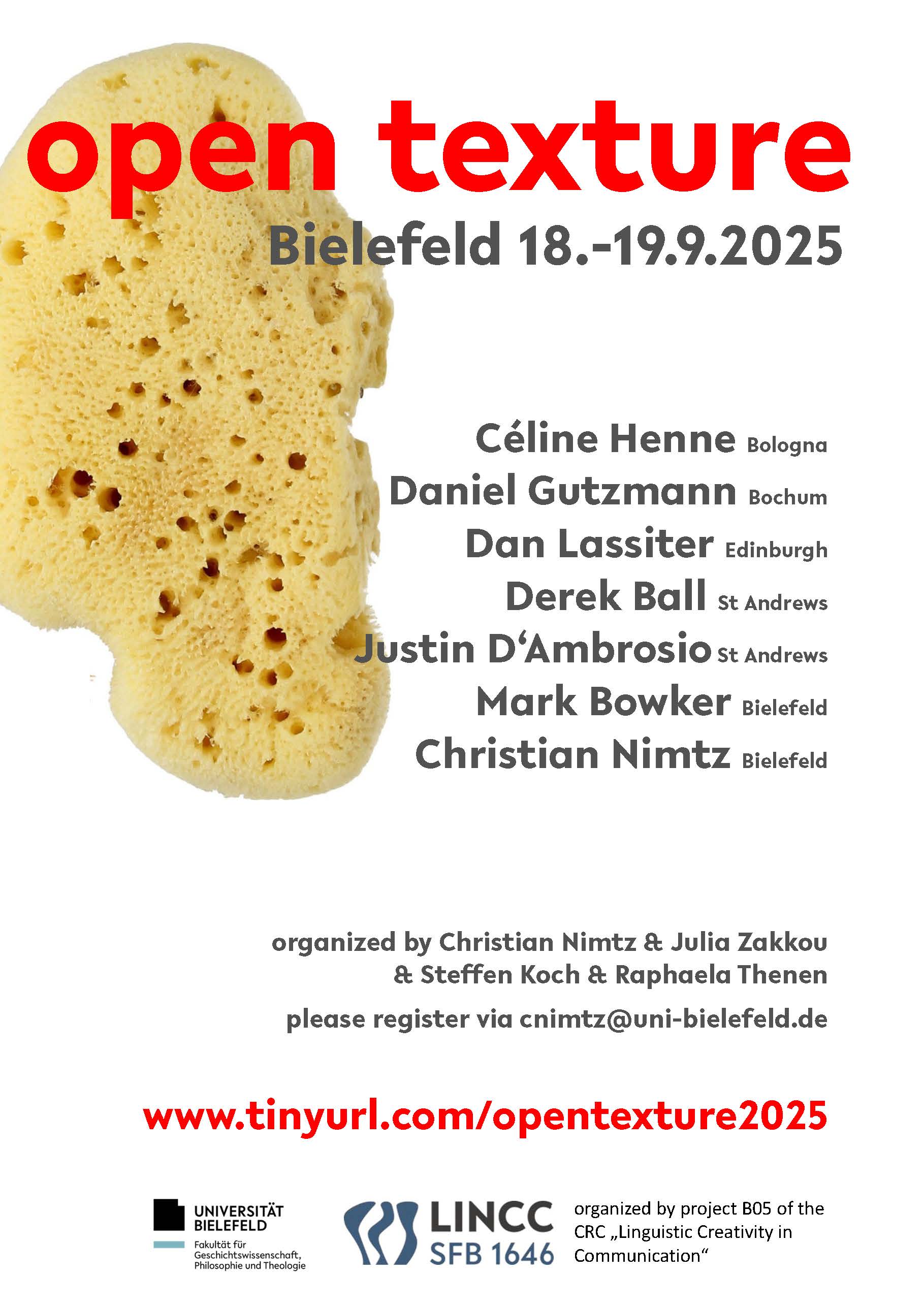
Open Texture
Bielefeld September 18 and 19 2025
forganized by Christian Nimtz, Julia Zakkou & Steffen Koch & Raphaela Thenen
with
- Céline Henne (Bologna)
- Dan Lassiter (Edinburgh)
- Derek Ball (St Andrews)
- Mark Bowker (Bielefeld)
- Justin D'Ambrosio (St Andrews)
- Daniel Gutzmann (Bochum)
- Christian Nimtz (Bielefeld)
The workshop engages with open texture as a linguistic phenomenon and its relation to other phenomena and indeterminacies in language.
You will find the program here.
For registration, please contact cnimt@uni-bielefeld.de
The workshop is organized by project B05 of the CRC 1646 "Linguistic Creativity in Communication" - see here.
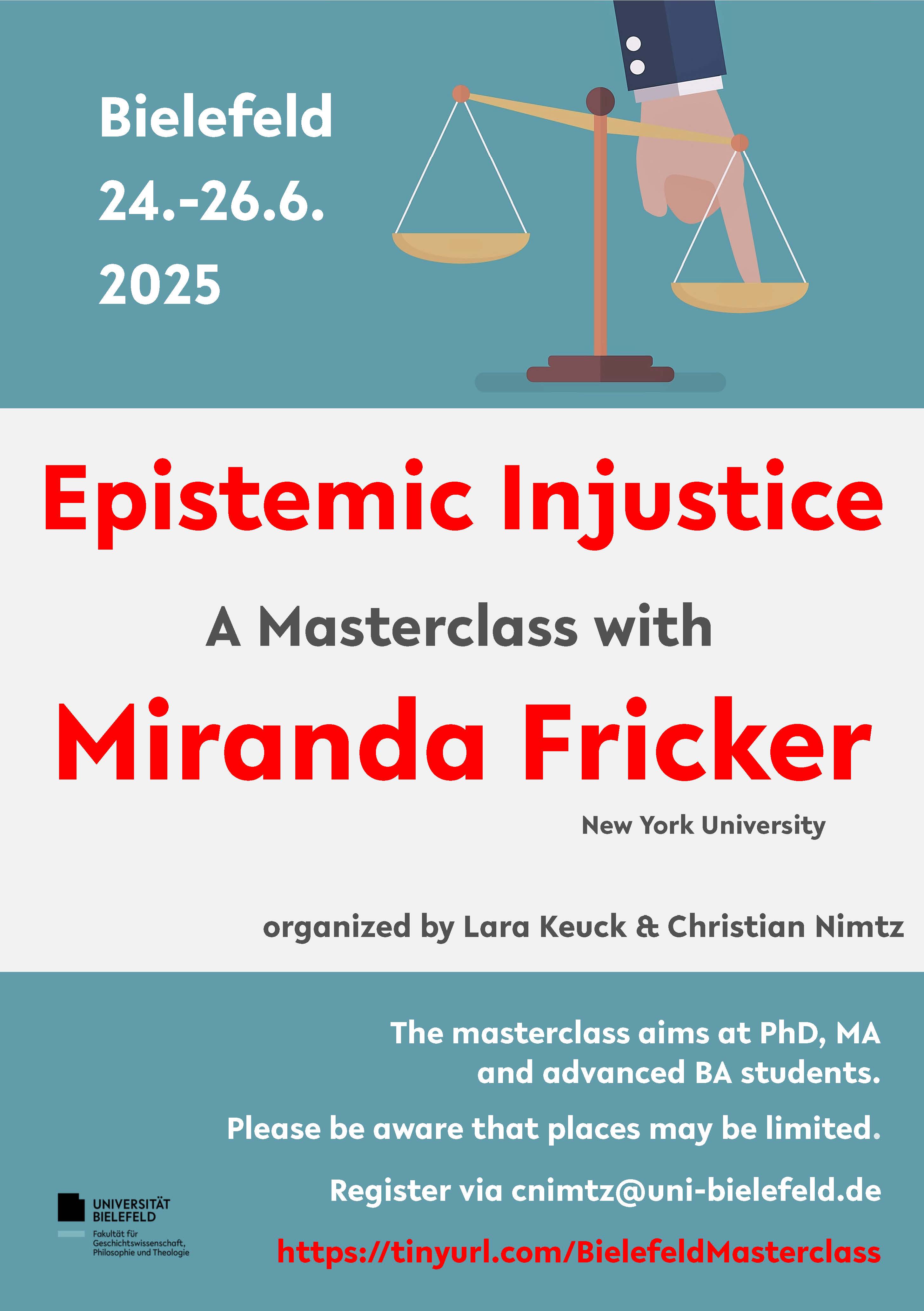
- Masterclass 2025 with Miranda Fricker on "Epistemic Injustice"
This masterclass presented Miranda Fricker, and it focused on a her work on epistemic injustice.
The master was jointly organized by Lara Keuck and me.
For more details, see our masterclass page here
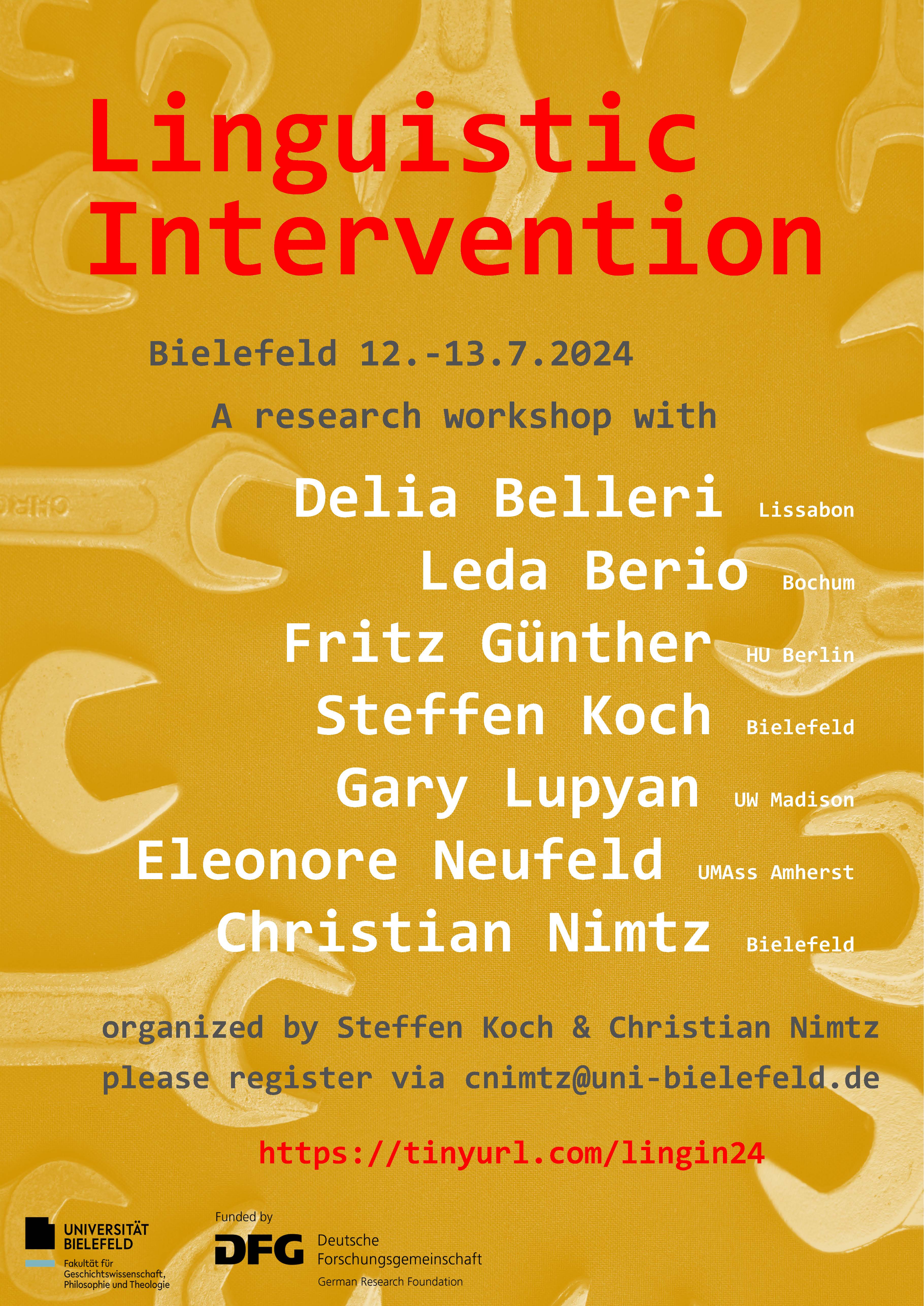
- Workshop: Linguistic Interventions - Philosophical and Empirical Perspectives, July 12-13 2024
The workshop took up a key issue in conceptual ethics & engineering: How can we intervene to change our language, and why should we do so?
Our discussion of this issue combined perspectives from philosophy, psychology and linguistics.
Here is a list of speakers: Delia Belleri (Lisbon), Leda Berio (Bochum), Fritz Günther (HU Berlin), Steffen Koch (Bielefeld), Gary Lupyan (Wisconsin-Madison), Eleonore Neufeld (UMass Amherst), and Christian Nimtz (Bielefeld).
You find all details and the programme here.
The workshop was supported by the DFG.
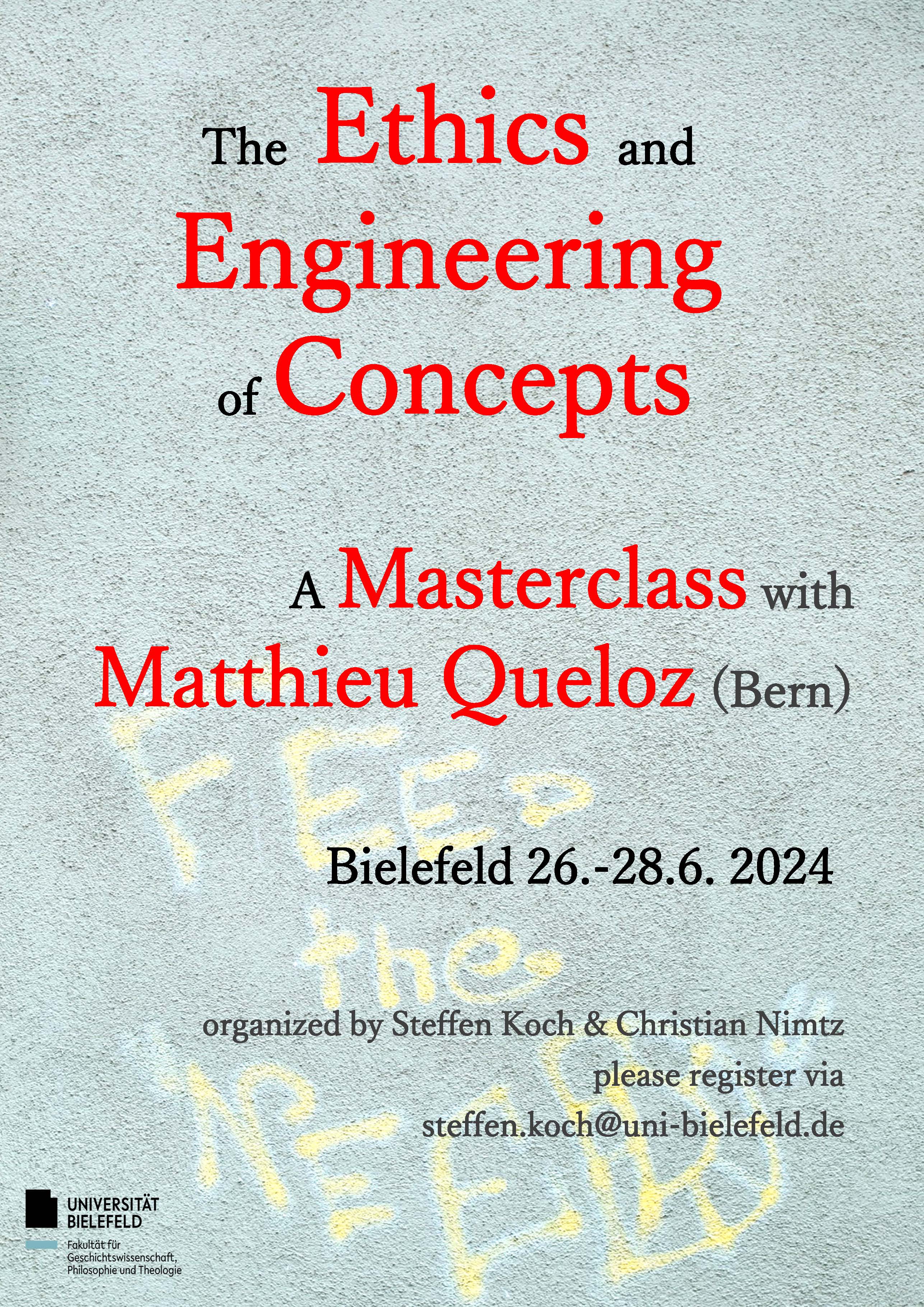
- Masterclass 2024 with Matthieu Queloz on "The Ethics and Engineering of Concepts"
Our masterclass with Matthieu Queloz (Bern) dealt in great detail with his now book "The Ethics of Conceptualization".
The book concerns key aspects of conceptual ethics and conceptual engineering, starting from the authority question: Why should we grant certain concepts an authority over our lives - over how we think, and what we take as a reason for action?
The masterclass-website with all details can be found: here.
- Summer School: Conceptual Engineering, Experimental Methods and Politically Correct Language - 2022/08, UZH Zürich
I have been taking part in the summer school organized by Kevin Reuter and Hanjo Glock (both UZH). Other people who have been there were Shaun Nichols (Cornell University), Rachel Sterken (University of Hongkong), Manuel Gustavo Isaac (UZH), Ethan Landes (UZH), Nicole Rathgeb (UZH), and Pascale Willemsen (UZH),
Here's the website.
- Conceptual Engineering: Feasibility & Normativity - 2021/03