Combined Bachelors Degree Programmes

Computer Science in the Natural Sciences


Just as computer science is making inroads into all areas of life, it has long since found its way into the natural sciences. The computer has evolved from an occasional aid into a crucial tool for controlling experiments or deriving insights from experimental data. These wide-ranging tasks cannot be undertaken by scientists with self-taught computer science skills. They require well-trained computer scientists who must also understand the language of the discipline in which their expertise is applied.
Computational Science is a key technology for progress in the fields of biology, biotechnology, Chemistry and physics. This practice-oriented degree programme is designed to enable students to apply information technology specifically in the service of a natural science.
The interdisciplinary Bachelor’s programme in Computational Science at Bielefeld University fulfils this aim by imparting knowledge and skills in both computer science and one of the above-named natural science disciplines. To ensure that students receive training that qualifies them for professional careers, the programme focuses not only on specialist knowledge but also on key social skills, such as communication skills. Even whilst studying for their Bachelor’s degree, students benefit from insights into current research.
Study programmes:
The Computer Science in Natural Sciences degree programme is offered by the Faculty of Technology as a single-subject B.Sc.
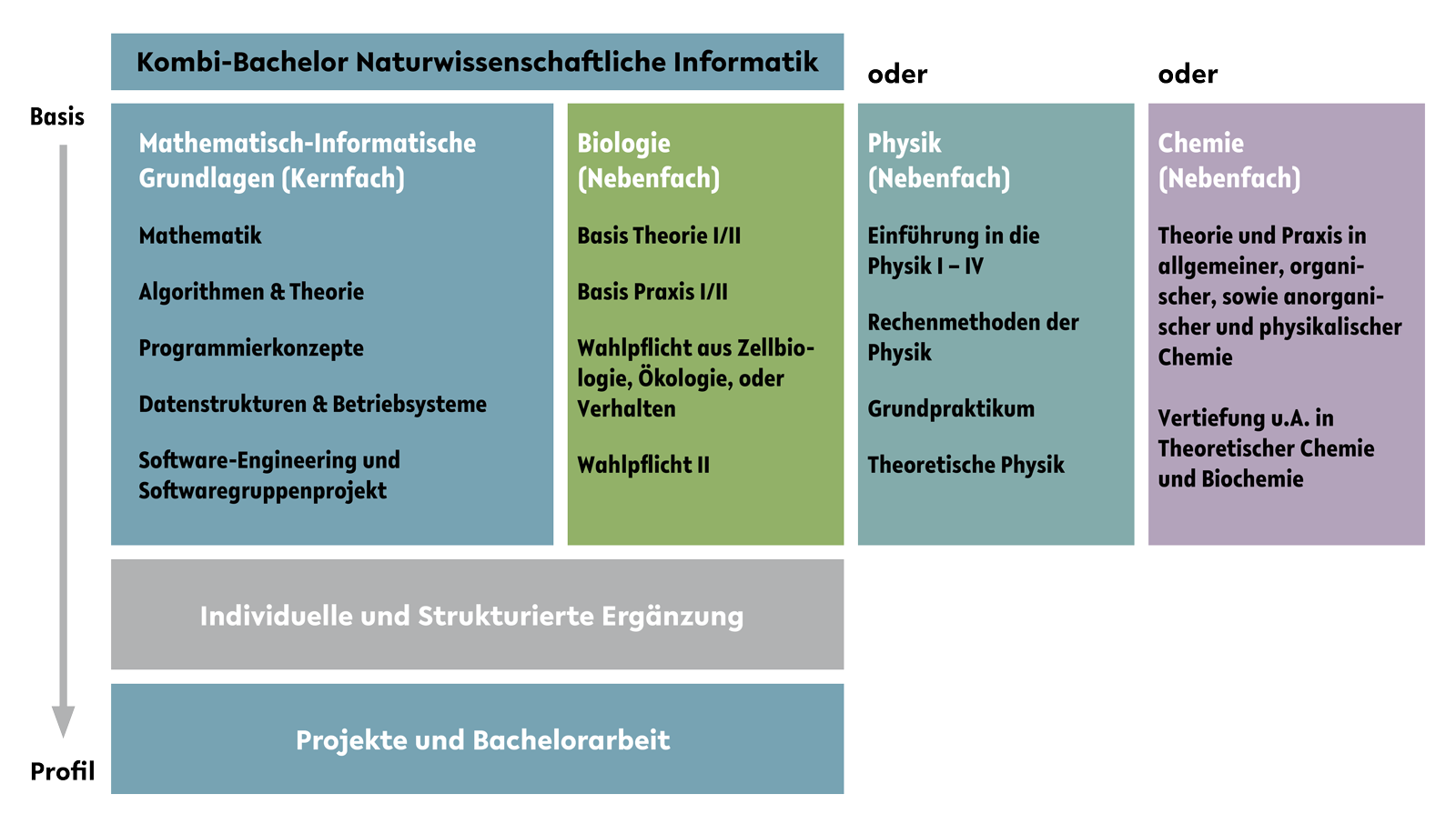
Alternatively – provided there is a clear focus on a specific subject within the natural sciences – a combined bachelors degree may also be chosen, e.g. by selecting Computer Science as the core subject with any profile (i.e. either Bioinformatics, Engineering Informatics or Modelling) and a minor subject in Physics, Chemistry or Biology (60 LP).


Entry requirements
Anyone wishing to study computer science with a focus on the natural sciences should have an aptitude for their chosen natural science subject and not be daunted by the formal methods of mathematics and computer science. A good command of English is essential for successful study, in order to be able to deal effectively with specialist literature and terminology.
International exchange and collaboration
Students are offered various opportunities to gain experience abroad and develop intercultural skills. The Erasmus+ programme takes them to universities across Europe; in addition, Bielefeld University maintains international collaborations and partnerships with higher education institutions on every continent. The International Office provides advice on all matters relating to choosing a place to study, scholarships for studying abroad and the application process.
- Course content
Specifically, the training programme consists of three components: basic training in mathematics, computer science and the natural sciences. In the field of mathematics, linear algebra, analysis and differential equations, as well as statistics and stochastics, lay the formal foundations for the rest of the programme. The basic training in computer science, which covers topics from the fields of algorithms and data structures, programming and software engineering, databases, engineering informatics and theoretical informatics, is designed to enable students to succeed in professional practice within the IT sector or to progress to any master course in computer science, thanks to the practical programming and project-oriented skills they acquire.
In the field of natural sciences, students are first taught a fundamental understanding of physics, biology and Chemistry. Thereafter, the focus within the natural sciences becomes more specialised, as well as the corresponding topics in computer science. Some topics, such as computer-aided administration, the visualisation of experimental data, or image processing, are important for all natural sciences. Others are more specific: algorithms for sequence analysis predominate in biology, whilst numerical algorithms are central to physics. The topic of the Bachelor’s thesis may lie within computer science or a natural science subject; ideally, it lies at the intersection of the two.
- Career prospects
Graduates of the Natural Sciences and Computer Science programme generally work as computer scientists in interdisciplinary research groups within the natural sciences. Their role is not, for example, to replace physicists, but to work alongside them to ensure the effective application of computer science methods to solving physical problems.
The range of activities and fields of application is therefore wide-ranging – examples of potential sectors include automation technology, the aerospace industry, the microelectronics industry, the pharmaceutical and chemical industries, and large-scale research institutions.- Further study opportunities
Upon successful completion of their Bachelor’s degree, graduates can either enter the workforce straight away or continue their higher education to deepen and broaden their knowledge.
Students can obtain a Master of Science (M.Sc.) in Computational Science. The Faculty of Technology also offers Master’s degrees in Bioinformatics and Genomics, and Intelligent Systems.
The route to a PhD is also flexible: in addition to the standard route via a Bachelor’s and Master’s degree, particularly qualified students have the option of commencing a PhD immediately after completing their Bachelor’s degree.