Ereignisse und Veranstaltungen

Aktuelle Veranstaltungen der Abteilung
Anmeldung & Teilnahme
Gastvorträge: Alle Mitglieder und Studierende der Abteilung sowie Interessierte sind herzlich eingeladen an den Gastvorträgen der Abteilung teilzunehmen.
Workshops: Zur Anmeldung schreiben Sie bitte eine Email an die jeweiligen Organisator*innen.
Clubsitzungen: Es wird vorab ein Aufsatz gelesen, der dann diskutiert wird. Um den Aufastz vorab zu erhalten, schreiben Sie bitte dmitry.ananiev[at]uni-bielefeld.de. Aufsätze dürfen nicht weiterverbreitet werden.
Kolloquien
Jährliche Veranstaltungen der Abteilung
Vergangene Veranstaltungen der Abteilung
Diese Liste umfasst nur Veranstaltungen aus dem vorherigen und dem aktuellen Semester.
Für einen vollständigen Überblick über alle vergangenen Veranstaltungen besuchen Sie bitte unser Veranstaltungsarchiv.
Sommer 2026
- 15.07.2026 Clubsitzung: Julie Schweer
- 08.07.2026 Wolfgang Spohn (Konstanz): Was haben die Grundlagen der Entscheidungstheorie mit dem Problem des freien Willens zu tun?
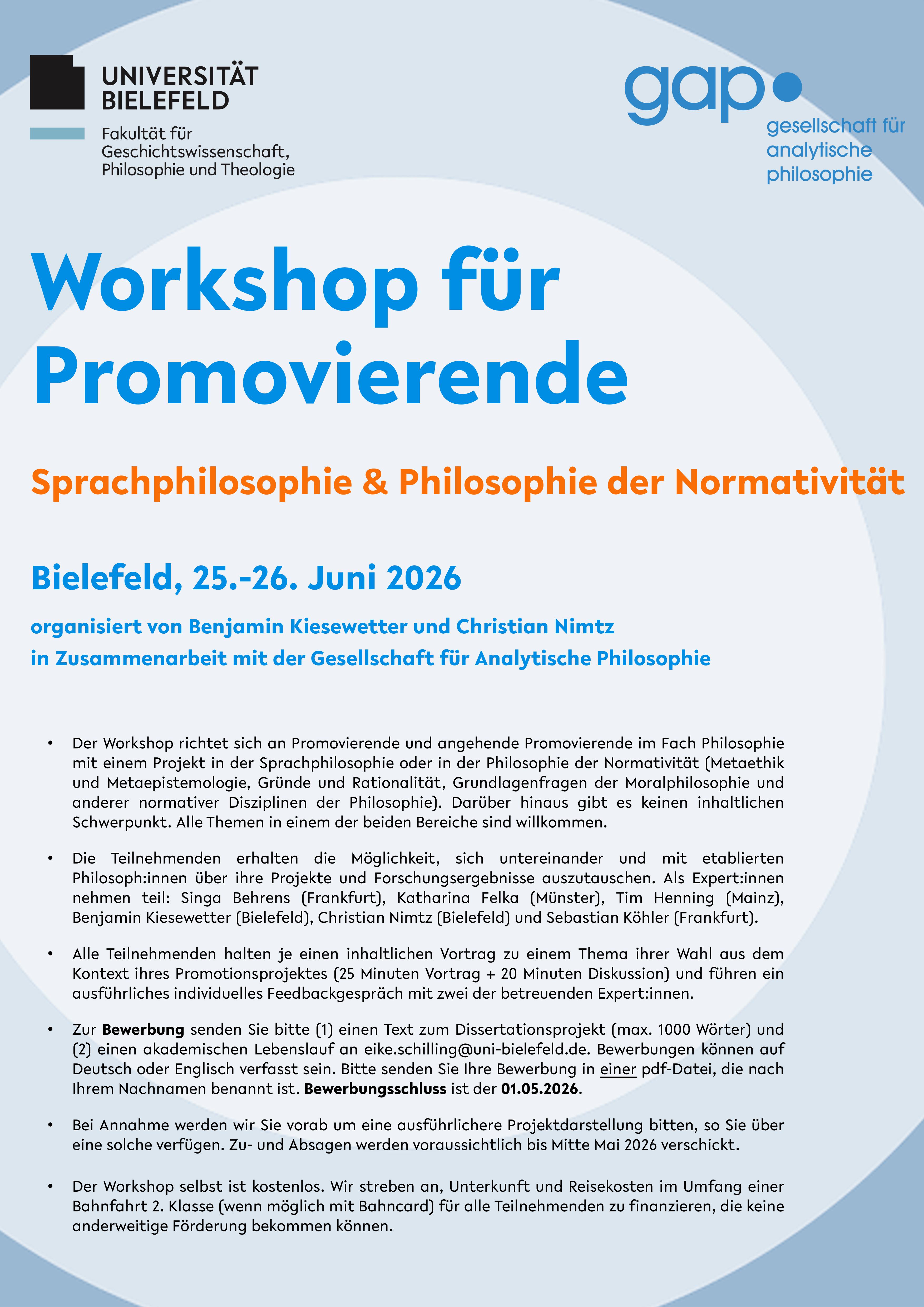
- 25.–26.06.2026 Workshop für Promovierende: Sprachphilosophie & Philosophie der Normativität
Bielefeld, 25.-26. Juni 2026 organisiert von Benjamin Kiesewetter und Christian Nimtz in Zusammenarbeit mit der Gesellschaft für Analytische Philosophie
- Der Workshop richtet sich an Promovierende und angehende Promovierende im Fach Philosophie mit einem Projekt in der Sprachphilosophie oder in der Philosophie der Normativität (Metaethik und Metaepistemologie, Gründe und Rationalität, Grundlagenfragen der Moralphilosophie und anderer normativer Disziplinen der Philosophie). Darüber hinaus gibt es keinen inhaltlichen Schwerpunkt. Alle Themen in einem der beiden Bereiche sind willkommen.
- Die Teilnehmenden erhalten die Möglichkeit, sich untereinander und mit etablierten Philosoph:innen über ihre Projekte und Forschungsergebnisse auszutauschen. Als Expert:innen nehmen teil: Singa Behrens (Frankfurt), Katharina Felka (Münster), Tim Henning (Mainz), Benjamin Kiesewetter (Bielefeld), Christian Nimtz (Bielefeld) und Sebastian Köhler (Frankfurt).
- Alle Teilnehmenden halten je einen inhaltlichen Vortrag zu einem Thema ihrer Wahl aus dem Kontext ihres Promotionsprojektes (25 Minuten Vortrag + 20 Minuten Diskussion) und führen ein ausführliches individuelles Feedbackgespräch mit zwei der betreuenden Expert:innen.
- Zur Bewerbung senden Sie bitte (1) einen Text zum Dissertationsprojekt (max. 1000 Wörter) und (2) einen akademischen Lebenslauf an eike.schilling@uni-bielefeld.de. Bewerbungen können auf Deutsch oder Englisch verfasst sein. Bitte senden Sie Ihre Bewerbung in einer pdf-Datei, die nach Ihrem Nachnamen benannt ist. Bewerbungsschluss ist der 01.05.2026.
- Bei Annahme werden wir Sie vorab um eine ausführlichere Projektdarstellung bitten, so Sie über eine solche verfügen. Zu- und Absagen werden voraussichtlich bis Mitte Mai 2026 verschickt.
- Der Workshop selbst ist kostenlos. Wir streben an, Unterkunft und Reisekosten im Umfang einer Bahnfahrt 2. Klasse (wenn möglich mit Bahncard) für alle Teilnehmenden zu finanzieren, die keine anderweitige Förderung bekommen können.
- 12.06.2026 Workshop Announcement: Ethical Theory and Obligatory Ends

Speakers:
- Maike Albertzart (Mainz)
- Dmitry Ananiev (Bielefeld)
- Douglas Portmore (Notre Dame)
- Martin Sticker (Bristol)
- Date and Location:
The workshop will be held at Bielefeld University, on June 12th as an in-person event.Summary:
The concept of an obligatory end is commonly associated with Kantian ethics, specifically, with Kant's idea that there are duties to adopt the happiness of others and one's own perfection as ends. However, the notion of obligatory ends has been recently attracting philosophical interest from outside Kantian tradition and there is good reason to think that this notion can be fruitfully employed in moral theorising beyond Kantian ethics. Obligatory ends play an important role in recent treatments of topics such as supererogation (Portmore 2023), moral demandingness and justification of moral options (Hanser 2014, Igneski 2008, Noggle 2009, Sticker 2024), collective harm (Albertzart 2019), and moral and non-moral normativity more generally (Bastian 2025, Greenspan 2010, Portmore ms, van Ackeren & Sticker 2018). The aim of this workshop is to further investigate the nature of obligatory ends and the role they can play in ethical theory broadly construed.
The following is a non-exhaustive list of questions, with which this workshop is concerned:What is the nature of obligatory ends? How are they related to other kinds of moral requirements? What obligatory ends are there?
How does the concept of an obligatory end relate to other normative concepts, such as rights, duties to act, reasons for action and reasons for attitudes?
Should morality be conceived as fundamentally end-based?
What are the implications of admitting obligatory ends as part of the moral landscape? How well do obligatory ends fit within non-consequentialist moral theories that admit of options and constraints?Participation is free, but registration is required and places are limited.
Registration deadline: 08 June 2026
Register at obligatory.ends(at)uni-bielefeld(dot)de
- 10.06.2026 Douglas Portmore (Notre Dame): Reasons, Contextualism, and Doxastic Wronging
Raum: X-E0-002
Abstract:I’ll argue that doxastic wronging consists in failing to respond appropriately to the moral reasons that one has for suspending judgment. And although moral reasons can never be the right kind of reasons for believing, they can be the right kind of reasons for suspending judgment. What’s more, I'll argue that if we accept a certain kind of contextualism about justification, we find that doxastic wronging is never epistemically impeccable. Thus, there is never any conflict between moral norms and epistemic norms.
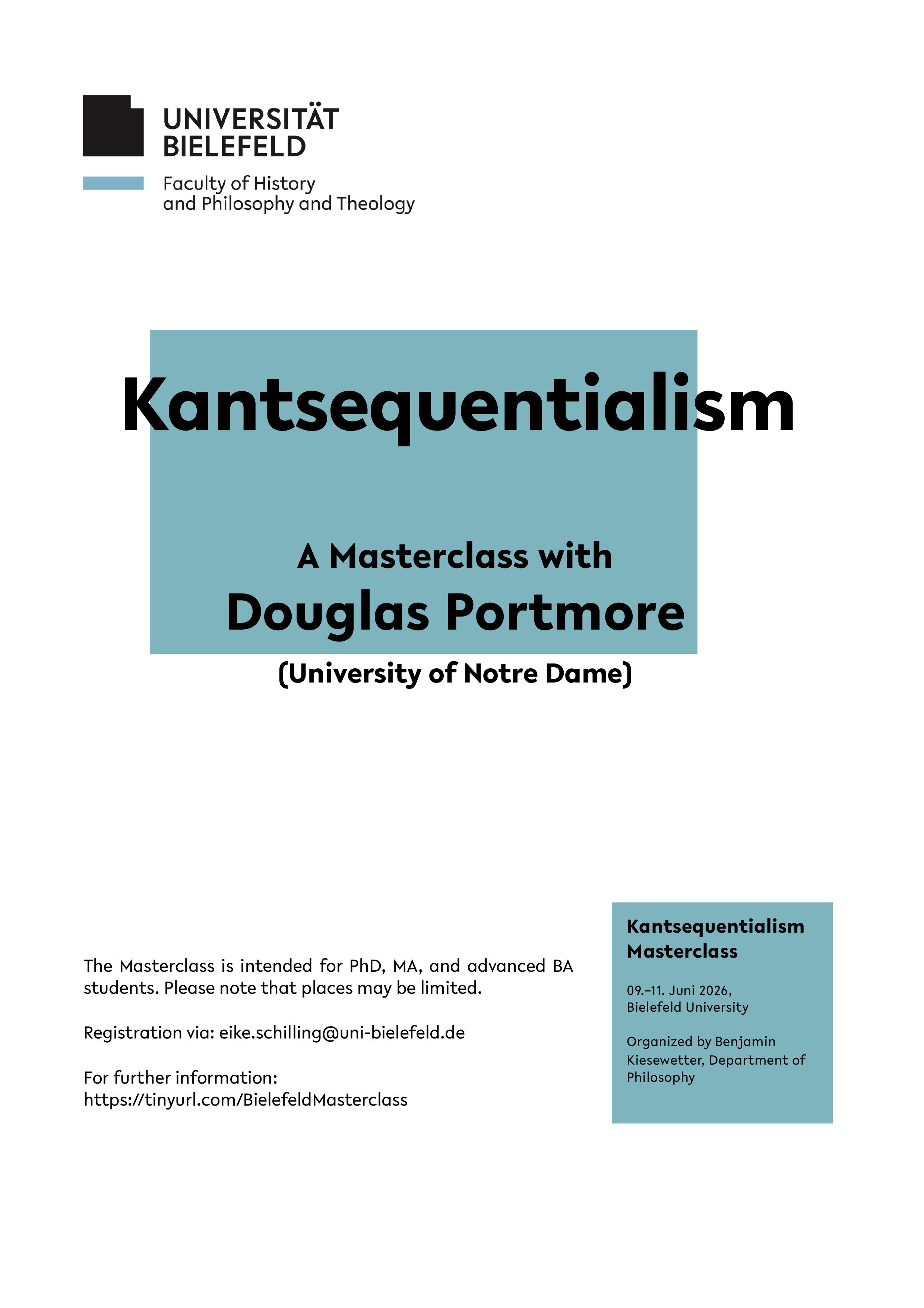
- 09.–11.06.2026 Masterclass: Kantsequentialism - Douglas W. Portmore (Notre Dame)
09.–11. Juni 2026, Bielefeld University
Douglas W. Portmore will teach the 2026 masterclass on themes from his book manuscript "Kantsequentialism: A Morality of Ends", which develops a new moral theory integrating the strengths of utilitarianism and Kantianism.
The Masterclass is intended for PhD, MA, and advanced BA students. Please note that places may be limited.
The masterclass is organized by Benjamin Kiesewetter. Please register via: eike.schilling@uni-bielefeld.de.
If you are a student at Bielefeld University, we encourage you to also enroll for the preparatory course for the masterclass: https://ekvv.uni-bielefeld.de/kvv_publ/publ/vd?id=645384192
Both the masterclass and the preparatory course will be based on Douglas Portmore’s manuscript, “Kantsequentialism”, available for download at https://sites.google.com/site/dwportmore/kantsequentialism-a-morality-of-ends.
Course Overview:
Douglas W. Portmore defends a new moral theory he calls Kantsequentialism. On this view, our most fundamental moral duty is to adopt certain ends—in particular, these four: (a) not manifesting a lack of recognition respect for any person, (b) promoting the impersonal good, (c) being partial concerning certain special relationships, and (d) avoiding the risk of any personal or impersonal disaster. As its name suggests, Kantsequentialism is a hybrid of utilitarianism and Kantianism that combines their different strengths. From utilitarianism, Kantsequentialism takes its act-consequentialism—the idea that whether an agent ought to perform an act just depends on whether they ought to prefer the way it would make the world go to all the ways that the available alternatives would make it go. This allows Kantsequentialism to accommodate our commonsense views about action and reasons for action. From Kantianism, Kantsequentialism takes its commitment both to respecting autonomy and to what W. D. Ross called “the highly personal character of duty” (1930, 22). This allows Kantsequentialism to accommodate our commonsense views about morality, including the idea that, besides the relation of benefactor to beneficiary, there are several other morally relevant relations, including that of agent to patient, lover to beloved, promiser to promisee, etc. These relations are morally relevant despite being relevant only from one’s own actual perspective. In this masterclass, we will take a close look at Portmore’s theory and critically engage with it as a philosophical proposal.
- 27.05.2026 Clubsitzung: Shane Ward
- 15.04.2026 Gastvortrag von Christine Bratu (Göttingen): „You may skip this: Our liberty to listen and freedom of thought”
Raum: X-E0-002
Abstract
In my talk, I argue against Joshi’s and McKenna’s claim that, in conversational exchanges which aim at the truth, we have a duty to listen and in favor of our (somewhat constrained) liberty to listen. First, I present Joshi’s and McKenna’s arguments for a duty to listen which highlight the importance of our shared epistemic resources and our duty to do our fair share in maintaining them. Then I point out an important aspect of listening Joshi and McKenna ignore which is its inherent invasiveness and the danger that this constitutes. The fact that we cannot unhear what people tell us and that we cannot keep it from affecting us speaks in favor of granting us the liberty to decide for ourselves when to listen, or so I contend. I also introduce some constraints on our liberty to listen which, contrary to what Joshi and McKenna argue, stem from moral commitments rather than from epistemic values. I end by discussing two objections.
.jpg)
Winter 2025/26
- 28.01.2026 Clubsitzung: Sophia Arbeiter
- 14.01.2026 Barbara Vetter (FU Berlin): Zur Genealogie der Modalität
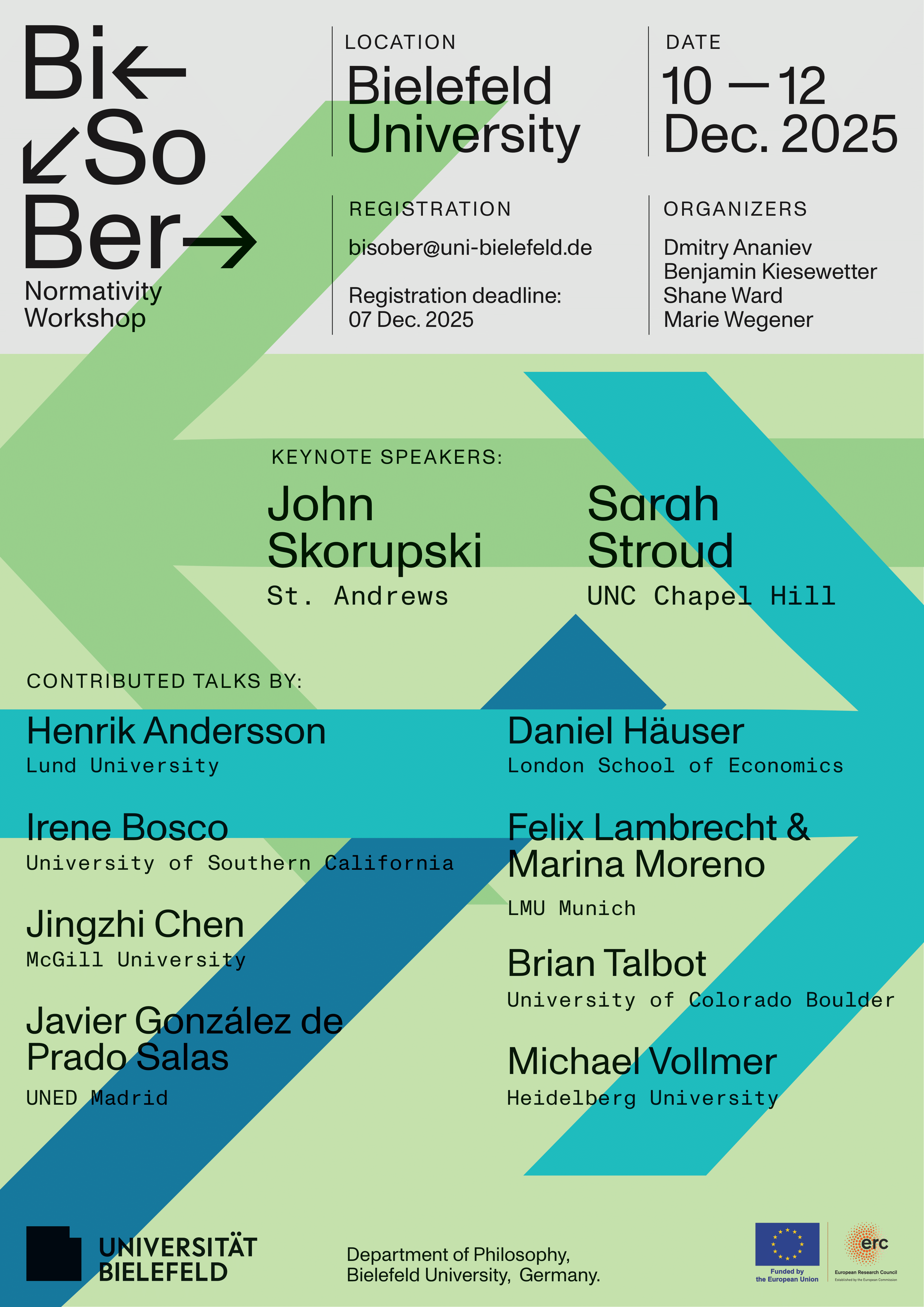
- 10.12.2025-12.12.2025 Workshop: BiSoBer
***Diese Veranstaltung findet ausschließlich auf Englisch statt.***
Organisation: Dmitry Ananiev, Benjamin Kiesewetter, Shane Ward, Marie Wegener
Raum: X-A2-103
Anmeldeschluss: 7. Dezember 2025
Anmeldung: bisober@uni-bielefeld.de
Beschreibung:This workshop will bring together philosophers working on normativity. We invite submissions on practical, epistemic, and other forms of normativity, on foundational problems of moral philosophy, and on reasons, rationality, and value. Our primary aim is to provide a forum for lively and constructive exchange amongst philosophers currently working in the field.
The Bielefeld-Southampton-Berlin (BiSoBer) Normativity Workshop, formerly known as Humboldt-Southampton Normativity Conference, is the tenth edition in a series of annual workshops, alternating between Humboldt University in Berlin, Southampton University, and, starting in 2025, Bielefeld University.
Hauptredner:- John Skorupski (St Andrews)
- Sarah Stroud (UNC Chapel Hill)
Redner:- Henrik Andersson (Lund University)
- Irene Bosco (University of South California)
- Jingzhi Chen (McGill University)
- Javier González de Prado Salas (UNED Madrid)
- Daniel Häuser (London School of Economics)
- Felix Lambrecht and Marina Moreno (LMU Munich)
- Brian Talbot (University of Colorado Boulder)
- Michael Vollmer (Heidelberg University)
- Participation is free, but registration is required and spaces are limited.
Weitere Informationen finden Sie auf unserer Website:
- 10.12.2025 Sarah Stroud (University of North Carolina, Chapel Hill): Pluralism: Evaluative, Not Normative
Raum: X-E0-002
Gastvortrag der Abteilung Philosophie in Kooperation mit der Tagung BiSoBer.
- 19.11.2025 Clubsitzung: Mark Bowker
- 12.11.2025 Julia Langkau (Genf): How to think about creativity
- 24.10.2025 Inaugural Conference des ISoS
Inaugural Conference of the Institute for Studies of Science (ISoS) at ZiF on Oct. 24, 2025
In May 2025, the Institute for Studies of Science (ISoS) has been established as a Central Academic Institute at Bielefeld University. Join the ISoS Inaugural Conference “Science in Practice and in Society” on October 24, 2025 at the Center for Interdisciplinary Research (ZiF) in Bielefeld.
For the program and registration modalities, please visit: https://www.uni-bielefeld.de/zwe/isos/events/opening-conference/
- 22.10.2025 Philipp Brüllmann (Heidelberg): Duty in Cicero's On Duties?