Combined Bachelors Degree Programmes

Artificial Intelligence and Cognitive Informatics


The importance of intelligent, cognitive systems is growing in many areas of everyday life. Mobile service robots, personal assistants, highly automated production facilities, autonomous vehicles and intelligent support systems in medicine and care – all of this is made possible by modern information technology, whose information-processing methods are increasingly modelled on the cognitive abilities of humans and animals. In this way, complex information (text, images, spoken language) can be processed, and the behaviour of machine systems can be flexibly adapted to different and novel situations. Through its bespoke ‘Artificial Intelligence and Cognitive Informatics’ Bachelor’s programme, the Faculty of Technology at Bielefeld University imparts the practical skills and knowledge that enable students to contribute to the development and implementation of cognitive, information-processing systems. The programme closely integrates the teaching of theories and methods from computer science and artificial intelligence with those from the cognitive and neurosciences. Bielefeld University ranks amongst the leading universities, both nationally and internationally, in the field of research and development of intelligent systems. Students benefit from this as early as their Bachelor’s degree and to an even greater extent during their Master’s and doctoral studies, as they gain insight into current research and are able to undertake study and research placements abroad with ease, thanks to the faculty’s extensive international collaborations.

Degree Programmes
Artificial Intelligence and Cognitive Informatics is offered by the Faculty of Technology as a single-subject B.Sc. programme. Alternatively, students may choose the equivalent combination of the core subject ‘Computer Science’, ‘Technical Computer Science’ profile (90 LP), and a strong minor subject in ‘Fundamentals of Cognitive Systems’ (60 LP).
Entry Requirements
To understand and master the technology and architecture of cognitive information-processing systems, a solid grounding in basic mathematics and an interest in digital information processing as well as interdisciplinary connections are good prerequisites for an optimal start to your studies.
The degree programme is taught in German. A good command of English is also helpful in order to be able to deal effectively with specialist literature and terminology.
International Exchange and Cooperation
Students are offered various opportunities to gain experience abroad and develop intercultural competence. The Erasmus+ programme takes them to universities across Europe; in addition, Bielefeld University maintains international collaborations and partnerships with higher education institutions on every continent. The International Office provides advice on all matters relating to choosing a study destination, scholarships for studying abroad and the application process.
- Course Content
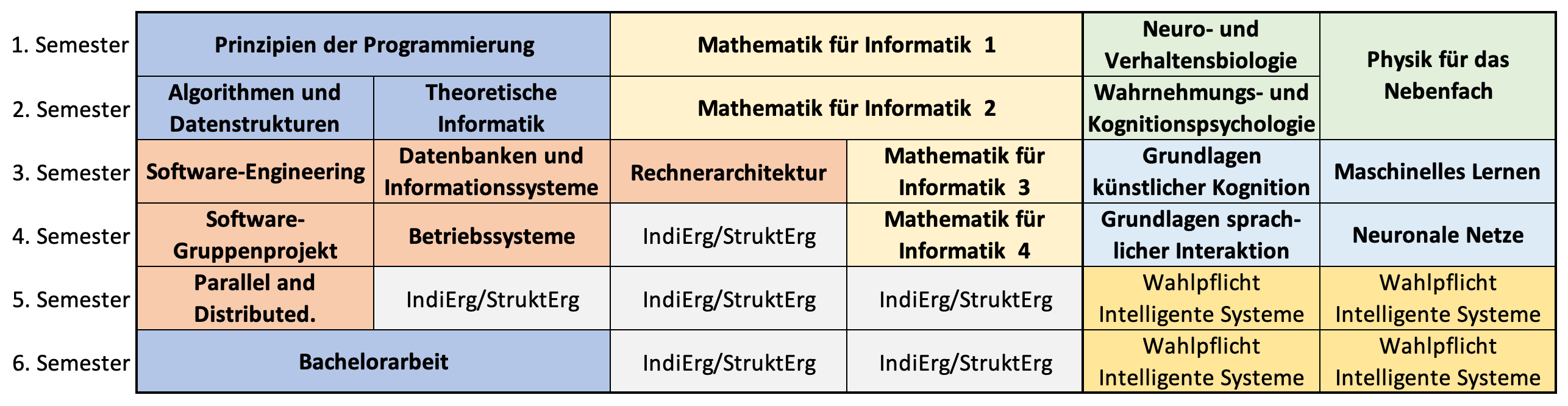
In the field of mathematics, the formal foundations for the rest of the course are laid through linear algebra, analysis and differential equations, as well as statistics and stochastics. In the field of computer science, the ‘core’ subjects of computer science (algorithms and data structures, operating systems, databases, software engineering, computer architecture, fundamentals of theoretical computer science), thereby ensuring that graduates have every opportunity in the ‘traditional’ computer science job market. Practical programming skills are acquired in the modules on algorithms and data structures and object-oriented programming (Java), operating systems (including low-level programming in C) and computer architecture (assembly language programming). The foundation in the field of cognitive systems is provided through content covering the fundamentals of neurobiology, the fundamentals of artificial cognition and linguistic interaction, machine learning (Python) and neural networks, and can be expanded through specialisation in areas such as robotics, computer vision, human–computer interaction, virtual reality or computer graphics. With regard to the programme’s contribution to professional qualifications, the project-based modules, the group software project and the Bachelor’s thesis in the field of cognitive systems are particularly noteworthy.
- Thesis Topics
- Career Prospects
There is a high demand for computer scientists with interdisciplinary training and a degree in Artificial Intelligence and Cognitive Informatics across many sectors of industry, the service sector and research. Wherever robots are developed and manufactured, intelligent agents are programmed or adaptive systems capable of learning are developed, expertise in Artificial Intelligence and Cognitive Informatics is indispensable. Potential career paths therefore include, for example, development departments in the automotive, mechanical and plant engineering sectors; the application of machine learning methods in the industrial, healthcare, service or financial sectors; the development of interactive assistance systems; and scientific research.
- Further Study Opportunities
Upon successful completion of their Bachelor’s degree, graduates can either enter the workforce straight away or continue their higher education to deepen and broaden their knowledge.
The path to a PhD is also flexible: in addition to the standard route via a Bachelor’s and Master’s degree, particularly qualified students have the option of commencing a PhD immediately after completing their Bachelor’s degree.
Students can obtain a Master of Science (M.Sc.) in the Intelligent Systems programme. The Faculty of Technology also offers Master’s degrees in Biomechatronics, Bioinformatics and Genomics, and Computational Science. In addition, a PhD programme in Intelligent Systems is available.