Bachelor’s Degree Programmes

Minor: Fundamentals of Cognitive Systems (B.Sc.)


The importance of intelligent, cognitive systems is growing in many areas of everyday life. Mobile service robots, personal assistants, highly automated production facilities, autonomous vehicles and intelligent support systems in medicine and care – all of this is made possible by modern information technology, whose information-processing methods are increasingly modelled on the cognitive abilities of humans and animals. In this way, complex information (text, images, spoken language) can be processed, and the behaviour of machine systems can be flexibly adapted to different and novel situations. The Faculty of Technology at Bielefeld University offers a bespoke Bachelor’s degree programme in ‘Cognitive Informatics’ that imparts the practical skills and knowledge enabling students to contribute to the development and implementation of cognitive, information-processing systems. The programme closely integrates the teaching of theories and methods from computer science and artificial intelligence with those from the cognitive and neurosciences. Bielefeld University ranks among the leading universities both nationally and internationally in the field of research and development of intelligent systems. Students benefit from this as early as their Bachelor’s degree and to an even greater extent during their Master’s and PhD studies, as they gain insight into current research and, thanks to the faculty’s extensive international collaborations, are able to undertake study and research placements abroad with ease.
Combined Bachelors Degree
In the combined bachelors degree programme at Bielefeld University, students study a major subject (90 credit points) alongside a minor subject (60 credit points) or two minor subjects (30 credit points each). The major and minor subjects differ in terms of the scope and content of the programme. The two minor subjects together have the same scope as one minor subject. To strengthen students’ personal academic profiles, the subjects are supplemented by the individual subsidiary subjects (30 CP).
Interdisciplinary Programme Offering – Tried-and-Tested Combined Bachelors Degree
The core subject of Computer Science with the Technical Computer Science profile, combined with the minor subject Fundamentals of Cognitive Systems, corresponds to the phased-out single-subject B.Sc. in Cognitive Informatics.
Entry Requirements
If you have an interest in digital information processing and possess a solid grounding in mathematics, you are well placed to succeed in this degree programme. A good command of English is also helpful in order to be able to deal effectively with specialist literature and terminology.
International Exchange and Cooperation
Students are offered various opportunities to gain experience abroad and develop intercultural skills. The Erasmus+ programme takes them to universities across Europe; in addition, Bielefeld University maintains international collaborations and partnerships with higher education institutions on every continent. The International Office provides advice on all matters relating to choosing a study destination, scholarships for studying abroad and the application process.
- Central Pages about Study Programmes: Admission Requirements; Study and Examination Regulations; Subject-Specific Regulations; Application; Admission, and Enrollment
The Central Webpages about Study Programmes of Bielefeld University (Dezernat Studium und Lehre) contain information about the programme of lectures for this course in the eKVV (lecture timetable), a link to an overview of the introductory and information events, about the course start, length and scope of studies, admission requirements, application, admission and enrollment, study and examination regulations, and subject-specific regulations.
More detailed informationen about Application, Admission, and Enrollment you will find on the webpages of the Student Office (Studierendensekretariat).
- Course content
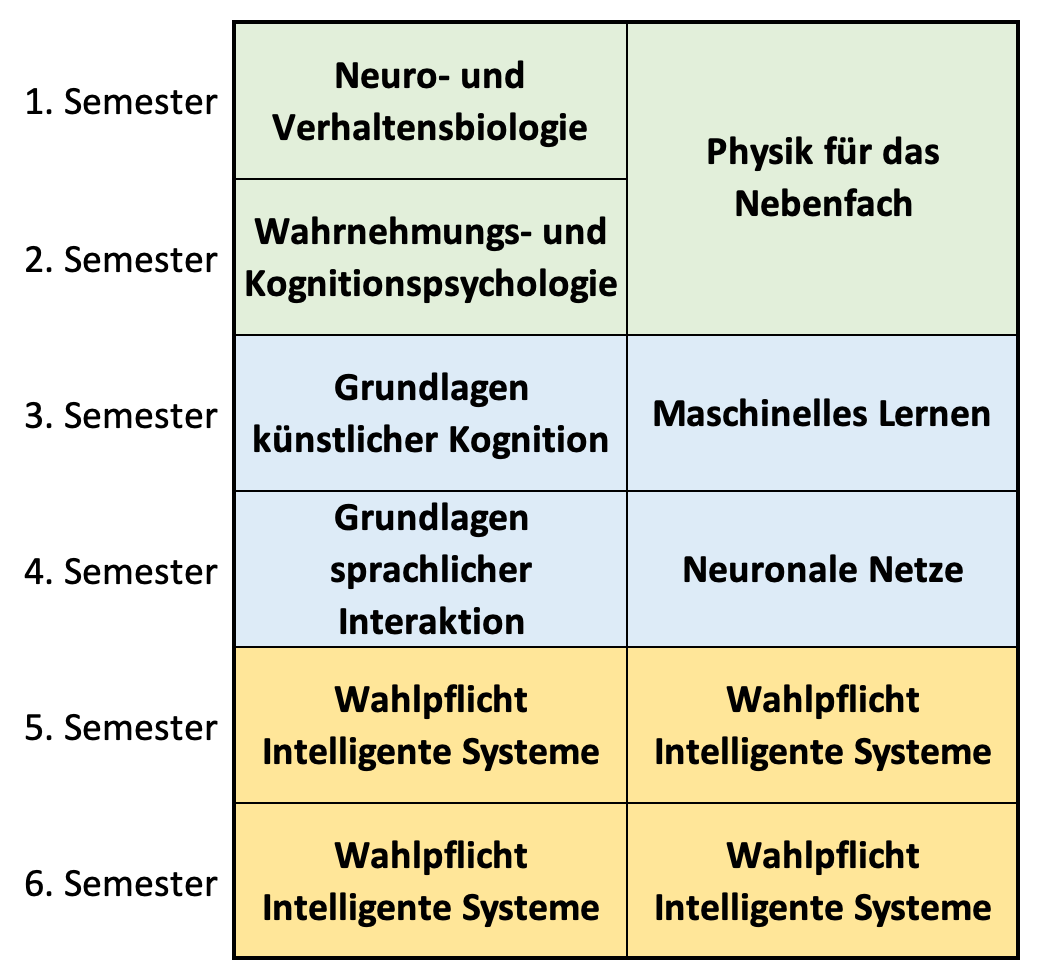
In the field of mathematics, the formal foundations for the rest of the course are laid through linear algebra, analysis and differential equations, as well as statistics and stochastics. In the field of computer science, the ‘core’ subjects of computer science (algorithms and data structures, operating systems, databases, software engineering, computer architecture, fundamentals of theoretical computer science) are taught, thereby ensuring that graduates have every opportunity in the ‘traditional’ computer science job market. Practical programming skills are acquired in the modules on algorithms and data structures and object-oriented programming (Java), operating systems (including low-level programming in C) and computer architecture (assembly language programming). The foundation in the field of cognitive systems is provided through content covering the fundamentals of neurobiology, the fundamentals of artificial cognition and linguistic interaction, machine learning (Python) and neural networks, and can be expanded through specialisation in areas such as robotics, computer vision, human–computer interaction, virtual reality or computer graphics. With regard to the programme’s contribution to professional qualifications, the project-based modules, the group software project and the Bachelor’s thesis in the field of cognitive systems are particularly noteworthy.
- Thesis Topics
- Career Prospects
There is a high demand for computer scientists with interdisciplinary training and a degree in Cognitive Informatics across many sectors of industry, the service sector and research. Wherever robots are developed and manufactured, intelligent agents are programmed or adaptive systems capable of learning are developed, expertise in Cognitive Informatics is indispensable. Potential career paths therefore include, for example, development departments in the automotive, mechanical and plant engineering sectors; the application of machine learning methods in the industrial, healthcare, service or financial sectors; the development of interactive assistance systems; and scientific research.
- Further Study Opportunities
Upon successful completion of their Bachelor’s degree, graduates can either enter the workforce straight away or continue their higher education to deepen and broaden their knowledge.
The path to a PhD is also flexible: in addition to the standard route via a Bachelor’s and Master’s degree, particularly qualified students have the option of commencing a PhD immediately after completing their Bachelor’s degree.
Students can obtain a Master of Science (M.Sc.) in the Intelligent Systems programme. The Faculty of Technology also offers Master’s degrees in Biomechatronics, Bioinformatics and Genomics, and Computational Science. In addition, a PhD programme in Intelligent Systems is available.