Informationen für Führungskräfte
Führungskräfte spielen eine zentrale Rolle beim betrieblichen Hitzeschutz. Sie sollten eine Kultur der Achtsamkeit fördern und Maßnahmen umsetzen, um Mitarbeiter*innen vor Hitzegefahren zu schützen.
Grundsätze für Führungskräfte:
- Anerkennung der Gefährdungen durch Hitze: Hitzeschutz muss als ernsthafte Gesundheitsgefährdung erkannt und als Führungsaufgabe verstanden werden.
- Gefährdungsbeurteilung: Die Berücksichtigung von Hitze in der Gefährdungsbeurteilung ist grundlegend, um spezifische Risiken zu identifizieren und Maßnahmen einzuleiten. Gefährdungsbeurteilungen sind von den Führungskräften durchzuführen.
- Informationsfluss sicherstellen: Mitarbeiter*innen zum Thema Hitzeschutz informieren und unterweisen.
- Unterweisungen
Eine wichtige Voraussetzung für ein sicheres und gesundes Arbeiten ist das Wissen darum, welche Schutz- und Notfallmaßnahmen zu beachten sind. Unterweisungen dienen dazu, Wissen über diese Schutz- und Notfallmaßnahmen zu vermitteln und Anweisungen und Erläuterungen zu geben. Unterweisungen sind Anweisungen, die zwingend zu beachten sind. Führungskräfte sind für die regelmäßige Unterweisung Ihrer Mitarbeitenden zuständig.
- Gesundheitsrisiken und psychische Belastung durch Hitze
Heiße Tage mit Temperaturen über 30 °C und tropische Nächte, in denen es nicht unter 20 °C abkühlt, können eine erhebliche Belastung für den menschlichen Körper darstellen und die körperliche und psychische Gesundheit gefährden.
Flüssigkeitsmangel, eine Verschlimmerung verschiedener Krankheiten, Hitzekrämpfe sowie Sonnenstich und Hitzschlag können die Folge sein. Ernstzunehmende Warnzeichen des Körpers sind: Kreislaufbeschwerden, Muskelkrämpfe in Armen und Beinen, Bauchkrämpfe, Kopfschmerzen, Schwindel, Übelkeit, Erbrechen, erhöhter Puls, ein Gefühl der Erschöpfung oder von Unruhe, Verwirrtheit und ein trockener Mund (1).
Die Gesundheitsrisiken von Hitze betreffen grundsätzlich alle Menschen. Gleichwohl sind einige Personengruppen aufgrund bestimmter Risikofaktoren an heißen Tagen besonders betroffen und tragen durch Hitze stärkere Gesundheitsfolgen davon (2).
Dies betrifft insbesondere (chronisch) kranke Menschen, Menschen mit Behinderungen, ältere Menschen, Schwangere, Kinder und Jugendliche, sowie Menschen mit arbeitsbedingten Risken. Ebenso können verschiedene Arzneimittelgruppen bei Hitze gefährliche Nebenwirkungen entfalten oder die Temperaturregulation des Körpers negativ beeinflussen.
Je nach Temperatur und Dauer der Hitzeexposition reichen die Reaktionen des menschlichen Organismus von leichter Hitzeerschöpfung oder Schlafstörungen über schwere Gesundheitsfolgen und Organschäden bis hin zu hitzebedingten Sterbefällen.
Spektrum der Folgen von Hitze auf menschliche Gesundheit (3):
- Hitzestress: Belastungsgefühl wie Erschöpfung, Schlafstörungen durch Hitzeexposition oder Beeinträchtigungsgefühl bei körperlicher Anstrengung oder Arbeit.
- Hitzekrämpfe: Muskuläre Krämpfe während körperlicher Anstrengung bei Hitze.
- Überwärmung: Milde bis mittelgradig schwere Belastung durch Wasser- und/oder Salzverlust (Dehydrierung) bei Hitzeexposition oder schwerer körperlicher Arbeit. Symptome sind insbesondere: Körpertemperatur von 37 bis 40 Grad Celsius, Schwäche, niedriger Blutdruck, Erbrechen, Kopfschmerzen und Verwirrung.
- Hitzesynkope: Ohnmächtig werden bei hoher Umgebungstemperatur durch Gefäßerweiterung.
- Hitzschlag : Wenn sich der Körper durch Maßnahmen wie Schwitzen nicht mehr abkühlen kann, kommt es zum Hitzestau. Die Körpertemperatur steigt dann schnell auf 40 Grad Celsius und das Gehirn schwillt an – bis hin zum Hirnödem, dem sogenannten „Hitzschlag“.
- Exsikkose (Austrocknung): Bei starkem Schwitzen und unzureichender Flüssigkeitszufuhr leidet der Körper unter Wassermangel und trocknet aus. Durstgefühl, trockene Haut und Schleimhäute, verminderter Hautturgor (stehende Hautfalte), Tachykardie (mit Symptomen wie Schwindel, Herzrasen oder -klopfen, Atemnot oder starkes Schwitzen) und Hypotonie (niedriger Blutdruck) sind häufige Folgen.
- Hyperthermie: Erhöhung der Körpertemperatur, wenn Thermoregulation durch Krankheiten, Medikamente oder durch exzessive äußere oder innere Wärmezufuhr bzw. -produktion gestört ist. Hyperthermie kann gesundheitsschädliche oder lebensbedrohliche Formen annehmen.
Neben körperlichen Gesundheitsrisiken kann Hitze die psychische Gesundheit belasten und die Arbeitsfähigkeit verringern. Hitze als exogener Stressor kann Symptome bereits bestehender psychischer Erkrankungen verschlimmern oder neu auftreten lassen. Darüber hinaus können auch unabhängig von Vorerkrankungen durch Hitzeexposition verursachte Schlafstörungen einen negativen Einfluss auf die psychische Gesundheit haben. An heißen Tagen kann es außerdem zu einer verringerten Aufmerksamkeit und Leistungsfähigkeit sowie einem gesteigerten Aggressionspotenzial und Erschöpfung durch Hitzestress kommen
Quellen:
- (1) Umweltbundesamt und Deutscher Wetterdienst: Klimawandel und Gesundheit, Tipps für Hitze und Hitzewellen.
- (2) / (3) Thüringer Ministerium für Umwelt, Energie und Naturschutz: Kommunale Hitze-Toolbox Thüringen.
- Besonders gefährdete Personengruppen
Einige Personengruppen sind möglicherweise aufgrund bestimmter Risikofaktoren an heißen Tagen besonders betroffen und tragen durch Hitze stärkere Gesundheitsfolgen davon. Hierzu gehören Menschen mit Behinderungen oder (chronischen) Erkrankungen, ältere Menschen, Schwangere, Kinder und Jugendliche, sowie Menschen mit arbeitsbedingten Risiken.
Hohe Temperaturen und Hitzewellen können daher hitzebedingte Erkrankungen auslösen, Vorerkrankungen verschlimmern und auch zu vorzeitigen Todesfällen führen. Ebenso können verschiedene Arzneimittelgruppen bei Hitze gefährliche Nebenwirkungen entfalten oder die Temperaturregulation des Körpers negativ beeinflussen.
Weitere Informationen zu den besonders gefährdeten Personengruppen
Bei Fragen zum Thema "Hitzeschutz und Arbeitsmedizin" steht der Betriebsärztliche Dienst der Universität Bielefeld unter der Funktionsadresse: betriebsmedizin@uni-bielefeld.de zur Verfügung.
- Arbeitsräume und Hitze

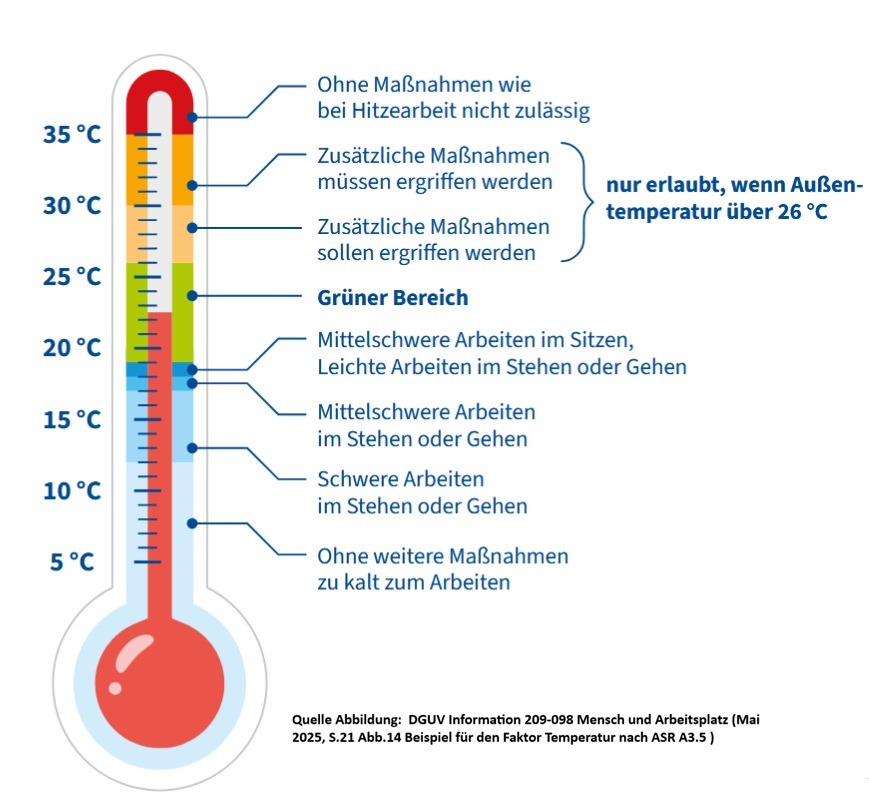
Die Technische Regel für Arbeitsstätten A3.5 Raumtemperatur unterteilt in vier Temperaturschwellenwerte, die einen Handlungsbedarf auslösen, um die Gefährdung durch sommerliche Hitze zu bewerten und zu minimieren. Abhängig von dem Schwellenwert müssen von den Führungskräften geeignete Schutzmaßnahmen getroffen werden.
Temperaturbereich im Arbeitsraum (ASR 3.5):
- Bis +26 °C (geringe Gefährdung): Normalbetrieb, keine Pflichtmaßnahmen bei Überschreitung dieses Werts, solange die Außentemperatur niedriger oder gleich ist.
- Über +26 °C (mäßige Gefährdung): Soll-Wert überschritten. Die Vorgaben der Maßnahmenin der ASR 3.5 Pkt. 4.4 (Tab.4) sind möglichst umzusetzen. Für hitzevulnerable Personen sind die Vorgaben möglicherweise verpflichtend umzusetzen.
- Über +30 °C (erhöhte Gefährdung): Muss-Wert überschritten. Es müssen wirksame Schutzmaßnahmen gemäß ASR 3.5 Pkt. 4.4 (Tab. 4) ergriffen werden.
- Über +35 °C (hohe/unmittelbare Gefährdung): Maximalwert überschritten. Der Raum gilt als ungeeignet für die Arbeit; Räume mit einer Raumtemperatur von mehr als + 35° C dürfen nicht genutzt werden. Arbeiten ist nur unter sehr spezifischen, technischen oder organisatorischen Hitzeschutzmaßnahmen zulässig (z. B. Entwärmungsphasen in kühleren Bereichen, Spezialkleidung).
Weitere Informationen der DGUV:
- Erste-Hilfe-Maßnahmen bei aktuten Hitzeerkrankungen
Alarmsignale einer akuten Hitzeerkrankung können z. B. sein:
- Kalte und feuchte Haut,
- niedriger Blutdruck und schneller Puls,
- rasche, aber schwache Atmung,
- Übelkeit,
- Schwindel und/oder
- Erbrechen.
Nehmen Sie bei sich oder anderen eines oder mehrere der genannten Symptome wahr, sollten Sie unverzüglich reagieren. Wird ein medizinischer Notfall vermutet, melden Sie:
- über Uni-internes Festnetz: 112
- vom Mobiltelefon: 0521-106-112
- über die EvAlarm-App der Universität Bielefeld
Weitere Informationen:
- Leitfaden Hitzeschutz
Zum Thema sommerliche Hitze und Hitzeschutz wurde ein spezieller Leitfaden mit Tipps und Ratschlägen für die Mitarbeitenden der Universität Bielefeld erstellt:
- Leitfaden Hitze und Hitzeschutz (pdf-Datei)
- Hilfe und Unterstützung
Hilfe und Unterstützung finden Sie unter folgenden Kontakten:
- Bei Fragen zum Thema Gefährdungsbeurteilung und Unterweisung: arbeitssicherheit@uni-bielefeld.de
- Bei Fragen zum Thema Gesundheit und Hitzeschutz: campusinbalance@uni-bielefeld.de und arbeitssicherheit@uni-bielefeld.de
- Bei Fragen zum Thema Hitze und Arbeitsmedizin: betriebsmedizin@uni-bielefeld.de
- Bei Fragen zur Haustechnik: Zentrale Leitwarte Tel. 7777
- Bei Fragen zur Notfallorganisation: arbeitssicherheit@uni-bielefeld.de
- Weitere Informationen und Links
Dokumente/Broschüren
- Leitfaden Uni Bielefeld "Hitze und Hitzeschutz" Tipps und Ratschläge (deutsche und englische Version)
- Tagesgesplan zur Minderung von Hitzeauswirkungen (Landesamt Gesundheit NRW)
- Geeignete Getränke/Essen (Landesamt Gesundheit NRW)
- Sommerhitze im Büro (Landesinstitut für Arbeitsgestaltung)
- Tipps für sommerliche Hitze (Umweltbundesamt)
- Hitzeknigge (Umweltbundesamt)
- Gesund durch die Sommerhitze (Bundeszentrale für gesundheitliche Aufklärung)
Weitere Links
- DGUV Beurteilung des Raumklimas
- Hitzeportal der Stadt Bielefeld
- Hitzeschutz (Bundesinstitut für Öffentliche Gesundheit)
- Bundesministerium für Gesundheit
- RKI
- Umweltbundesamt Gesundheitsrisiken
- Umweltbundesamt Tipps gegen Hitze
- Bundesinstitut für Öffentliche Gesundheit: Hitzeschutz Beschäftigte
- Bundesinstitut für Öffentliche Gesundheit (BIÖG) – ehemals Bundeszentrale für gesundheitliche Aufklärung (BZgA)
- DGUV Publikationen