Faculty of Educational Science

Rethinking quality and accountability in educational technologies
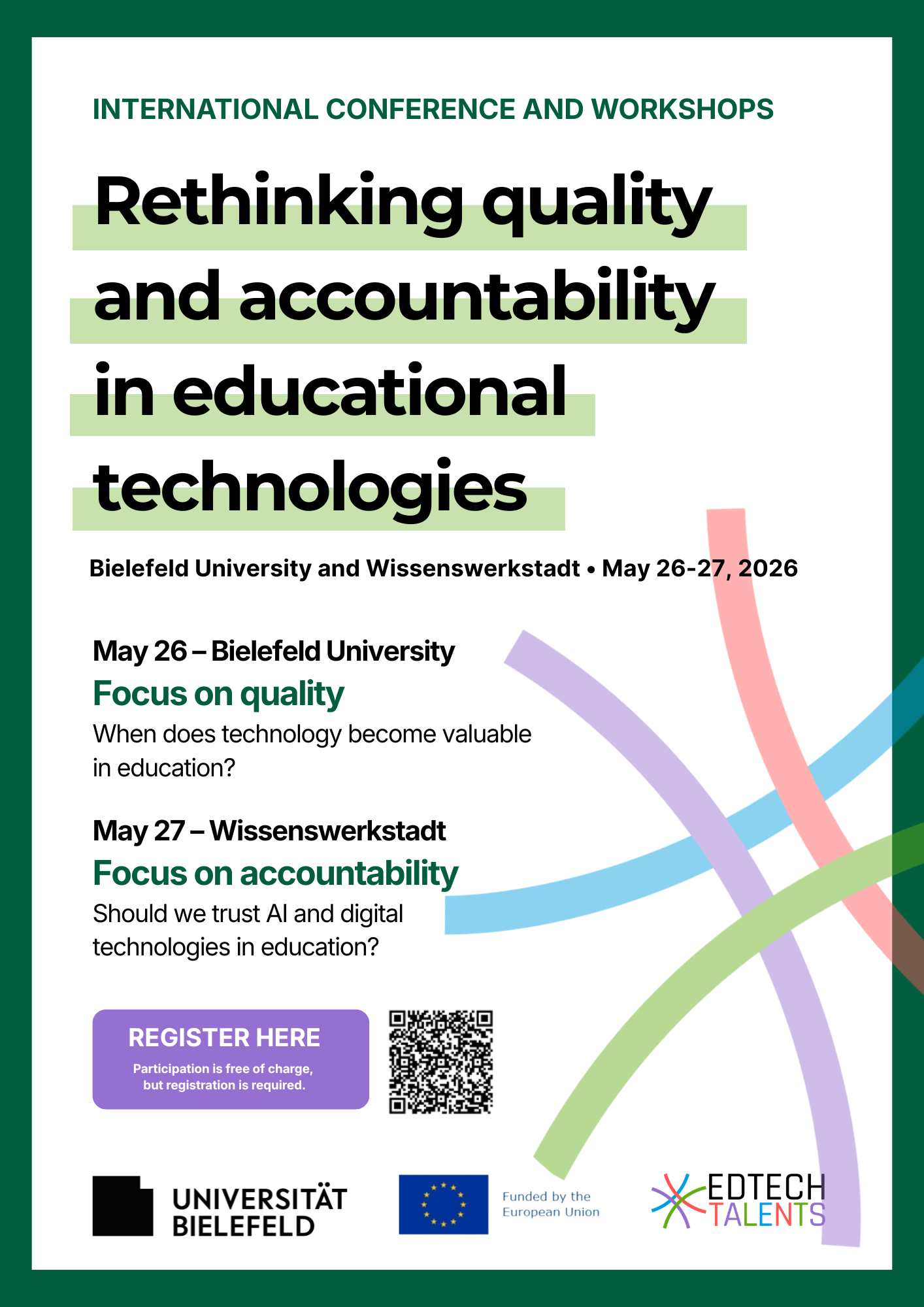
Bielefeld University and Wissenswerkstadt
May 26-28, 2026
This event brings together diverse stakeholders, such as educators, students, edtech professionals, or researchers, from across Europe to exchange perspectives on digital transformation in education through interactive workshops, evidence-informed discussions and invited talks. It offers a space to challenge assumptions and further develop ideas collaboratively.
Why this matters now
Educational technologies are increasingly used in different contexts, sometimes with the idea that their value is self-evident. Yet the ways in which they are introduced and interpreted raise important questions about who defines their value and under what conditions.
In this context, the event focuses on two interconnected notions, quality and accountability, both conceptually and in practice. They are intentionally framed in a broad way to create space for dialogue across diverse disciplines and professional contexts.
Quality
Quality is about the value given to educational technologies by various actors. This includes assessment practices, international frameworks, and policy approaches, as well as how certain technologies come to be seen as desirable or worth investing in. It also refers to more personal ways of defining what is good for one’s own teaching and learning practice.
Within this landscape, stakeholders may assume they “know how things work”, but do they? Such situations highlight the need for clearer in-depth exchanges and raise questions of explainability and intelligibility. How do various groups make what they do clear to one another? How does this shape how people think and organize their activities?
Accountability
Further issues point to less discussed questions of accountability and responsibility. They may be understood in a focused way, for example, in relation to data protection, transparency of AI processes, bias, or ethics. But accountability can also be approached more broadly. What kind of education of tomorrow are we shaping through today’s decisions? How are responsibilities distributed at both local, national and international levels?
Venues: Bielefeld University and Wissenswerkstadt Bielefeld
Event registration
All participants must register for the event. Participation is free of charge. Please note that onsite places are limited. Registration link: https://utfragen.uni-bielefeld.de/index.php/158789?lang=en
Access for online participants
If you plan to attend online, please also complete the Zoom sign-up to receive the access details: https://uni-bielefeld.zoom-x.de/meeting/register/NEs5zqExRl68bApYHpFfTw
This event is organized within the framework of the European Horizon project EdTech Talents.
For additional information or questions, please contact Dr. Cristina Popescu at cristina.popescu@uni-bielefeld.de
Program
Tuesday, May 26 – Focus on quality
When does technology become valuable in education?
Workshops & Capacity building
Bielefeld University – Room X-E1-201
X Building, Universitätsstraße 24, 33615 Bielefeld
Online participation is available for selected sessions only.
- Morning session
09:00‑09:30
Arrival and registration
09:30‑10:00 Welcome to Bielefeld University
- Opening address - Prof. Dr. Barbara Thiessen, Dean of the Faculty of Educational Science, Bielefeld University, Germany
- International projects and collaborations - Kristina Schröder, Bielefeld University
- EdTech Talents project - Prof. Dr. Janika Leoste, Tallinn University
- Introduction to the event - Dr. Cristina Popescu, Bielefeld University
10:00‑11:00
Panel session - Digital landscapes in German education
Moderator: Dr. Antoanneta Potsi, Bielefeld University
- Digital technologies: Services, spaces, and support at Bielefeld University - Jan Felix Trettow, IT-Service center (BITS), Bielefeld University
- AI and digitalisation in higher education - Dr. Fabian Schumacher, Bielefeld University
- University:Future Festival. Under Pressure! - Johanna Leifeld, Hochschulforum Digitalisierung
- From idea to impact: Supporting EdTech startups in Germany - Nik Riesmeier, Founders Foundation, Bielefeld
11:00‑11:30 Coffee break
11:30‑12:30 Panel session - Quality and assessment of EdTech solutions in practice (hybrid)
Moderator: Liis Siiroja, Edtech Estonia
- Learning Cabinet initiative - Olli Vallo, UNICEF (online)
- EdTech Evidence Report - Dr. Nicole Law, Researcher at Instructure
- When certification substitutes regulation - Dr. Veli Hillman, EDDS Institute and Goldsmiths, University of London, UK
12:30‑13:45 Lunch break
- Afternoon session
13:45‑15:45 World café and round table - AI in (higher) education. Challenges and opportunities across countries
Moderators: Sebastian Schwaebe, Blinc eG, Germany and Prof. Dr. Piedad Tolmos Rodríguez-Piñero, Rey Juan Carlos University, Spain
Round table participants:
- Sarah Becker, CHE/Hochschulforum Digitalisierung
- Prof. Dr. Janika Leoste, Tallinn University, Estonia
- Prof. Dr. Luis Pastor, Rey Juan Carlos University, Spain
- Dr. Fabian Schumacher, Bielefeld University
- Prof. Dr. Giedrė Tamoliūnė, Vytautas Magnus University, Lithuania
- Dr. Eva Ulbrich, Linz University, Austria
15:45‑16:00 Coffee break
16:00‑17:00 Theme session - Pedagogy and digital tool design (hybrid)
Moderator: Prof. Dr. Simona Szakács-Behling, Helmut Schmidt University Hamburg, Germany
- Co-design of digital tools - Chaula Gupta and Dr. Stefani Pautz Stephenson, Digital Promise (online)
- Frictions and fractures in the making of Edtech: When pedagogy meets technology - Julie Lüpkes, University of Oldenburg, Germany
Wednesday, May 27 – Focus on accountability
Should we trust AI and digital technologies in education?
International conference
Wissenswerkstadt Bielefeld
Wilhelmstraße 3, 33602 Bielefeld
Online participation is available throughout the day.
- Morning session
9:00‑09:30 Arrival and registration
09:30‑09:45 Conference opening
09:45‑10:45 Theme session - The terms of trust
Moderator: Prof. Dr. Stephan Dahmen, Bielefeld University
- What counts as (un)ethical in educational AI? - Prof. Dr. Michał Wieczorek, University College Dublin, Ireland (online)
- AI literacy for soft regulation: what frameworks do (and don’t) do - Dr. Veli Hillman, EDDS Institute and Goldsmiths, University of London, UK
10:45‑11:15 Coffee break
11:15‑12:45 Theme session - Making sense of digital technologies in schools
Moderator: Dr. Davide Taibi, Institute for Educational Technology, Palermo, Italy
- Trained to take the lead? AI-related school leadership qualifications in Germany (and some impressions from China) - Dr. Sarah Fichtner, Leuphana University Lüneburg, Germany
- From policy to classroom practice: Educational technologists as key actors in Estonia’s EdTech ecosystem - Tiina Kasuk, Tallinn University of Technology, Estonia
- Teachers’ professional agency in the age of algorithmic tools -Prof. Dr. Tobias Röhl, University of Education Zurich, Switzerland
12:45‑14:00 Lunch break
- Afternoon session
14:00‑15:15 Round table - Intelligibility and responsibility. Perspectives from the EdTech sector
Moderator: Dr. Cristina Popescu, Bielefeld University
- José María Cañas, JdeRobot, Spain
- Dustin Matzel, ZAB, Bielefeld University
- Balázs Pethő, Education:NEXT, Hungary
- Sebastian Schwaebe, Blinc eG, Germany
- Liis Siiroja, Edtech Estonia
15:15‑15:30 Coffee break
15:30‑16:30 Fishbowl conversation - Why research and evidence matter
Participants: researchers, teachers, students, edtech representatives
- Dr. Veli Hillman, EDDS Institute and Goldsmiths, University of London, UK
- Dr. Nicole Law, Researcher at Instructure
- Julie Lüpkes, University of Oldenburg, Germany
- Dr. Davide Taibi, Institute for Educational Technology, Palermo, Italy
16:30‑17:00 Collective conclusion - What’s next? Engaging with (post)digital futures