We are pleased to announce that the 11th International Conference of the German Cognitive Linguistics Association (GCLA/Deutsche Gesellschaft für kognitive Linguistik - DGKL) will take place on-site in Bielefeld, Germany, from August 31st to September 2nd, 2026. The call for papers will be published in fall 2025.
Early bird deadline: 30.06.2026
Registration closes: 15.08.2026
Registration for the conference takes place through your Converia account. For statistical purposes, you will be asked to indicate whether you hold a PhD. Payment is done through Converia, too. After registering for the conference and completing the payment process, you will be able to download your invoices directly.
(PhD) Student fee: 50€ early bird; 70€ normal fee
Participant fee: 105€ early bird; 125€ normal fee
Students and researchers affiliated with Bielefeld University: Please email us at dgkl2026@uni-bielefeld.de. If you are a PhD student, please upload a confirmation of PhD student status during the registration process.
There will be a conference dinner on Tuesday (01.09.2026) and a warming up on Monday (31.08.2026).
The conference dinner will take place in Wirtshaus 1802 im Bültmannshof. More information on this will be published soon!
Construction Morphology is one of the younger offspring of the Construction Grammar family (see, e.g., Booij 2010, 2018; Jackendoff & Audring 2020). Yet, it has developed in directions that are of interest for the constructionist enterprise as a whole. This talk explores the particular questions, opportunities, and insights that morphology contributes to constructional theory, focusing on two key domains: constructions and relations.
Morphological constructions are marked by a strong inclination toward lexical storage, unpredictable restrictions on productivity, and a complex interplay of regularity and idiosyncrasy. While construction-based frameworks are well equipped to capture such behaviour, certain issues remain unresolved. The peculiar nature of complex words often raises questions about their internal structure. Since Hay (2001), scholars have increasingly recognized that morphological structure may be a matter of degree. I will present ways to model this structural gradience, drawing on seemingly peripheral phenomena such as borrowed morphology, back-formation, and folk etymology. Further, I will examine methodological and conceptual issues involved in assessing morphological productivity, considering whether it, too, may or may not be inherently graded.
Recognizing relations is central to how we perceive structure. Building on Jackendoff & Audring (2020) and subsequent work, I outline a framework for linking constructions both internally and externally. This framework diverges from other proposed linkage systems (e.g., Diessel 2019), inviting further discussion. A related concern is paradigmatic organization, for which I will also suggest modeling strategies.
All theoretical proposals will be connected to constructicography and to the challenge of developing a “Morphicon” — a morphological constructicon — for Dutch.
Booij, Geert. 2010. Construction Morphology. Oxford: Oxford University Press.
Booij, Geert (ed.). 2018. The construction of words. Advances in Construction Morphology. Cham: Springer International Publishing.
Diessel, Holger. 2019. The Grammar Network: How Linguistic Structure Is Shaped by Language Use. Cambridge: Cambridge University Press.
Hay, Jennifer. 2001. Lexical frequency in morphology: is everything relative? Linguistics 39(6). https://doi.org/10.1515/ling.2001.041.
Participants in a spontaneous spoken interaction are faced with the ongoing task of making sense of each other. This involves recognising what kind of communicative action their conversational partners are currently pursuing, determining what personal stance to take towards it, identifying opportunities to come in to speak, and much more. Crucially, in spontaneous interactions, participants neither have the time to ponder their interpretations and choices, nor is there a ‘manual’ that explains what is happening. Instead, verbal and non-verbal cues need to provide all the information required to guide participants' moment-by-moment interpretations and communicative actions. Consequently, recurrent patterns and routines are particularly important as quick guidelines for production and interpretation. However, paradoxically, routinisation and automatisation can also lead to the creation of new forms.
This talk addresses the paradox from the perspectives of usage-based linguistics and Interactional Linguistics (Bybee 2001; Couper-Kuhlen & Selting 2018). It begins by introducing the basic theoretical and methodological tenets of Interactional Linguistics, including the notion of 'contextualisation cues' (Gumperz 1982). These are non-referential, context-sensitive means that contribute to meaning-making in a non-symbolic, indexical manner. For instance, rising intonation can convey diƯerent meanings depending on its position in a conversational sequence and the other linguistic cues with which it co-occurs, including other prosodic and phonetic cues. Similarly, phonetic properties have been shown to convey meanings that extend beyond lexical distinctions to encompass interactional structure and fine-grained sociological information (Docherty & Mendoza-Denton 2012; Plug 2010; Schleef & Turton 2016; Szczepek Reed 2015).
In light of this complex picture of meaningful prosodic and phonetic variation, the talk will take diƯerent usage-based and interactional perspectives on frequency, routinisation and the creation of new forms (Pierrehumbert 2001; Schweitzer et al. 2015). It will demonstrate how these are intertwined with their situated use in interaction. It will do so by discussing current research into the prosody and phonetics of one-word particles such as yeah/yes or genau ‘exactly’ as they evolve from responsives into turn-initial elements (Bergmann & Groß 2025; Szczepek Reed & Cantarutti 2024).
References
Bergmann, Pia, & Groß, Alexandra (2025). The prosodic marking of discourse functions: German genau ‘exactly’ between confirming propositions and resuming actions. Open Linguistics 11(1), 20250064. https://doi.org/10.1515/opli-2025-0064
Bybee, Joan (2001): Phonology and Language Use. Cambridge: Cambridge University Press.
Couper-Kuhlen, Elizabeth; Selting, Margret (2018): Interactional Linguistics. Cambridge: Cambridge University Press.
Docherty, Gerard & Mendoza-Denton, Norma (2012): Speaker-related variation – sociophonetic factors. In: Abigail C. Cohn, Cécile Fougeron and Marie K. HuƯman (eds.): The Oxford Handbook of Laboratory Phonology. Oxford: Oxford University Press, 43-60.
Gumperz, John J. (1982): Discourse Strategies. Cambridge: Cambridge University Press.
Pierrehumbert, Janet B. (2001): Exemplar dynamics: word frequency, lenition and contrast. In: Joan Bybee and Paul Hopper (eds.): Frequency and the emergence of linguistic structure. Amsterdam: John Benjamins, 137-157.
Plug, Leendert (2010): Pragmatic constraints in Usage-based Phonology, with reference to some Dutch phrases. Journal of Pragmatics 42, 2014-2035.
Schleef, Erik & Turton, Danielle. 2016. Sociophonetic variation of like in British dialects: eƯects of function, context and predictability. English Language and Linguistics 22, 35–75.
Schweitzer, Katrin et al. (2015): Exploring the relationship between intonation and the lexicon: Evidence for lexicalised storage of intonation. Speech Communication 66, 65-81.
Szczepek Reed, Beatrice (2015): Managing the Boundary Between “Yes” and “But”: Two Ways of DisaƯiliating With German ja aber and jaber. Research on Language & Social Interaction 48, 32–57.
Szczepek Reed, Beatrice, & Cantarutti, Marina (2024): Turn continuation in yeah/no responding turns: Glottalization and vowel linking as contrastive sound patterns. In: Margret Selting and Dagmar Barth-Weingarten (eds.): New perspectives in interactional linguistic research. Amsterdam: John Benjamins, 73–102
Speakers can readily invent new words or use creative circumlocutions when encountering unfamiliar objects or when lacking the proper names for known entities. They may also choose to engage in wordplay or employ humorous alternatives to conventional expressions.
Our interest in linguistic creativity from a cognitive perspective lies in uncovering the underlying processes involved in creative language use. The studies I will present target different planning levels and procedural aspects of written and spoken language and gesture production. These studies investigate (i) lexical creativity and the word formation strategies speakers employ under invention pressure, (ii) how co-speech gestures support creative language production in such contexts, and (iii) how speakers’ novel phonetic productions vary across different communicative settings.
In addition to the experimental data, we collected data from a test battery investigating individual differences in cognition and personality. These measures will provide a better understanding of the role of individual differences in linguistic creativity. The extent to which speakers use language creatively varies, as does the extent to which they utilise their cognitive resources. Understanding how cognitive resources and linguistic creativity interact will help inform and potentially extend cognitive models of language production.
Construction Grammar has given us a powerful picture of linguistic knowledge as a richly structured network of constructions—form–meaning pairings stored in memory. But a central explanatory problem remains: what cognitive operations make it possible to construct form-meaning pairings, to combine them into a communicative performance, and to interpret such a performance? Creative Construction Grammar argues that the mental operation of conceptual blending provides the explanation. On this view, there is no principled divide between routine and creative language at the level of basic mental operations: the difference is primarily one of entrenchment and frequency, not of mechanism. Even the most apparently “frozen” idiom or proverb depends on ongoing blending—selective projection, compression, unpacking, and emergent structure—each time it is deployed in a situated interaction. Conversely, the most striking innovation is continuous with mundane usage, differing mainly in how visible the blending work becomes.
The communicative abilities of humans are remarkably flexible and creative. For example, people appear able to infer the meaning of novel linguistic expressions (like ‘mask-shaming’) in one shot, where inferring plausible meanings requires integrating relevant background knowledge (e.g., COVID-19 pandemic). At the same time, having open-ended conversations also requires an ability to flexibly recover from temporary breakdowns in mutual understanding, when the meaning of an utterance is not immediately clear. Luckily, people also seem able to flexibly infer what underlying misalignment in beliefs might be causing them trouble in understanding, and to resolve that through an interactive process known as conversational repair.
As (computational) cognitive scientists, we aim to understand (and ultimately explain) what the underlying cognitive capacities are that enable humans to do such things as the flexible linguistic inference or communicative belief alignment described above. However, developing theories about cognitive capacities that show such immense flexibility is very challenging, and raises (meta)theoretical questions like: What is the phenomenon that needs to be explained, exactly? And what would count as a good explanation?
In this talk, I will present several (meta)theoretical insights that can aid theory-development about cognitive capacities like flexible linguistic inference and communicative belief alignment. I will argue that computational modelling can help us think through questions like: (i) What are the core properties of the phenomenon that together make up the explanandum? (ii) What are explanatory desiderata that can help make sure a theory really explains that explanandum? And (iii) What are cognitive constraints that can ensure a given theory can plausibly be realised by human cognition (and the brain)? I will argue that going through this process can reveal the ‘force field’ that theories of a given explanandum have to navigate. And that this, in turn, aids theory-development because it allows researchers who aim to solve one part of the puzzle to keep in clear view the other parts.
| Ad Foolen |
|
Alexander Bergs |
|
Alexander Willich |
|
Ana Mansilla Pérez |
|
Antje Quick |
|
Arne Zeschel |
|
Beate Hampe |
|
Benedikt Szmrecsanyi |
|
Benoît Leclercq |
|
Carmen Mellado Blanco |
|
Claudia Lehmann |
|
Clara Ureña Tormo |
|
Elena Smirnova |
|
Elisabeth Zima |
|
Florent Perek |
|
Holger Diessel |
|
Jens Fleischhauer |
|
Juliana Goschler |
|
Lieven Vandelanotte |
|
Livio Gaeta |
|
Lotte Sommerer |
|
Maarten Lemmens |
|
Maricel Esteban Fonollosa |
|
Martin Hilpert |
|
Martin Konvička |
|
Masaru Kanetani |
|
Michael Pleyer |
|
Nely Iglesias Iglesias |
|
Nikolas Koch |
|
Pedro Ivorra Ordines |
|
Peter Petré |
|
Regina Ruf |
|
Stefan Hartmann |
|
Stefan Th. Gries |
|
Steffen Höder |
|
Steven Schoonjans |
|
Thomas Hoffmann |
|
Tobias Ungerer |

Contact
E-mail us: dgkl2026@uni-bielefeld.de
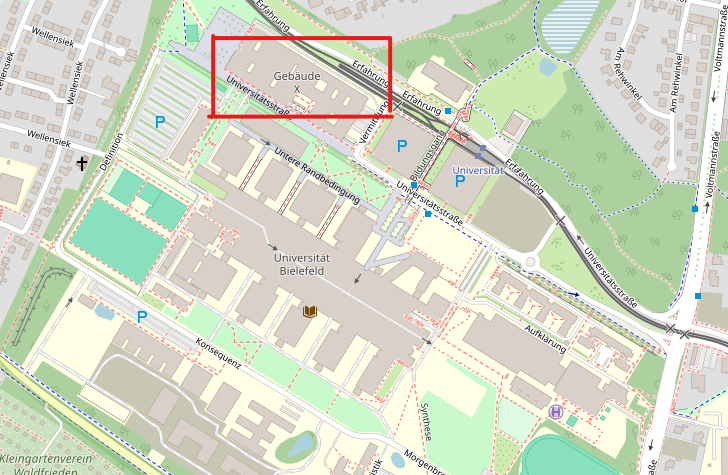
Conference venue: (open map )
Bielefeld University, Universitätsstraße 24
Building/ Gebäude X

The conference takes place at the Bielefeld University, Universitätsstraße 24 in the Building/ Gebäude X.
The venue is wheelchair-accessible. Appropriate seating is available, as well as a lift for presenters who use a wheelchair to get to the front of the auditorium. Wheelchair-accessible all-gender toilets are also available on-site. The university also provides an app called UniMaps for accessibility-friendly navigation on campus.
The university canteen (“Mensa”) where lunches take place is located in the X-Building on campus and is also wheelchair-accessible. There is an option to use a button at the entrance to call an employee of the canteen in case assistance during the visit is desired, for instance, with carrying the tray.
It is possible to have a mobile inductive listening system during the event.
There is a “quiet room” on-site that can be used for a variety of purposes including breast-feeding. Babies are welcome at DGKL 2026!
If you have any access requirements you would like us to be aware of, please, let us know in the registration form.

By Public Transport (from the city center)
When using the tram or bus, we recommend getting an “Entdecker-Karte” at one of the tram station ticket machines.
By Tram: From the city center (Tram stop Jahnplatz, Hauptbahnhof or Rathaus take tram line 4 towards Lohmannshof and get off at the stop Wellensiek (travel time: around 10 minutes). Trams in Bielefeld are mostly wheelchair-accessible (for wheelchairs under 350 kg). So are the stops mentioned above. Further information on accessibility of public transport in Bielefeld can be found here (in German).
By Car
There are numerous free parking spaces available on campus. Parking spaces for people with disabilities are available directly at the venue.
From the North: Take the A2 motorway, exit at Bi-Ost, and follow Detmolder Str. towards the city center (6 km, approximately 10 minutes). Follow the route via Kreuzstr., Oberntorwall, Stapenhorststr., and Kurt-Schumacher-Str. (signposted).
From the South: Take the A2 motorway. At the Bielefeld junction, switch to the A33 towards Bi-Zentrum. Exit at Bi-Zentrum and continue towards the city center on Ostwestfalendamm (B61). Take the Universität exit and follow the route via Stapenhorststr. and Kurt-Schumacher-Str. (signposted).
Travelling to Bielefeld by plane
Nearest bigger international airports are Düsseldorf and Hanover. There are also smaller airports in Paderborn, Dortmund and Köln/Bonn.

During your free time, you can explore a variety of activities in Bielefeld.
You can visit the city's landmark Sparrenburg Castle with panoramic views and historical significance. The Old Town offers a blend of historic architecture, quaint shops, and cosy cafés.
Art enthusiasts will enjoy the Kunsthalle Bielefeld, which hosts exhibitions of modern and contemporary art. If you prefer the outdoors, the nearby Teutoburg Forest has walking or hiking trails.
In the evening, you can explore Bielefeld's restaurants, theatres and cultural venues at your own pace.
For more tips, try Bielefeld’s personalisable travel guide
Dr. Katja Christina Politt
Wissenschaftliche Mitarbeiterin im Projekt: INF
Nutzerorientierte Forschungsinfrastruktur zur Unterstützung der Erhebung und (Wieder-) Verwendung von Sprachdaten

Dr. Désirée Kleineberg
Wissenschaftliche Mitarbeiterin im Projekt: A06
Aufkommen und Grenzen kreativen Sprachgebrauchs. Gescheiterte Kreativität im Deutschen und Romanischen

Leonie Schade, M.A.
Wissenschaftliche Mitarbeiterin im Projekt: A02
Neuschöpfung phonetischer Repräsentationen in unterschiedlichen kommunikativen Situationen

Dr. Anna Kutscher
Mitarbeiterin von Prof. Dr. R. Vogel

Dr. Birgit Kohn
Geschäftsführung im SFB 1646