Cross-Clausal Dependencies
by CRC 1646 project A01 | Bielefeld: 29 to 31 October 2025

Cross-Clausal Dependencies

Announcement
We are delighted to announce a workshop on "Cross-clausal Dependencies" (CCD) organized by the project A01 of the CRC 1646 from Bielefeld University. The three day workshop will take place at Bielefeld University, Germany, from Wednesday 29 October to Friday 31 October 2025.
Invited Speakers
- Stefan Keine
Stefan Keine (UCLA)
- Krisztina Szécsényi
Krisztina Szécsényi (University of Deusto)
- Renuka Ozarkar
Renuka Ozarkar (University of Mumbai; she participated online)
Sarah Bernolet is an Associate Professor at the Department of Linguistics at the University of Antwerp.
Programme
On Wednesday, we host a warm-up event with talks by project members of A01 presenting our project work and results.
On Thursday and Friday, the accepted talks will be presented as well as the invited speakers will give the keynote talks.
This is the final programme: A01_CCD_Workshop_Programm.pdf
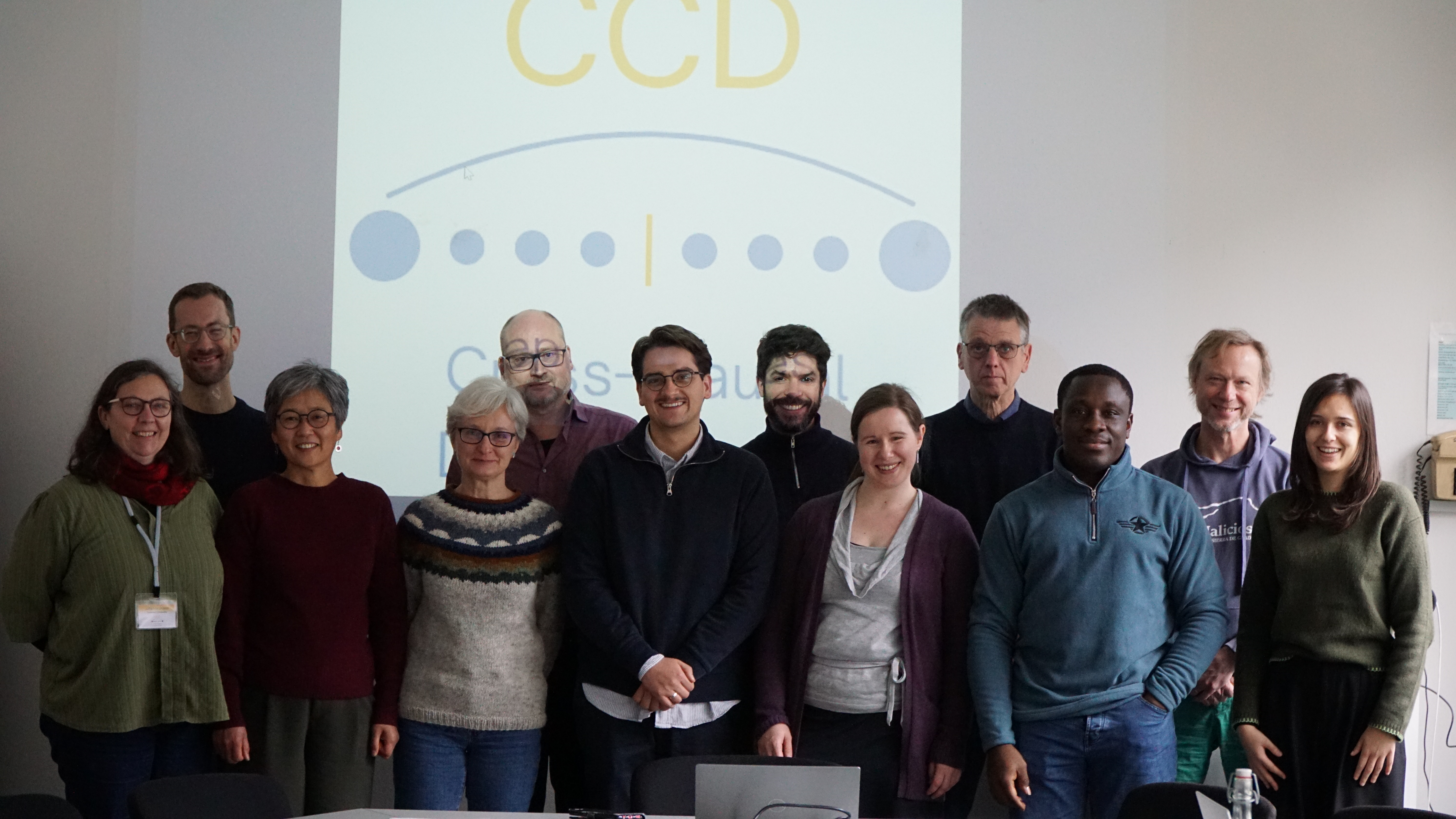
Social events
- Wednesday: Warm-up at L'arabesque
- THursday: Workshop dinner at Nichtschwimmer
Venue
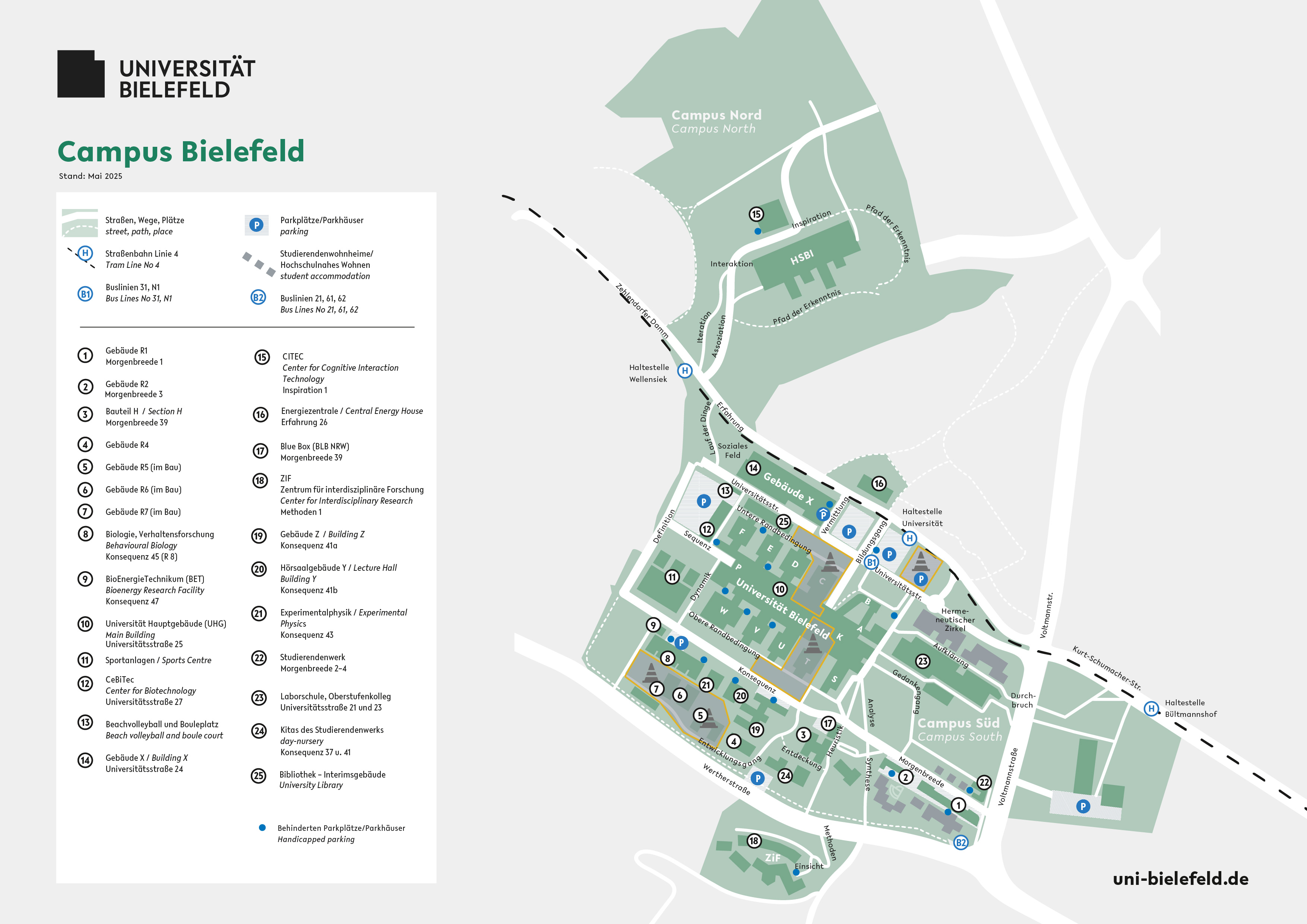
The workshop takes place at Bielefeld University. All activities take place in the main building of the University (number 10 on the campus map).
For navigation, use this address:
Bielefeld University
Universitätsstraße 25
D-33615 Bielefeld
- by train
by train:
You can reach Bielefeld by long-distance trains and regional trains. They will take you to the mainstation, Bielefeld Hauptbahnhof.
From Bielefeld Hauptbahnhof take tram line 4 in the direction of Lohmannshof to the stop Universität (journey time 7 minutes; every 10 mins).
For the timetable for your time of arrival, check here.- by car
by car:
From the north:
Motorway A2: Exit Bi-Ost, Detmolder Str. direction Zentrum (6 km, approx. 10 min). Way via Kreuzstr., Oberntorwall, Stapenhorststr., Kurt-Schumacher-Str. (is signposted).From the south:
Motorway A2: At the Bielefeld junction, take the A33 towards Bi-Zentrum, exit at Bi-Zentrum, follow the signs to the city centre on Ostwestfalendamm (B61), exit at Universität, follow Stapenhorststr., Kurt-Schumacher-Str. (is signposted).- by plane
Closest airports are Düsseldorf (190 km from Bielefeld), Dortmund (110km from Bielefeld), Hanover (110 km from Bielefeld), Cologne-Bonn (200 km from Bielefeld) and Frankfurt am Main (320 km from Bielefeld). All of them can be reached (with mostly only one change) by train. For more details, click here.
- B&B HOTEL Bielefeld-City
B&B HOTEL Bielefeld-City
Europa Platz 2, 33613 Bielefeld
0521 304330 or +49 521 304330We have arranged for 10 rooms for the period of 28th October to 1st Novemeber, 2025.
One room costs 81,90€ per night (breakfast included). Sign-ups close on the 10th of October.
Please make your room reservation using the pre-arranged code. We will send you the code in a separate email. Please note, the discount code for the B&B rooms is only valid by e-mail and cannot be booked via the website.
Alternatively, the university’s Boardinghouse has a very limited number of guest apartments available. This costs 65,00€ per night (no discount or breakfast available). This must be organised privately.Boardinghouse Campus Bielefeld
Morgenbreede 2-4, 33615 Bielefeld
+49 521 106 886 50
e-mail: Boardinghouse@stwbi.de and boardinghouse-campus-bielefeld@stwbi.deIf another accommodation is wished for, we recommend booking early.
- Boardinghouse Campus Bielefeld
Alternatively, the university’s Boardinghouse has a very limited number of guest apartments available. This costs 65,00€ per night (no discount or breakfast available). This must be organised privately.
Boardinghouse Campus Bielefeld
Morgenbreede 2-4, 33615 Bielefeld
+49 521 106 886 50
e-mail: Boardinghouse@stwbi.de and boardinghouse-campus-bielefeld@stwbi.deIf another accommodation is wished for, we recommend booking early.
Call for Papers
Subproject A01 “Creativity in morphosyntax: The role of analogy” of the Bielefeld University Collaborative Research Centre 1646 “Linguistic Creativity in Communication” is organising a three day workshop (Wednesday afternoon to Friday midday) on long-distance dependencies in October 2025. A01 studies long-distance movement (in particular islands) and long-distance agreement phenomena and explores the role of structural similarities between generally ac- ceptable and unacceptable long-distance dependencies. The workshop will focus on long-distance movement and long-distance agreement depend- encies and aims to shed light on questions regarding the syntactic configuration of clauses involving long-distance dependencies, the properties of domains involved in long-distance dependencies, as well as the role of pragmatic and semantic context for the acceptability of long- distance dependencies.
While there has been extensive work on islands (for overviews see Phillips 2013a,b, Szabolcsi & Lohndahl 2017, Sprouse & Villata 2021), movement dependencies of different types (wh-movement, topicalization, focus movement) and to a lesser degree on long-distance agree- ment (see Boeckx 2009, Bhatt & Keine 2017 for overviews and Polinsky & Potsdam 2001, Bhatt 2005, Keine 2013, Ozarkar 2020 for work on particular languages and phenomena), there is less work explicitly comparing long-distance dependencies of various types and/or across different languages (but see e.g. Börjesson & Müller 2020, Mursell 2020). We are particularly interested in work that relate their findings in movement dependencies to properties of agreement and vice versa.
We invite submissions dealing with long-distance movement and agreement dependencies, in particular work that focuses on:
- The role and properties of domains in long-distance movement and agreement dependencies
- Are long-distance dependencies always successive–cyclic (a.o. McCloskey 2002, Bošković 2014, van Urk 2015, den Dikken 2018)?
- Does long-distance agreement require some kind of intermediate proxy or move- ment between the agreement controller and target (Boeckx 2009, Keine 2013, LeSourd 2018)?
- To what extent, if at all, can long-distance agreement relations be reduced to move- ment (Chandra 2007, Hammerly & Mathieu 2025)?
- The structural configuration, integration and interaction of complex clauses and the con- sequences for long-distance dependencies
- How are subordinate structures integrated into superordinate structures? (cf. a.o. Frey, Meinunger & Schwabe 2016, Axel-Tober et al. 2023 and articles therein. See also Moulton 2009, Hartman 2012, Elliott 2020, Wurmbrand & Lohninger 2023.)
- How do long-distance dependencies into complements differ from those into ad- juncts and how can we account for these differences? (a.o. Chaves 2022)
- What are the effects of finiteness?
- What is the role of event structure and situations in the acceptability of long- distance dependencies? (a.o. Truswell 2007, 2011)
- The possible space of variation across languages
- Are there universal domains for long-distance dependencies? (a.o. Sprouse et al. 2016)
- What are the points of variations in the structural configuration and morphological expression of movement dependencies? (a.o. Bošković 2012)
- Improvements of acceptability in long-distance dependencies through repeated exposure (facilitation, satiation) or through context
- Can repeated exposure to identical or structurally similar experimental items lead to improved acceptability? If so, what factors influence these effects? (a.o. Luka & Barsalou 2005, Snyder 2000, 2022)
- What is the role of context and plausibility in the acceptability of long-distance dependencies? (a.o. Hofmeister & Sag 2010, Abeillé et al. 2020, Culicover, Varaschin & Winkler 2022)
We welcome work applying different qualitative and quantitative methodology, as well as papers with a focus on theoretical argumentation.
We invite abstracts for 30-minute presentations (+ 10-minute discussion). You may submit at most two abstracts, of which only one may be single authored.
Please submit your abstract via EasyAbs
Extended submission deadline: Sunday, 2025-07-13 23.59 CEST
Notification of acceptance: End of August
Format:
- A4, 2.5cm margin
- No more than two pages (including references)
- No smaller than 11pt
Please find the references in the .pdf file (CCD_CFP.pdf)