Flexible Meaning Adjustments in Context: Underspecification vs. Reinterpretation
by CRC 1646 project B01. Bielefeld: 12-13 Nov 2026

Flexible Meaning Adjustments in Context: Underspecification vs. Reinterpretation

Workshop description
In view of the combinatorial nature of linguistic meaning, semanticists agree that some version of the Fregean Principle of Compositionality must certainly hold. But there is also consensus that the richness and complexity of meaning components in natural language go far beyond what is determined by purely grammatically driven processes. When interpreting a sentence, we draw on information from context, world knowledge and the acute situation of the utterance. Language interpretation also regularly displays meaning adjustments, smoothly giving rise to creative interpretations and pragmatic enrichments in a variety of phenomena at the semantics-pragmatics interface. One particularly prominent example is complement coercion, that has been on the agenda of both theoretical and experimental work now for more than 30 years. A number of theoretical proposals have been put forward ranging from underspecification accounts to theories assuming dedicated coercion mechanisms. On the empirical side, findings from experimental studies also provide a diverse picture in evidence of various accounts.
Our workshop aims at forming a coherent picture of the evidence gathered on coercion and related phenomena, synthesizing the different findings, and evaluate theoretical proposals in the light of the available evidence.
We want to touch on the questions of how linguistic modeling can encompass all the different types of information used during sentence comprehension, and how we can distinguish between hard limits governed by the language facilities and conventions that can be overwritten. Special focus lies on the limits of online, in situ meaning adjustment. Do (clear) limits exist, what is their nature and can they be creatively extended or overwritten? Or, is language processing accomplished by inherently flexible operations, drawing on sources of many different knowledge domains? How is the influence of different information organized, and how is its impact best observed?
We invite to address these questions both from the perspective of formal modeling as well as from an experimental angle. We aim to discuss interface-architecture modeling, processing mechanisms that involve meaning adjustment and their limits, as well as ways of empirically testing the predictions that can be derived from the hypothesized mechanisms, for example by identifying critical conditions not tested yet, and scrutinizing the observability of low-level processing costs caused by everyday meaning adjustments.
In Project B01, Coercion as a creative mechanism in compositional interpretation, enrichment is investigated for the phenomenon of complement coercion. Important questions in B01 concern the conditions under which enrichment occurs and whether enrichment is semantic or pragmatic in nature.
- Peter Sutton: "Missive nouns, polysemy and coercion"
Missive nouns, polysemy and coercion
Peter Sutton (University of Potsdam)Noun-related complementiser clauses (nccs) which are formed with that in English have a limited distribution. They are found with a wide variety of informational nouns such as those in (1a). However, there is a class of informational nouns that have been observed not to license nccs, namely informational–physical entity ‘dot object’ nouns such as those in (1b) (see e.g., Elliott, 2020). Moreover, nccs cannot be used with nouns that straightforwardly denote physical objects (1c) or events (1d).
(1)
a. the allegation/belief/evidence/fact/information/report/statement that Bilbo found the ring
b. #the book/brochure/newsletter/newspaper that Bilbo found the ring
c. #the house that Bilbo met Gandalf
d. #the event/celebration that Gandalf set off fireworks
This talk presents data, derived from corpus studies on English and Finnish, that are surprising, given the distribution of nccs with nouns such as book and newspaper in (1b). We show that a subset of informational–physical entity ‘dot object’ nouns in fact do license nccs, a class I label missive nouns.
For instance, in (2) and (3) letter and artikkeli (‘article’, Finnish) occur with nccs.
(2) Well that old lady got a letter that she had to bring all her valuables and she was sent accordingly to an old people’s home. (UkWaC)
(3) Luinread.1.pst
artikkelin,
article.acc
ett¨a
comp
viel¨a
still
t¨an¨a
this.ess
vuonna
year.ess
tullaan
come.pass
myym¨a¨an
sell.inf.ill
enemm¨an
more
dvd-soittimia,
DVD-player.pl.par
kuin
than
blu-ray
Blu-ray
soittimia.
player.pl.par
“I read an article that, this year, there will still be more DVD players than Blu-ray players sold.”
(FiTenTen24)
These and similar data are challenging for analyses of nccs. On ratzer’s approach, nccs select for nouns that denote ‘contentful entities’ Bondarenko, 2022; Elliott, 2020; Kratzer, 2006; Moulton, 2015,
2009). However, the notion of contentful entities becomes ad hoc if, for instance, newspapers are not contentful entities, but newspaper articles are. An alternative to the Kratzerian analysis is to restrict the distribution of nccs in terms of the polysemy class of the head noun (Sutton, 2026, manuscript). However, this also cannot straightforwardly account for the data in (2) and (3). The goal of this talk is to present and assess both the alternative semantic and pragmatic solutions to this puzzle. Using a combination of corpus data and native speaker judgements for English and Finnish, I show that argue that, based on the restricted distribution of missive nouns with nccs, that the solution must be at least in part pragmatic, of which one possible analysis is based upon coercion.- Giosuè Baggio: How rare is complement coercion? Converging evidence from corpora, language models, and the language of science
How rare is complement coercion? Converging evidence from corpora, language models, and the language of science
Giosuè Baggio (Norwegian University of Science and Technology)In this talk we will discuss the phenomenon of complement coercion – the interpretation of constructions like “Lisa began the book” as ‘Lisa began doing something with the book’. We will consider competing accounts from the literature concerning the mechanisms and processing steps involved in the comprehension of this interesting phenomenon at the interface of syntax, semantics and pragmatics, and critically reflect on the predictions they make concerning observable processing costs and effects. We will present our own ideas and observations with regard to the presumed interpretive mechanisms as well as their application limits, and the necessary prerequisites and architecture of the mental faculties underlying sentence comprehension. Further, we will present first results from our project's ongoing experimental work on the online processing of coerced expressions. In particular, we will discuss some methodological shortcomings of previous relevant research and how we aim to overcome these in our replication study. Next to this, we will discuss preliminary results from a corpus analysis we conducted on German data demonstrating the distinct behaviour of two of the aspectual verbs we consider in our studies, namely beginnen and beenden. The latter study is part of a cross-linguistic study we are conducting in collaboration with Maria Piñango (Yale University), where we investigate the generalisability of the phenomenon and its implications across languages. We will conclude the talk with an outlook on future research regarding the influence of discourse effects on the interpretation of coerced expressions.
- Sebastian Bücking
- Project CoCoCo (Coercion and Copredication as Flexible Frame Composition)
- Berit Gerke: Against inchoative/inceptive states
Venue
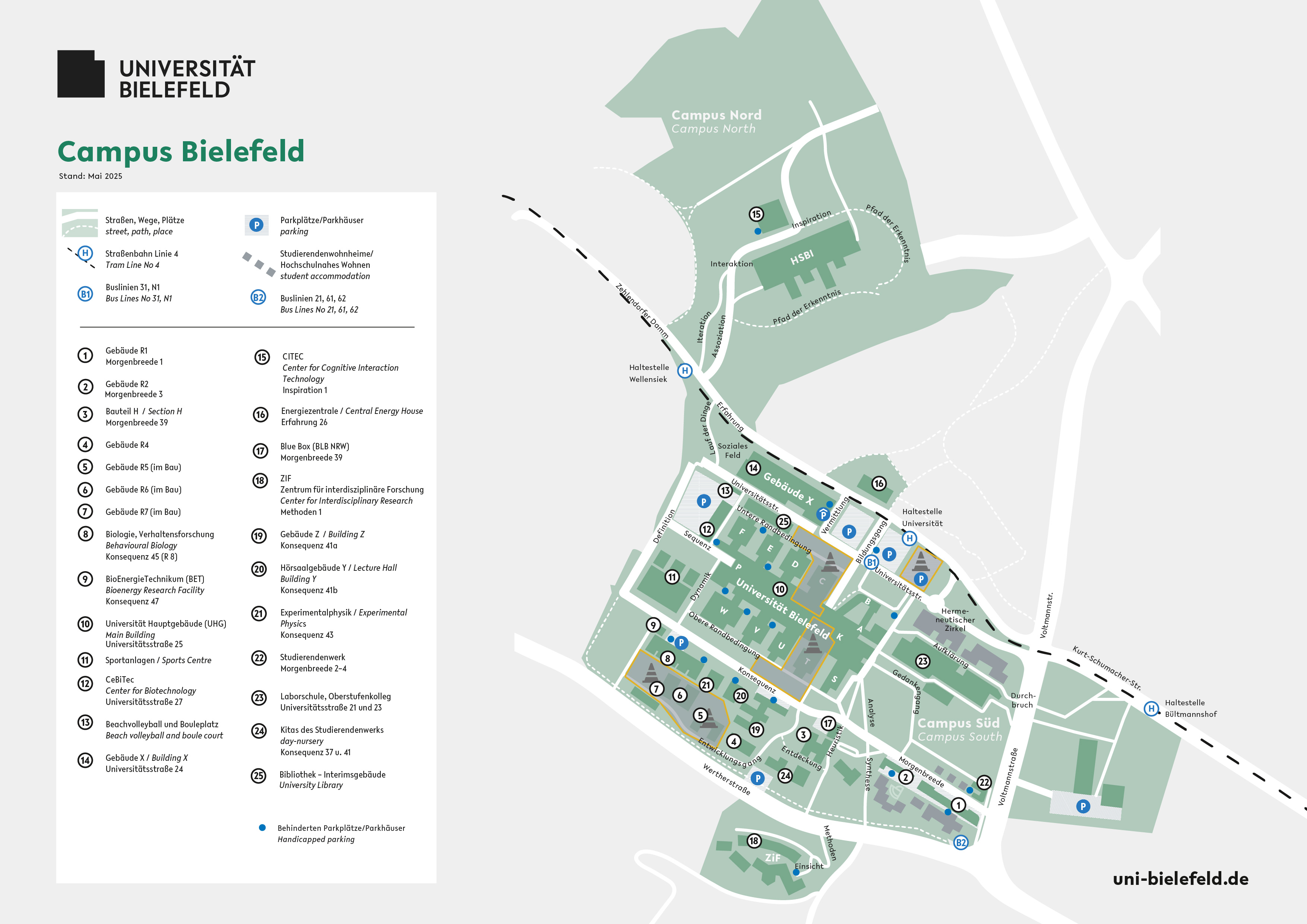
The workshop takes place at Bielefeld University. All activities take place in the main building of the University (number 10 on the campus map).
For navigation, use this address:
Bielefeld University
Universitätsstraße 25
D-33615 Bielefeld
- by train
by train:
You can reach Bielefeld by long-distance trains and regional trains. They will take you to the mainstation, Bielefeld Hauptbahnhof.
From Bielefeld Hauptbahnhof take tram line 4 in the direction of Lohmannshof to the stop Universität (journey time 7 minutes; every 10 mins).
For the timetable for your time of arrival, check here.- by car
by car:
From the north:
Motorway A2: Exit Bi-Ost, Detmolder Str. direction Zentrum (6 km, approx. 10 min). Way via Kreuzstr., Oberntorwall, Stapenhorststr., Kurt-Schumacher-Str. (is signposted).From the south:
Motorway A2: At the Bielefeld junction, take the A33 towards Bi-Zentrum, exit at Bi-Zentrum, follow the signs to the city centre on Ostwestfalendamm (B61), exit at Universität, follow Stapenhorststr., Kurt-Schumacher-Str. (is signposted).- by plane
Closest airports are Düsseldorf (190 km from Bielefeld), Dortmund (110km from Bielefeld), Hanover (110 km from Bielefeld), Cologne-Bonn (200 km from Bielefeld) and Frankfurt am Main (320 km from Bielefeld). All of them can be reached (with mostly only one change) by train. For more details, click here.