International

Interkulturelle Kompetenzen
- Introduction

Before you plan your stay abroad, look at this website, the Moodle, and, if possible, visit the How to English Week workshop!
If they are planning to become teachers of English, students are required by the Ministry of Education (NRW) to spend at least three months abroad in an English-speaking environment during the BA phase of their studies (Auslandsaufenthalte nach § 11 Abs. 10 S. 1 LABG Fassung gültig ab 06.07.2025)*. It is strongly recommended that students organize longer stays though, and, where possible, take the opportunity to gain credit points at post-secondary institutions during their stays abroad. Students should aim for full immersion in the culture and English language, in order to fulfil the module requirements. The immersion in the English culture and language can happen either in countries where English is the official or de facto L1 or L2 or in cases where the stay abroad facilitates the use of as English as a lingua franca or as the language of instruction.
*„(10) Das Studium moderner Fremdsprachen umfasst mindestens einen Auslandsaufenthalt von drei Monaten Dauer in einem Land, in dem die studierte Sprache als Landessprache gesprochen wird; Hochschulen können im Einzelfall eine Ausnahme vom Auslandsaufenthalt zulassen, wenn eine in der Person der oder des Studierenden oder in der Person nächster Angehöriger begründete schwerwiegende Mobilitätseinschränkung vorliegt und die Ausnahmegenehmigung dokumentiert wird. In den Unterrichtsfächern Kunst, Musik und Sport beruht bereits der Zugang zum Studium auf dem Nachweis der Eignung für diese Studiengänge; die Zugangsanforderungen sind nach Lehrämtern zu unterscheiden; der Abschluss des Studiums beruht auch auf fachpraktischen Prüfungsleistungen.“
- Going Abroad
Going Abroad
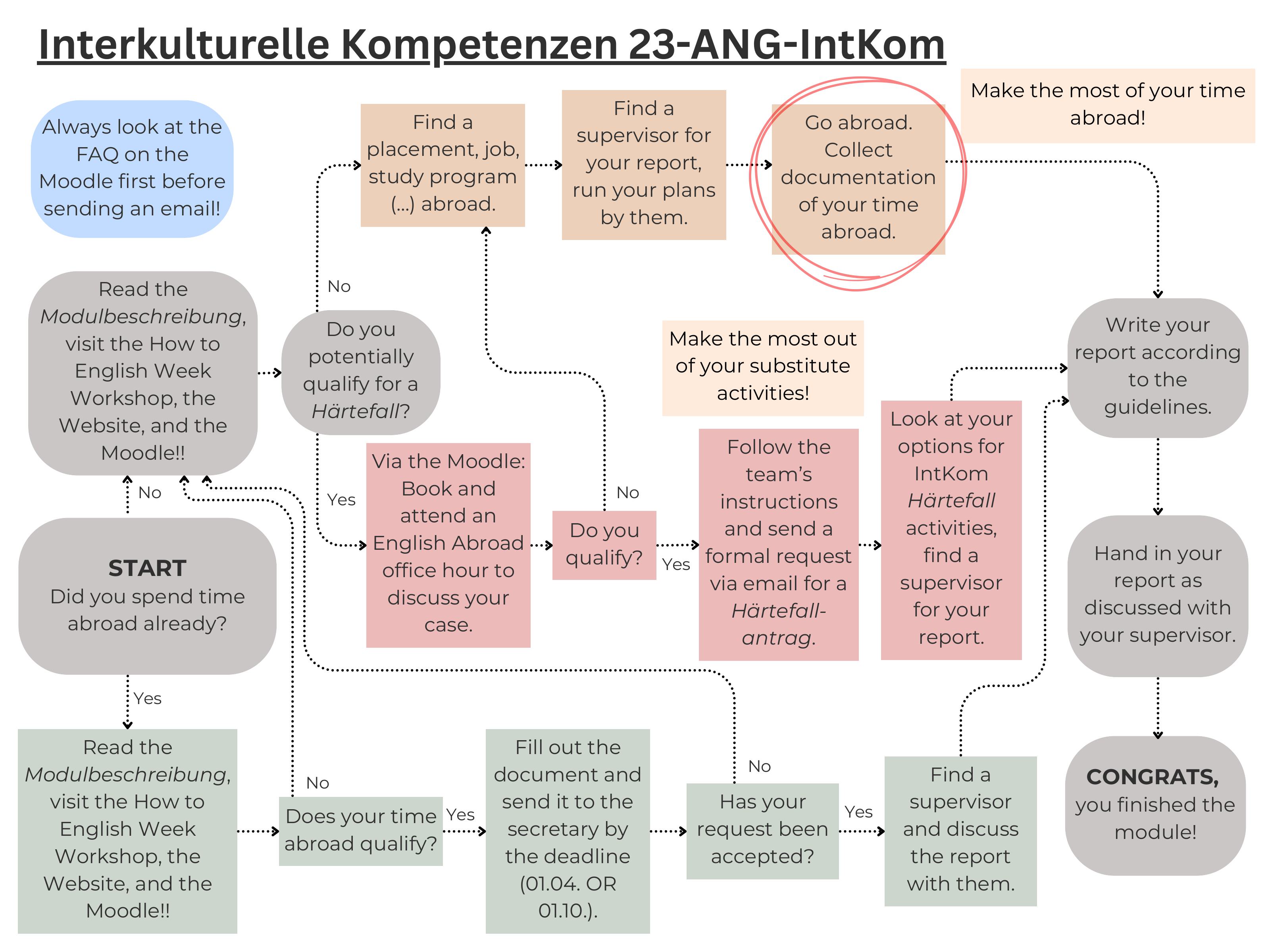
Students who are going abroad for this module have different options to consider to fulfil the requirements of the module. A non-exhaustive list can be found below. Students should always look at this website, visit the Moodle, and, if possible, the “How to English” workshop first before organizing a stay abroad. Specific placements, jobs (…) have to be discussed with a supervisor before going abroad to make sure that they fulfil the requirements for the Interkulturelle Kompetenzen module.
Studying abroad or working in another country as an assistant teacher (of German) are two options of immediate relevance to your studies or future careers. The Erasmus+ programme offers many such opportunities.
Studying Abroad
a) Studying Abroad in Europe: Erasmus+
If you're interested in going abroad with our Erasmus+ cooperations, you can find information under this link. There you will find a list with the Erasmus+ cooperations of this faculty.
Please also look at the information offered by our International Office.
b) Studying Abroad in the USA: ISEP
British and American Studies here at Bielefeld University is a member of ISEP (International Student Exchange Program) https://www.isepstudyabroad.org/about-isep. Through this, we are able to send up to six students per academic year to the United States, where they study for a semester at a host institution of their choice. ISEP not only offers a full-immersion experience, it's also by far the most affordable way to study in the United States.
For further information on ISEP, see the “How to English” LernraumPlus pages.
- If you are interested in applying for an ISEP exchange, contact Dr Julia Andres via the following address: julia.andres@uni-bielefeld.de
c) Going Abroad as an Assistant Teacher
Working as an assistant teacher of German at a school or university in another country is a particularly attractive “Interkulturelle Kompetenzen” option for those students who do teaching degrees. Further information on assistant teacher opportunities, and application forms, can be found on the PAD (Pädagogischer Austauschdienst) website https://www.kmk-pad.org/.
- Accrediting previous stays abroad
Accrediting previous stays abroad
Students who have had sufficiently long stays abroad before beginning their courses of study may request that the stay be approved for the module. As a general rule, stays abroad should not have taken place more than about 5 years prior to the beginning of their English studies.
A REQUEST FORM must be completed by the student and submitted to the module coordinator for authorization. Please hand in completed request forms as an email attachment to Ms. Retzlaff (kathrin.retzlaff@uni-bielefeld.de).
Each request will be considered individually by the English Abroad team once per semester.
- Due dates for submission are the 1st April and 1st October each year.
After the approval of the stay abroad, the student is still required to fulfill the other requirements of the module (i.e. the report; see the guidelines for this below).
At Bielefeld University confirmation of a stay abroad is the first step to fulfilling the requirement of the Interkulturelle Kompetenzen module, which is worth 10 CP (credit points).
To complete the module, students must write a 3,600 word report, reflecting on the experience as well as showing the greater depth of cultural awareness they have obtained; see the guidelines below. This paper is to be handed in and judged acceptable by a member of staff in the English department.
- Härtefallregelung
Härtefallregelung
The Härtefallregelung is an individual case regulation, specifically for students who are unable to spend a three-month period in an English-language environment abroad (Modul 23-ANG-IntKom Interkulturelle Kompetenzen), so that they too can gain international experience. Before considering this option, students have to book an office hour via the Moodle and present their case to the module coordinators. Only after a Härtefall exeption has been granted, can students partake in substitute activities.
The opportunity to take part in the Härtefallregelung is offered to those students who cannot go abroad - for example for health reasons, due to pregnancy, because they have children to care for or other kinds of caring commitments. It is decided on an individual basis if a student is eligible for the Härtefallregelung.
- The ‘Härtefallregelung’ activities that a student plans to carry out should amount to 270 hours (9 CPs) in total.
- 90 hours (3 CPs) can be completed by participating in a study group (Studiengruppe).
- 180 hours can be completed by organizing a study group. Only one study group can be chosen in this module.
- Plans for ‘Härtefallregelung’ activities must be approved in advance by a lecturer in British and American Studies, who will also assess the final report.
- Students can approach any member of staff to do this, with the exception of temporary lecturers (Lehrbeauftragte).
- Should a student be unable to find a lecturer to supervise their project and read the report, the module coordinators will suggest someone they could approach.
Here are some options for substitute activities once a Härtefall exception has been granted.
- Stays in non-English-speaking environments abroad can also be recognized, provided they take place in a predominantly English-speaking context. Examples might be internships with international organizations, public authorities or businesses where English is the working language. That is, the students should gain practical experience, for example by doing internships in firms, foundations, embassies, libraries, in media organizations (such as TV, radio, print media, etc.), or with cultural organizations in Germany or other countries, provided that the language they use is predominantly English, so that the competences outlined earlier can be developed.
- Participation in research projects conducted in English, mentoring, or other similar activities can also be recognized, again provided that the context in which they take place is predominantly an English-language one.
- Participation in student-led study groups or seminars with integrated excursions offered by British and American Studies can also be recognized for this module.
- Specific seminars from the Fachsprachenzentrum, though not language classes.
- Participating in English speaking language tandems. For more information look at this website.
Participation in an internship, project, seminar etc. must be documented or certified and confirmed by the signature of the relevant lecturer, project leader, representative of the institution, etc. Alternatively, in the case of a seminar, the work required for a Studienleistung must be completed.
The Modulprüfung takes the form of a report approximately 3,600 words in length, and can be submitted to any of the lecturers in British and American Studies (excluding Lehrbeauftragte), providing this lecturer was approached in advance and approved the project.
For more detailed information about the module as well as its requirements and expectations click on the following link Interkulturelle Kompetenzen - Studieninformation.
Module coordinators can be reached via email: english_abroad@uni-bielefeld.de
- Guidelines for the Interkulturelle Kompetenzen Report
Guidelines for the Interkulturelle Kompetenzen Report
The following suggestions are meant to guide students in writing their reports for the Interkulturelle Kompetenzen module. They are not given in order of importance, nor are they to be regarded as tests of knowledge to be answered correctly or incorrectly, but are intended to assist students in reflecting on their experiences during their internships or stays abroad.
- It is crucial that this report is not written as a journal or diary documenting daily experiences.
- Instead, it should be a means for students to reflect on their experiences from a critical and informed perspective, demonstrating that they have fulfilled the module's requirements.
- For more detail on these expectations and requirements, again see Interkulturelle Kompetenzen - Studieninformation.
- Give a brief overview of your experience abroad (max. ½ page)
- Reflect on your English language progress from the beginning of your stay to the end of it. Give concrete examples of how you felt your language developed.
- Reflect on the theories of language learning you may have learned about and how your own language acquisition process may have confirmed or contradicted the ideas or hypotheses of these theories.
- Discuss your expectations about the people and culture you were involved with. Reflect on how these expectations may have been confirmed or contradicted by your experience.
- What stands out in your mind as the most salient example of how you gained awareness of self and other through your experience?
- What would you describe as a moment that made you more culturally aware, either about your own culture, or the one that you spent time in?
- Reflect on how the experiences you had may have an influence your future career.
- For example, discuss how your understandings of the foreign language culture may influence the way you teach pupils about the country you visited.
- Reflect on your relationships and/or cooperation with friends/colleagues/classmates/host family and how these influenced you.
- Describe an eye-opening moment that left an impression on you. This may include an epiphany about the foreign language, your own language, the foreign culture, your own culture, your own personality, etc.
The language of this report must be coherent, effective and accurate. Any report that shows major weaknesses in the language should not be accepted by the supervisor.
- All reports in these modules are evaluated with either “bestanden” or “nicht bestanden”.
- A report judged to have been “nicht bestanden” must be rewritten by the student and resubmitted to the supervisor.
Only upon successful completion and acceptance of the report will the allocated 10 CP be granted.
Praxisstudien
- Praxisstudien
The module Praxisstudien is a compulsory module in the BA programme for students who are NOT planning to become teachers. The aim of this module is for students to gain experience in a professional environment that they might work in after completing their BA. Students are strongly encouraged to work or do internships in an English-speaking country to acquire valuable cultural awareness and language skills as well as professional experience.
Ideally, students will try to find work / internships in institutions that are possible workplaces for English studies graduates.
- If students go to a primarily English-speaking country for their work / internships, jobs that are less ideally suited can also be recognised.
- If students choose a work placement in Germany or another country in which English is not spoken as a first or official second language, this has to meet higher professional standards.
It is crucial that the tasks carried out are done in a working relationship and not a formal learning situation.
- A semester at a university in another country or a language course abroad CANNOT be recognised for this module.
Students have to find a supervisor for their reports before they start their work / internship. The supervisor decides whether the work placement planned by the student is appropriate for the module and also evaluates the report and reflection.
Suitable work / internships completed before a student's enrolment at university may be approved for the module as well if the respective work / internship does not date back more than 5 years prior to the student's enrolment in the English and American Studies programme.
A request form Antrag-Anerkennung-Praxisstudien.pdf must be completed by the student and submitted to the module coordinators for authorisation. Each request will be considered individually by a committee of department members once per semester.
- Due dates for submissions are 1st February and 1st August each year.
After the approval of the work placement, the student is still required to fulfil the other requirements of the module (i.e. the report; see the guidelines for this below).
Report
Students have to find a member of staff who will evaluate their final report before they start their work / internship. This report consists of two parts: the documentation of the student's work (not more than 500 words) and a reflection on their experiences (see the guiding questions below).
- It may also contain pieces of work carried out by the student or feedback from supervisors, but such material does not count towards the final word count of the report, which is 3000-5000 words.
The report is to be written in English. Although it is not an academic text, the level of English should be appropriate for a university context.
- Reports are evaluated as bestanden or nicht bestanden.
Any report that shows major weaknesses in the language will be evaluated as nicht bestanden. Students may rewrite and then resubmit their report to their supervisor if their report has been judged as nicht bestanden. The credit points for the module are only awarded after successful completion of the report.
Guiding questions
The following points are to guide students in their writing of the report for the Praxisstudien module. These are not given in order of importance, nor are they to be regarded as tests of knowledge, to be answered correctly or incorrectly. Students do not need to refer to all of these points in their reports, as they are simply provided for reference to assist students in reflecting on their experiences during their internships or stays abroad.
- It is crucial that this report is not written as a journal or diary documenting daily experiences.
- Rather, it is intended as a medium for students to reflect on their experiences from a critical and informed perspective, demonstrating that they have fulfilled the module's requirements.
- For more detail on these expectations and requirements, see the official information (in German) on the "Praxisstudien-Modul".
- Give a brief overview of your experience abroad (max. ½ page)
- Reflect on your English language progress from the beginning of your stay to the end of it. Give concrete examples of how you felt your language developed.
- Reflect on the theories of language learning you have learned about and how your own language acquisition process may have confirmed or contradicted the ideas or hypotheses of these theories.
- Discuss your expectations about the people and culture you were involved with. Reflect on how your experience may have confirmed or contradicted these expectations.
- What stands out in your mind as the most salient example of how you gained awareness of self and other through your experience?
- What would you describe as a moment that made you more culturally aware, either about your own culture or the one that you spent time in?
- Reflect on how your experiences may have influenced your way of thinking about other cultures.