Priming, Analogy, and Linguistic Creativity
by CRC 1646 projects A01, A04 & C01 | Bielefeld: 27-29 May 2026

Priming, Analogy and Linguistic Creativity

The workshop The relation of Priming, Analogy, and Linguistic Creativity (27–29 May 2026, Bielefeld, Germany) is organised by three projects of the Collaborative Research Center 1646 Linguistic Creativity in Communication. It deals with creative morphosyntactic expressions. In particular, the workshop focuses on the role of priming and analogy in this context.
Project A01 studies the role of analogy in the creation of novel, creative morphosyntactic patterns. The project takes as a start point existing, grammatical structures and studies to what extent they can be generalised by processes such as priming to create novel structures which are structurally similar.
Project A04 investigates empirical profiles of phenomena of grammatical creativity, exploring a typology that includes grammatical gaps, grammatical conflicts, grammaticalisation and grammatical extravagance. Priming and analogy may have a different impact on speakers' creative solutions in these different classes. They might for instance support ongoing language change, but in situations of gaps or conflicts, where no conventional solution exists, they could play a more conservative role, preventing extreme non-conventionality.
Project C01 investigates how creative word formations are produced and understood, and how priming and analogy shape these processes. Analogy may support the creation of novel forms by extending familiar patterns and help listeners interpret those by linking them to known structures. Priming influences which linguistic patterns are activated during production and comprehension, thereby facilitating or hampering the emergence of creative forms.
Registration/Submission
Relevant dates:
- Submission deadline: March, 26 [click here for the Call for Abstracts (Workshop-description.pdf)]
- Registration deadline: tba.
Invited Speakers
- Elsi Kaiser
Elsi Kaiser is Professor for Linguistics at University of Southern California.
- Iva Ivanova
Iva Ivanova is an Associate Professor at University of Texas at El Paso, Departement of Psychology.
- Holly Branigan
Holly Branigan is Professor of Psychology of Language and Cognition at the University of Edinburgh.
- Sandra Pappert
Sandra Pappert is a lecturer at University of Heidelberg.
Venue
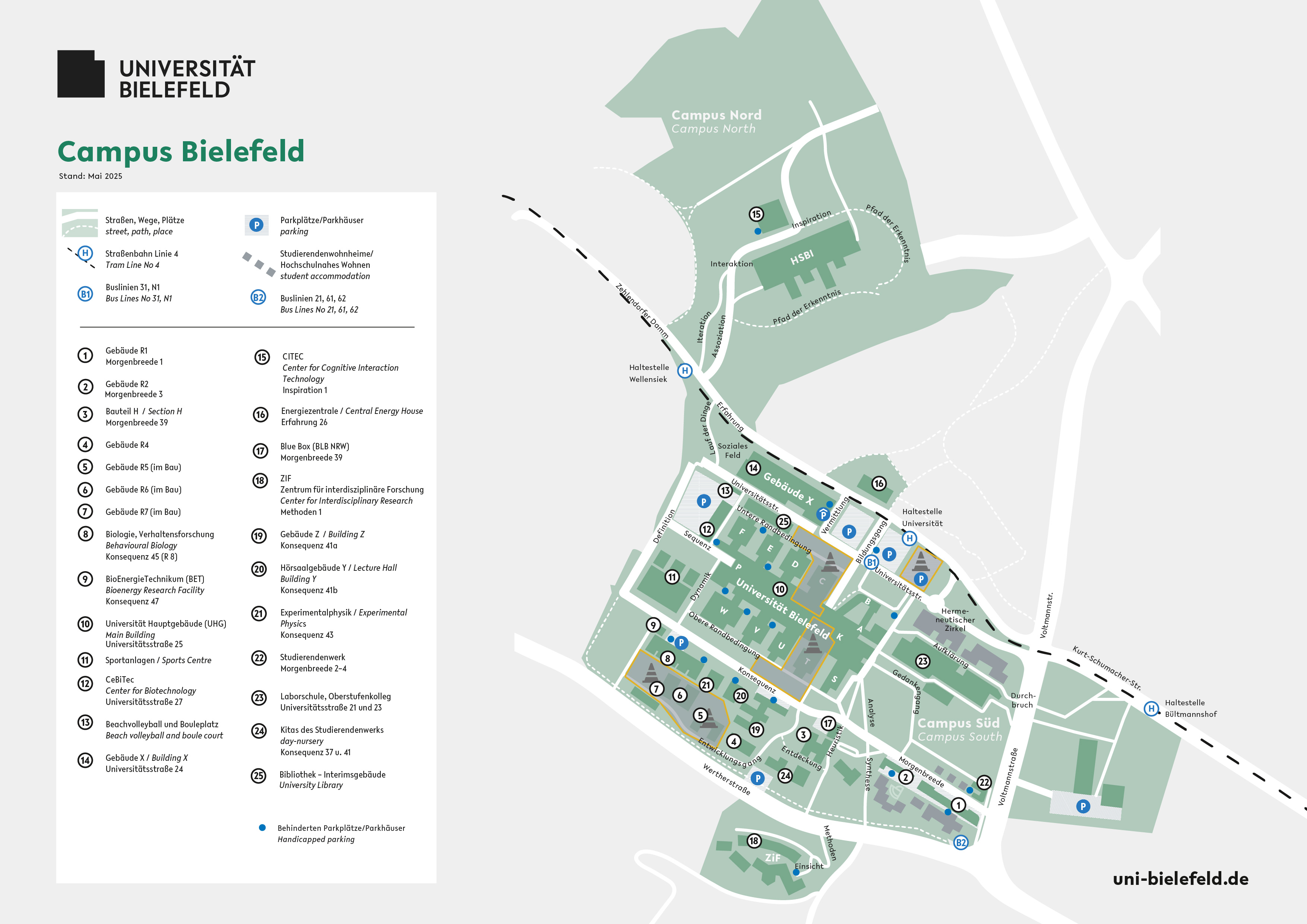
The workshop takes place at Bielefeld University. All activities take place in the main building of the University (number 10 on the campus map).
For navigation, use this address:
Bielefeld University
Universitätsstraße 25
D-33615 Bielefeld
- by train
by train:
You can reach Bielefeld by long-distance trains and regional trains. They will take you to the mainstation, Bielefeld Hauptbahnhof.
From Bielefeld Hauptbahnhof take tram line 4 in the direction of Lohmannshof to the stop Universität (journey time 7 minutes; every 10 mins).
For the timetable for your time of arrival, check here.- by car
by car:
From the north:
Motorway A2: Exit Bi-Ost, Detmolder Str. direction Zentrum (6 km, approx. 10 min). Way via Kreuzstr., Oberntorwall, Stapenhorststr., Kurt-Schumacher-Str. (is signposted).From the south:
Motorway A2: At the Bielefeld junction, take the A33 towards Bi-Zentrum, exit at Bi-Zentrum, follow the signs to the city centre on Ostwestfalendamm (B61), exit at Universität, follow Stapenhorststr., Kurt-Schumacher-Str. (is signposted).- by plane
Closest airports are Düsseldorf (190 km from Bielefeld), Dortmund (110km from Bielefeld), Hanover (110 km from Bielefeld), Cologne-Bonn (200 km from Bielefeld) and Frankfurt am Main (320 km from Bielefeld). All of them can be reached (with mostly only one change) by train. For more details, click here.
Call for Paper
Workshop: On the relation of Priming, Analogy and Linguistic Creativity (PALC)
May 27–29, 2026
Bielefeld, Germany
Priming and analogy are central mechanisms in human language. Priming supports the activation of linguistic structures and meanings, while analogy enables speakers to extend patterns and recognise relational similarities. Although both mechanisms are well studied, they have largely been investigated in isolation. Recent research, however, suggests that they may be deeply interconnected, even as the directionality of this relationship remains a matter of debate. The workshop aims to contribute to this debate, although from a specific perspective: their role in linguistic creativity. Linguistic creativity involves producing expressions that go beyond routine or fully conventionalised patterns. Both priming and analogy offer pathways into such creativity. Priming may create the immediate conditions for innovation by activating particular forms or meanings that speakers then recombine in unexpected ways. Analogy, in turn, provides the cognitive mechanism through which speakers project familiar patterns onto new contexts, giving rise to innovative constructions. By examining how priming and analogy jointly support creative language practices, the workshop seeks to shed light on how new linguistic forms arise, how existing patterns are transformed, and how speakers navigate the balance between conventionality and innovation.
The workshop is organised by three projects of the collaborative research centre 1646 “Linguistic Creativity in Communication” hosted at Bielefeld University. Each project approaches the theme from a different perspective:
Project A01 studies the role of analogy in the creation of novel, creative morphosyntactic patterns. The project takes as a starting point existing, grammatical structures and studies to what extent they can be generalised by processes such as priming to create novel structures
which are structurally similar.
Project A04 investigates empirical profiles of phenomena of grammatical creativity, exploring a typology that includes grammatical gaps, grammatical conflicts, grammaticalisation and grammatical extravagance. Priming and analogy may have a different impact on speakers’ creative solutions in these different classes. They might for instance support ongoing language change, but in situations of gaps or conflicts, where no conventional solution exists, they could play a more conservative role, preventing extreme non-conventionality.
Project C01 investigates how creative word formations are produced and understood, and how priming and analogy shape these processes. Analogy may support the creation of novel forms by extending familiar patterns and help listeners interpret those by linking them to known structures. Priming influences which linguistic patterns are activated during production and comprehension, thereby facilitating or hampering the emergence of creative forms.
Together, we invite submissions for a three‑day workshop dedicated to understanding the relation between priming, analogy, and linguistic creativity. Possible topics include, but are not limited to:
- The relationship of priming and analogy
- The role of analogy and priming in creative language use
- Cognitive and linguistic models linking priming, analogy, and creativity
- Priming across languages and in multilingual contexts
- Psycholinguistic factors underlying priming and analogy (in creative language use)
- Methodological approaches to studying these questions
The list of topics above is intended as a guideline and may be supplemented by further proposals.We invite submissions for 30 minutes presentations (+ 10 minutes discussion). The conference language is English.
Abstract submission
Format
- A4, 2.5 cm or 1 inch margins
- No more than two pages (including references)
- Standard, legible fonts (e.g., Times New Roman) with minimum 11 pt size
- Anonymous pdf
Submission
- Please send your abstracts by March 26, 2026
- To the following address: <crc1646-palc@uni-bielefeld.de>
- The email should include the title, your affiliation, the names of all contributing authors.
- Please add three keywords and a short (one-sentence) summary of your submission.
- You may submit at most two abstracts, of which only one may be single authored.
Key dates
- Submission deadline: March 26, 2026
- notification of acceptance: early April, 2026
- Conference Dates: May 27–29, 2026
- Location: Bielefeld, Germany
Contact Email:
- crc1646-palc@uni-bielefeld.de
pdf-file: PALC-2026-CfP.pdf