
Biobank OWL


Die Biobank OWL ist Teil der translationalen Forschungseinheit der Medizinischen Fakultät der Universität Bielefeld und wird in enger Kooperation mit dem Universitätsklinikum OWL (Evangelisches Klinikum Bethel, Klinikum Bielefeld und Klinikum Lippe) aufgebaut. Als einrichtungsübergreifende Liquid- und Tissue-Forschungsbiobank schafft sie Synergien und bündelt Bioproben, assozierte Daten sowie Biobank-Expertise.
Die Biobank OWL hat zwei Standorte:
- Standort am Campus der Universität Bielefeld
- Standort am Campus Klinikum Lippe
Ziele
Ziel der Biobank OWL ist es, gut charakterisierte und qualitativ hochwertige Bioproben (human, Modellorganismen) und assoziierte Daten für die krankheits- und patient*innenorientierte klinische Forschung zur Verfügung zu stellen. Die Verknüpfung mit klinischen Daten aus der Routineversorgung bzw. weiteren assoziierten Daten wird durch die Zusammenarbeit mit dem Datenintegrationszentrum von Beginn an berücksichtigt.
Kontakt

Services

© BRIC GmbH Beratung
Das erfahrene Team der Biobank OWL berät zu allen Aspekten der Sammlung, Aufbereitung, Lagerung und des Datenmanagements von Bioproben sowie zu Fragen bzgl. Ethikunterlagen.
Wenn Sie eine Studie mit Bioproben planen, wenden Sie sich gerne frühzeitig an uns!

© Universität Bielefeld Probenlogistik
Bioproben werden sicher und nachverfolgbar in die Biobank OWL transportiert, dort gelagert und an entsprechende Analyselabore im Rahmen (klinischer) Studien und Forschungsprojekte herausgegeben. Wir bevorzugen barcodierte Probenbehälter, so sind die Proben digital und automatisiert dokumentierbar. Probenbehälter mit identifizierenden Daten von Patient*innen und Proband*innen dürfen wir nicht entgegennehmen!
Wir beraten Sie gerne bei der Umsetzung dieser Anforderung und zeigen Ihnen auch gerne geeignete Probenbehälter.

© Universität Bielefeld (Langzeit-)Lager
Zur (Langzeit-)Lagerung stehen uns aktuell folgende Kapazitäten zur Verfügung
(bezogen auf 1,8-ml-Röhrchen):- Automatisierte Stickstofftanks (< -150°C): 42.200 Röhrchen
- Manuelle Stickstofftanks (< -150°C): 144.000 Röhrchen
- Tiefkühlgeräte (-80°C): 109.000 Röhrchen

© Universität Bielefeld Probenaufarbeitung
Die Biobank OWL bietet alle gängigen Aufarbeitungsschritte für Bioproben an. Dazu gehören:
- Blutfraktionierung
- Automatisierte Aliquotierung
- Isolation von mononukleären Zellen des peripheren Blutes (PBMCs)
- Aufarbeitung von Stuhlproben
- Probenhomogenisierung
- Isolation von DNA oder RNA (human oder mikrobiell) aus verschiedenen Quellen
- Qualitätskontrolle (PBMC-Funktion, Integrität der Nukleinsäuren,…)

© Universität Bielefeld Support bei (klinischen) Studien
Die Biobank OWL unterstützt (klinische) Studien durch:
- Bereitstellung von Studienkits für Bioproben
- Bereitstellung von Proben-Lager- und -Logistikstrukturen
- Dokumentation der Bioproben
- Transfer von Altproben und -daten
- Zusätzliche Assays (PCR, ELISA,…)

© Universität Bielefeld Weitere Dienstleistungen auf dem Campus
- Bereitstellung von Flüssigstickstoff
- Bereitstellung von Trockeneis (je nach Verfügbarkeit)
- Lagerraum in Backup-Gefriergeräten
- Unterstützung bei der Temperaturüberwachung (für stationäre Geräte oder für den Versand)
Team


- Leitung der Biobank OWL

- Wissenschaftliche Mitarbeiter*innen


Dr. Sonja Kunze
NUM-Projektmanagerin
- sonja.kunze@uni-bielefeld.de
- Telefon
- +49 521 106-86424
- Büro
- R.2 B0-206


Dr. Timm Weber
Wissenschaftlicher Mitarbeiter in der Biobank im Bereich Qualitäts- und Projektmanagement
- timm.weber@uni-bielefeld.de
- Telefon
- +49 521 106-87718
- Büro
- R.2 B0-221

- Technische Assistent*innen

Geneviève Jaspaert
Technische Assistentin in der Biobank
Beauftragte für Qualitätsmanagement- Telefon
- +49 521 106-86214
- Büro
- R.2 B0-207

Räumlichkeiten und Ausstattung
Campus Universität Bielefeld
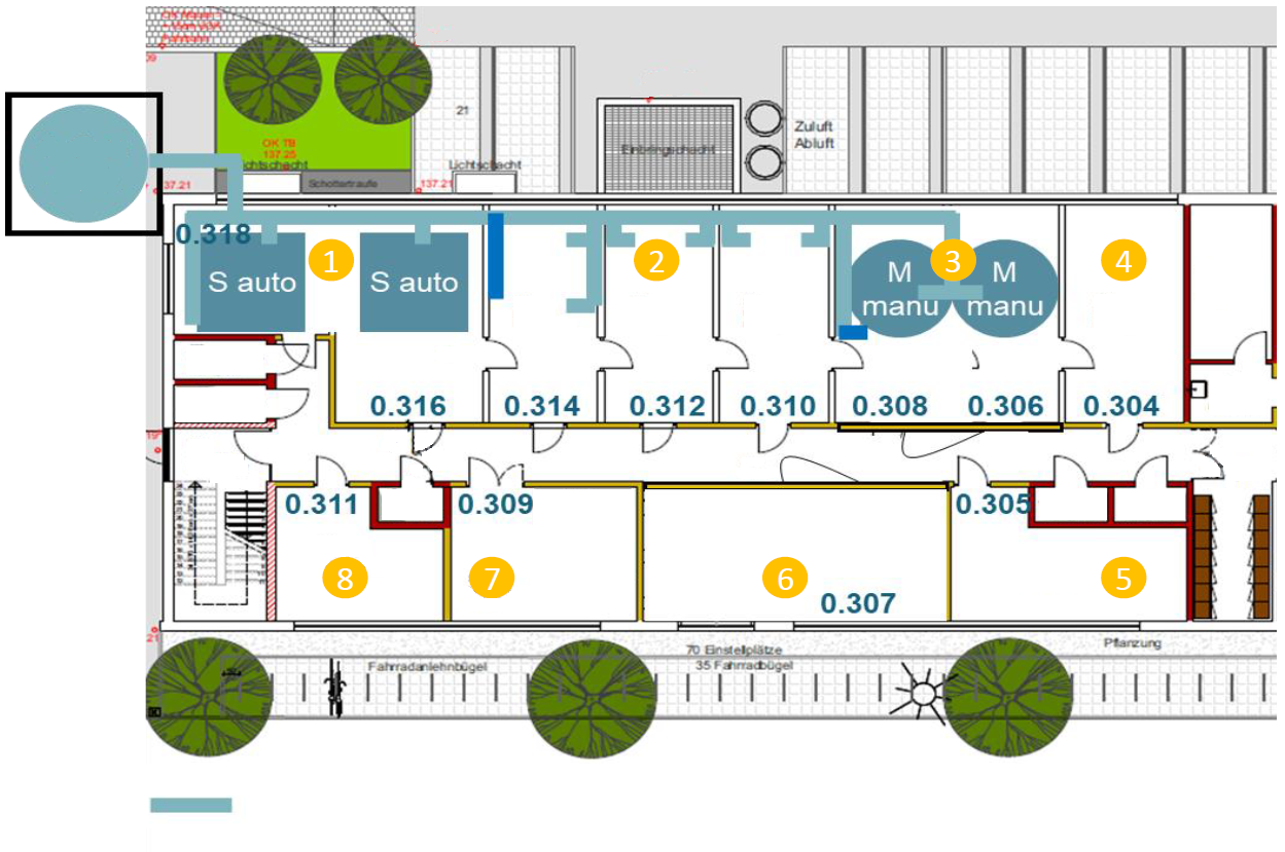
Probenlager
1. Automatisierte Stickstofftanks
2. Tiefkühlgeräte (-20°C, -80°C, -150°C)
3. Manuelle Stickstofftanks
Manuelle Stickstoff-Abfüllanlage
Labore (BSL-2)
2. Molekularbiologie (post-PCR)
4. Probenannahme (inkl. Roboter zur Blutfraktionierung und Aliquotierung)
5. Stuhl-Verarbeitung
6. Lager
7. Molekularbiologie (inkl. Pipettierroboter für die Nukleinsäureextraktion)
8. Zellkultur
Projekte
- Netzwerk Universitätsmedizin (NUM)
Aktivitäten im bundesweiten Netzwerk Universitätsmedizin (NUM)
- Ko-Koordination des NUM Methoden-& Bioproben-Hub (NUM-MB)
- Beteiligung an:
- Studiennetzwerk Infektionen
- Studiennetzwerk Schlaganfall
- Studiennetzwerk Intensivmedizin
- NAPKON
- Populationsbasierte Plattform (POP; COVIDOM+)
- Sektorenübergreifende Plattform (SÜP)
- Hochauflösende Plattform (HAP; Pa-COVID-19)
- NAPKON-TIP - RAPID_REVIVE
- NAPKON-TIP - RAPID_ELAPSE
- ENRICH
Eine Übersicht aller NUM-Projekte, an denen die Universität Bielefeld mit der Medizinischen Fakultät OWL und dem Universitätsklinikum OWL beteiligt ist, finden Sie hier.
- Kleine Eulen OWL
- ENDEMIC-2
- VReady: Virtuelle Realität im Notfalltraining
- SMELL & TASTE
- SHAPE
- Studie über die Rolle von Steroidhormonen in COVID-19 und dem postviralen Syndrom)
- retrospektive Analyse bereits erhobener Daten und Bioproben im Rahmen des Projektes NAPKON
- Univ.-Prof. Dr. med. Joachim Feldkamp, Klinikum Bielefeld, Universitätsklinik für Allgemeine Innere Medizin, Endokrinologie, Diabetologie und Infektiologie, UK OWL & AG Endokrinologie und Diabetologie, Allgemeine Innere Medizin, Infektiologie, Med. Fakultät OWL
- Dr. Gabriele Anton, Biobank Ostwestfalen-Lippe, Med. Fakultät der Universität Bielefeld
- Dr. Tobias Busche, Core Facility Omics, Bereich Next Generation Sequencing Unit, Universität Bielefeld
- Dr. Marcus Persicke, Core Facility Omics / Bereich Proteomics/Metabolomics, Universität Bielefeld
- Prof. Dr. Sabine Oertelt-Prigione, Geschlechtersensible Medizin Med. Fakultät OWL
- Prof. Dr. Thorsten Kaiser, Universitätsinstitut für Laboratoriumsmedizin, Mikrobiologie und klinische Pathobiochemie, Campus Klinikum Lippe, UK OWL
- Dr. Ilijana Begcevic Brkovic, Universitätsinstitut für Laboratoriumsmedizin, Mikrobiologie und klinische Pathobiochemie, Campus Klinikum Lippe, UK OWL
- Eico-Scan
- MikrobiomProCheck
- Forschungsprojekt über die Rolle des Darmmikrobioms bei Morbus Crohn und Colitis ulcerosa mit dem Ziel einer besseren Diagnosestellung und individuell angepasster Therapien.
- Es sollen DNA, Proteine und Stoffwechselprodukte aus Stuhlproben mittels KI analysiert werden. Langfristig sollen Stuhlproben von zu Hause aus Therapien überwachen und vorhersagen helfen.
- Die Biobank OWL unterstützt bei der automatisierten Probenaufbereitung und der Probenlogistik
- Beteiligung unter anderem:
- Universitätsklinikum Essen
- Universitätsklinikum Bonn
- ISAS Institut
- Kinderzentrum, EvKB, UK OWL
- CeBiTec, Universität Bielefeld (Prof. Dr. Alexander Sczyrba und Dr. Tobias Busche)
- Biofidus AG, Bielefeld
- Studierendenprojekte und Abschlussarbeiten
Aktuelles
- 05.10.2026 - Neue Auditor:innen für das GBN - Dr. Sonja Kunze und Geneviève Jaspaert von der Biobank OWL haben die GBN-Auditor:innen-Schulung erfolgreich absolviert
- 28.09.2026 - Hightech Agenda Deutschland: Neue Biobank-Plattform vernetzt Forschungsressourcen in Deutschland
- 22.09.2026 - Webinar: From Sample to Sequence
- 17.08.2026 - Erste:r Patient:in erfolgreich in Post-COVID-Studie RAPID_ELAPSE eingeschlossen
- 23.06.2026 - Kick-off „Biobank-Plattform für Deutschland“
- 29.01.2026 - GBN bestätigt Vorstand – Erweiterung auf vier Mitglieder