© Universität Bielefeld



News
05.10.2026 - Kick-off Treffen des TMF-Netzwerks "Frauen in der vernetzten medizinischen Forschung"


Am 05.10.2026 trafen sich über 100 Frauen aus Wissenschaft und Forschung bei der Technologie- und Methodenplattform e.V. (TMF e.V.) in Berlin. Frauen sind in Entscheidungspositionen in Wissenschaft und Forschung oft noch unterrepräsentiert. Das Netzwerk stärkt durch gezielte Vernetzung neue Kooperationen, Sichtbarkeit und Karrierewege. Der Austausch zeigte vielfältige Perspektiven und bei diesem Treffen wurde bereits zu ersten Themenschwerpunkten gearbeitet. Beispielsweise wurde über die Nutzung der CoARA-Kriterien (Coalition for Advancing Research Assessment) diskutiert, die ein alternatives Anreizsystem mit einem Potential für mehr Chancengleichheit bieten. Die AG Geschlechtersensible Medizin der Universität Bielefeld war durch Dr. Eva Becher vertreten.
Weitere Informationen zum Netzwerk finden Sie hier.
01.10.2026 – Women´s Health and Innovation Event im Europäischen Parlament


Am 01. Oktober richtete das Büro der Vizepräsidentin des EU-Parlaments, Dr. Ewa Kopacz, zusammen mit dem European Innovation Council and SME Executive Agency (EISMEA) einen Workshop im Europäischen Parlament in Brüssel aus. Unter dem Titel „From Challenges to Actions: Scaling Women´s Healt Innovation in Europe” kamen Wissenschaftler*innen, Kliniker*innen, Politiker*innen, Start Ups und Investor*innen zusammen, um sich dem Thema der geschlechtersensiblen Medizin und Frauengesundheit zu widmen. Frau Prof. Sabine Oertelt-Prigione hielt eine der Keynotes und konnte dabei die Notwendigkeit der Zugänglichkeit von Innovationen für alle Menschen hervorheben – besonders für Frauen mit begrenzten ökonomischen Chancen. Innovationen sollten breit zugänglich gemacht werden, um einer Verschärfung des Gender Health Gaps aufgrund sozialer Ungleichheiten, die Frauen spezifisch im höheren Alter betreffen können, entgegenzuwirken.
30.09. - 02.10.2026 - Kongress "Gesundheit gestalten" in Göttingen


Der Kongress fand auf Einladung der Fachgesellschaften DEGAM (Deutsche Gesellschaft für Allgemeinmedizin), DGSMP (Deutsche Gesellschaft für Sozialmedizin und Prävention), DGMS (Deutsche Gesellschaft für Medizinische Soziologie) und des EbM-Netzwerks (Netzwerk für Evidenzbasierte Medizin) statt. Mit rund 1.600 Teilnehmenden und mehr als 1.000 eingereichten Abstracts erreichte der Kongress ein weites, interdisziplinäres Fachpublikum. Im Mittelpunkt stand unter anderem die Frage, wie unter schwierigen gesellschaftlichen Rahmenbedingungen mit sozialer Ungleichheit und knappen Ressourcen im Gesundheitssystem eine bestmögliche, evidenzbasierte Versorgung erreicht werden kann. In der Session „Soziale Determinanten“ präsentierte Dr. Eva Becher für die AG Geschlechtersensible Medizin einen Posterbeitrag mit dem Titel „Erfassung von Geschlecht in bevölkerungsbezogenen Studien: Eine erste Bestandsaufnahme von nationalen Kohorten- und Registerstudien“.
23.09.2026: Geschlechtersensible Medizin im Dialog mit Politik und Versorgung
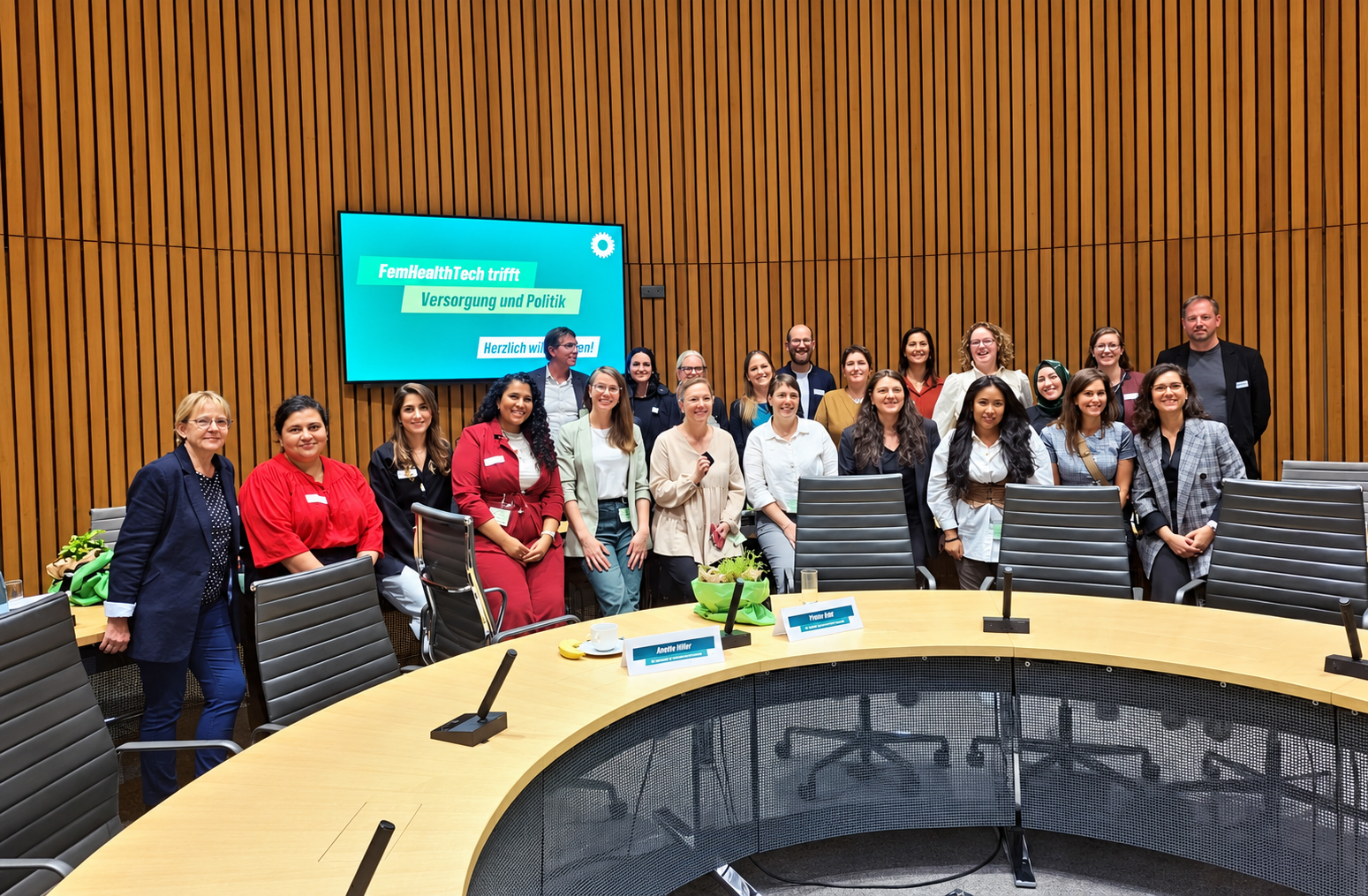
Bei der Veranstaltung „FemTech trifft Politik und Versorgung“ im Landtag Nordrhein-Westfalen standen innovative Ansätze für die Gesundheit von Frauen und ihre Bedeutung für Forschung, Versorgung und gesundheitspolitische Rahmenbedingungen im Mittelpunkt.
Wissenschaftliche Expertise aus der geschlechtersensiblen Medizin war u.a. durch Prof. Dr. Sabine Oertelt-Prigione als Mitglied der Fachjury eingebunden. Sie brachte die Perspektive auf die systematische Berücksichtigung von Sex und Gender in medizinischer Forschung und Versorgung in den fachlichen Austausch ein.
Das Veranstaltungsformat wurde unter Mitwirkung von Ute Wenning, Projektkoordinatorin von GenDiMedNet, entwickelt. Erkenntnisse und Fragestellungen der geschlechtersensiblen Medizin konnten so bereits in die Konzeption und den Dialog mit Politik, Versorgung und innovativen Akteur*innen einfließen.
Im Mittelpunkt stand damit die Frage, wie wissenschaftliche Evidenz, geschlechtersensible Forschung und technologische Innovation stärker miteinander verbunden werden können, um Versorgungslücken zu erkennen und bedarfsgerechte Lösungen zu entwickeln. Für GenDiMedNet steht der Austausch exemplarisch für den Anspruch, Erkenntnisse zu Sex und Gender frühzeitig in Forschungs- und Innovationsprozesse einzubringen und ihren Transfer in Versorgung und Gesellschaft zu unterstützen.
23.9.2026: Prof. Dr. med. Sabine Oertelt-Prigione im Deutschlandfunk


Zusammen mit vielen Kolleg*innen aus der geschlechtersensiblen Medizin kam auch Prof. Sabine Oertelt-Prigione im Deutschlandfunk zu Wort. Im Format "Hintergund" ging es um die Geschichte und aktuelle politische Entwicklungen des Faches.
09.-11.06.2026: GenDiMedNet auf der World Design Capital Frankfurt 2026


Im Rahmen der World Design Capital 2026 veranstaltete das international Gender Design Network (iGDN) vom 9. bis 11. Juni im Museum Angewandte Kunst Frankfurt die Reihe „Falling in Love with All Genders" – mit Ausstellung, Workshops und einer Dialogwerkstatt. Das GenDiMedNet war mit zwei Beiträgen vertreten: einem Vortrag von Prof. Dr. Sabine Oertelt-Prigione und einem Workshop von Claudia Herling. Prof. Dr. Sabine Oertelt-Prigione referierte über geschlechtersensible Medizin und den Einsatz von Designmethoden in medizinischen Kontexten – ein Ansatz, der in der medizinischen Ausbildung und Versorgung bislang wenig etabliert ist. Sie erläuterte, wie gestalterische Verfahren genutzt werden können, um Versorgungskonzepte partizipativ, inklusiv und diversitätssensibel zu entwickeln.


Claudia Herlings Workshop „Designing Care Futures: Wie gestalten wir gendersensible Gesundheitsprodukte?“ am 9.6. beleuchtete exemplarisch die Themen Schmerzwahrnehmung, Kardiologie und Endometriose mit geschlechtersensiblem Fokus. Dazu diskutierten die Teilnehmenden zwei übergreifende Fragen: Wie entstehen Gender-Biases in digitalen Gesundheitsprodukten? Und wie könnten zukünftige Szenarien für gendersensible Gesundheitsprodukte aussehen?


Das Herzstück der Veranstaltung bildete die Dialogwerkstatt am 10. Juni, in der zahlreiche Referent*innen verschiedene Perspektiven auf das Verhältnis von Gender und Design vorstellten und diskutierten. Die Medizin diente dabei als zentrales Praxisbeispiel, um aufzuzeigen, wie Design, Geschlecht und medizinische Forschung, Lehre und Versorgung zusammenhängen. Der Austausch machte deutlich, wie notwendig interdisziplinäre Ansätze sind, die Geschlechterforschung, Design und Medizin verbinden. Für GenDiMedNet ist die Teilnahme an solchen Veranstaltungen ein zentraler Bestandteil der Netzwerkarbeit, um über die eigenen Projektgrenzen hinaus in Austausch mit externen Communities zu treten. Dass Organisation und Workshop-Leitung hier in einer Person zusammenkamen – Claudia Herling ist zugleich iGDN-Vorsitzende und GenDiMedNet-Mitarbeiterin –, verdeutlicht, welche Synergien entstehen können, wenn Netzwerke personell ineinandergreifen.
21.05.2026: Veranstaltung im NRW-Landtag „Digital Health Start-ups im Dialog mit Praxis, Versorgung und Politik“


Am 21. Mai 2026 fand im NRW-Landtag die nicht öffentliche Veranstaltung „Digital Health Start-ups im Dialog mit Praxis, Versorgung und Politik“ statt. Akteur*innen aus Forschung, Versorgung, Selbstverwaltung und Politik diskutierten dort über die Zukunft digitaler Gesundheitsinnovationen und deren Integration in die Versorgungspraxis.
Die AG geschlechtersensible Medizin der Medizinischen Fakultät OWL brachte dabei Perspektiven zu verantwortungsvoller KI, gendersensibler Medizin, patient*innenzentrierter Versorgung und kontextsensibler Produktentwicklung ein. Im Mittelpunkt stand die Frage, wie digitale Gesundheitslösungen fair, praxistauglich und nachhaltig gestaltet werden können.
Zudem unterstrich die Veranstaltung die Bedeutung interdisziplinärer Zusammenarbeit für eine gesellschaftlich verantwortliche digitale Gesundheitsversorgung. Die Moderation übernahm Ute Wenning.
18.05.2026: Prof. Dr. Sabine Oertelt-Prigione zu Gast bei NDR Info zu den Vorwürfen der sexuellen Belästigung auf dem Ärztetag in Hannover


Professorin Sabine Oertelt-Prigione spricht beim NDR zu den strukturellen Hintergründen der Vorwürfe von sexuellen Belästigungen auf dem Ärztetag am 12.-15. Mai 2026 in Hannover. Link zum Video
Die Charité hat in 2015 eine erste umfassende Erhebung zum Thema Grenzverletzungen (sexuelle Belästigung) sexualisierte Diskriminierung und Gewalt (SBDG) am Arbeitsplatz durchgeführt. Weitere Informationen zur Watch - Protect - Prevent Studie finden Sie hier.
Publikationen zum Thema:
Jenner S, Djermester P, Prügl J, Kurmeyer C, Oertelt-Prigione S. Prevalence of Sexual Harassment in Academic Medicine. JAMA Intern Med. 2019;179(1):108–111. doi:10.1001/jamainternmed.2018.4859
Jenner, S. C., Djermester, P., & Oertelt-Prigione, S. (2022). Prevention Strategies for Sexual Harassment in Academic Medicine: A Qualitative Study. Journal of interpersonal violence, 37(5-6), NP2490–NP2515. https://doi.org/10.1177/0886260520903130
Oertelt-Prigione, Sabine; Jenner, Sabine C. (2017): Prävention sexueller Belästigung
Study der Hans-Böckler-Stiftung Nr. 369, Düsseldorf, ISBN: 978-3-86593-279-2
21.-23.04.2026: GenDiMedNet auf der DMEA Interaktive Technologien für geschlechter- sensible Medizin im Fokus


Berlin/Bielefeld, April 2026 – Mit einem dialogorientierten Veranstaltungsformat war das Forschungsnetzwerk GenDiMedNet unter der Leitung von Frau Prof. Dr. med. Sabine Oertelt-Prigione vom 21. bis 23. April 2026 auf der DMEA in Berlin vertreten. Im Zentrum stand der Austausch zwischen Akteur*innen aus Forschung, Entwicklung und Versorgung zu Fragen geschlechtersensibler digitaler Gesundheitsanwendungen.
GenDiMedNet ist ein kooperatives Verbundvorhaben der Universität Bielefeld, der Universität Greifswald, der Charité – Universitätsmedizin Berlin sowie des Bernhard-Nocht-Instituts für Tropenmedizin in Hamburg, initiiert durch das Bundesministerium für Forschung, Technologie und Raumfahrt. Als übergeordnetes Netzwerk fungiert es als organisatorischer und inhaltlicher Rahmen für die Verbundprojekte aus der Förderrichtlinie Interaktive Technologien für eine geschlechtsspezifische Gesundheit (GeGe). In der Begleitforschung verknüpft GenDiMedNet Ansätze der geschlechterdifferenzierten Gesundheitsforschung mit Fachwissen zu Implementierungsprozessen, Datenerhebung, Datenmanagement und Interoperabilität, geschlechtersensibler Produktentwicklung sowie Wissenschaftskommunikation.
Die Beteiligung an der DMEA verdeutlicht die zunehmende Bedeutung geschlechtersensibler Ansätze im Kontext digitaler Gesundheitsinnovationen. Der Austausch vor Ort lieferte Impulse für die weitere Forschungsarbeit und unterstrich die Notwendigkeit, Geschlechteraspekte und kontextsensible Perspektiven langfristig in technologischen Entwicklungsprozessen zu verankern.
In dieser Live-Podcastfolge von der DMEA spricht Matthias Schwarz mit Ute Wenning über geschlechtersensible Medizin, Diversitätsmedizin und die Frage, warum viele Menschen in der Gesundheitsversorgung noch nicht ausreichend berücksichtigt werden. Im Podcast "Bauen wir uns eine Zweiklassenmedizin" von Kathrin Rindfleisch kommen neben Ute Wenning weiter Akteur*innen aus der geschlechtersensiblen und digitalen Medizin zu Wort.
15.04.2026: Besuch aus dem Evangelischen Gymnasium Werther


Am 15.04. kam ein Kurs mit 13 Schüler*innen eines neunten Jahrgangs des Evangelischen Gymnasiums Werther in Begleitung ihrer Lehrerin Frau Sarina Heermann und einer Praktikantin an die Universität Bielefeld, um sich über das Thema Geschlechtersensible Medizin zu informieren. Sie wurden an der Universität durch Frau Prof. Dr. med. Sabine Oertelt-Prigione, der Leiterin der Arbeitsgruppe „Geschlechtersensible Medizin“ sowie zwei ihrer Teammitglieder Frau Dr. Eva Becher und Sophie Stüve herzlich begrüßt.
Die Schule ist Projektschule im Netzwerk Schule der Vielfalt und Mitglied im Netzwerk Schule ohne Rassismus - Schule mit Courage. Der Kurs hatte sich bereits im Vorfeld mit den Themen Diversität und Gender befasst und Fragen vorbereitet.
Die Schüler*innen traten spielerisch in Teams gegeneinander an und erlernten so mehr zum Thema Geschlechtersensible Medizin. Frau Professorin Sabine Oertelt-Prigione gab einen informativen und spannenden Einblick in die Grundlagen des Themas und ermöglichte immer wieder Fragen der Schüler*innen zu klären. Auch über die Inhalte im Medizin Studium wurde berichtet. Im dritten Teil durften die Schüler*innen anhand eines Kartenspiels medizinische Fälle diskutieren und gemeinsam erarbeiten, warum Geschlecht für die Erkrankung und Behandlung eine Rolle spielen könnte.
20.01.2026: Frau Prof. Dr. med. Sabine Oertelt-Prigione zu Gast als Expertin bei der Eröffnung des Wissenschaftsjahres 2026

Juni 2025: Erstellung eines Fachtextes der Bundesstiftung Gleichstellung
Prof. Dr. med. Sabine Oertelt-Prigione unterstützt die Bundesstiftung Gleichstellung durch die Erstellung des Fachtextes „Geschlechtersensible Medizin“. Dieser ist hier abrufbar.
Dezember 2024: Interaktives Buch zu Gender, Intersektionalität und Gesundheit in der Klimakrise
In Zusammenarbeit mit Petra Verdonk (Ed.) und mit Beteitligung von Prof. Dr. med. Sabine Oertelt-Prigione erscheint ein interaktives Open Access Buch. Der Titel lautet: „Coloring Connections. Researching Gender, Intersectionality, and Health in the Climate Crisis”. Das Buch ist hier abrufbar.
Dezember 2024: Podcast der Bundesärztekammer
Prof. Dr. med. Sabine Oertelt-Prigione zu Gast im Podcast "Sprechende Medizin" der Bundesärztekammer zum Thema: „Gendersensible Medizin – Aktuelle Herausforderungen und Chancen“. Zum Nachhören geht es hier entlang.
September 2024: Teilnahme am Panel "Sex and Gender in Clinical Trials and Health Research" der Nature Conference
Prof. Dr. med. Sabine Oertelt-Prigione war als geladene Referentin auf dem Panel zum Thema “Sex and Gender in Clinical Trials and Health Research” auf der Nature Conference „Breaking Barriers for Gender and Health Equity Through Research“.
April 2024: Berufung in den Medizinausschuss des Wissenschaftsrats
Prof. Dr. med. Sabine Oertelt-Prigione wurde in den Medizinausschuss des Wissenschaftsrats berufen. Der Medizinausschuss gibt gesondert und regelmäßig Empfehlungen und Stellungnahmen zu allen Fragen von Lehre und Forschung sowie Krankenversorgung ab. Liste der Mitglieder
03.12.2023: WDR / ARD alpha: Sendung Planet Wissen „Medizin und Geschlecht“
Frauen und Männer können bei ein und derselben Krankheit unterschiedliche Symptome haben - beispielsweise landen Frauen mit Herzinfarkt viel später auf der Intensivstation als Männer. Welche Folgen haben diese Unterschiede für Patient:innen und Mediziner:innen? Die Sendung ist hier noch bis zum 03.12.2026 verfügbar.
November 2023: Berufung in den Wissenschaftlichen Beirat der Pettenkofer School of Public Health München
Prof. Dr. med. Sabine Oertelt-Prigione wurde in den Wissenschaftlichen Beirat der Pettenkofer School of Public Health München berufen.
Juni 2023: Berufung in den Wissenschaftlichen Beirat des Sonderforschungsbereiches NRP 86
Prof. Dr. med. Sabine Oertelt-Prigione wurde in den Wissenschaftlichen Beirat des Sonderforschungsbereichs „NRP83 – Gender Medicine and Health“ des Schweizer Nationalfonds berufen.
März 2023: Veröffentlichung des Abschlussberichtes der Expert*innengruppe der EU Kommission zu COVID-19
Unter dem Vorsitz von Prof. Dr. med. Sabine Oertelt-Prigione und Dr. Jens-Peter Andersen des Universität Aarhus (DK) wurde der Abschlussbericht der Expert*innengruppe der EU Kommission zu „COVID-19 impact on gender equality in research & innovation“ erstellt und veröffentlicht.
Frühere Meldungen:
09.11.2021: blog interdisziplinäre Geschlechterforschung
Hochschulmedizin geschlechtersensibel gestalten – Interview mit zwei Pionierinnen
2021: GEO Wissen Gesundheit 18/2021 "Der weibliche Körper"
mit einem Beitrag zu: Gendermedizin - Warum Frauen oft andere Therapien brauchen
07.07.2021: Deutschlandfunk
Geschlecht in Covid-19-Studien selten berücksichtigt
News European Parliament, 07.07.2021
Evelyn Regner: "Gender should be taken into account in clinical trials for anti-COVID-19 treatments"
SWR 2, 13.7.2021
Geschlecht endlich mitdenken – Sabine Oertelt-Prigione kämpft für eine geschlechtersensible Medizin
Spiegel Online, 21.4.2021
Gendermedizin - Warum Ärztinnen und Ärzte dieses Fach brauchen