Non-Equilibrium QCD

Research Areas
Non-Equilibrium Dynamics & Matter under Extreme conditions
We investigate the theoretical description of quantum many-body systems out of thermal equilibrium. By combining advanced numerical simulations with (semi-) analytical methods, we decode the complex, real-time dynamics of matter under extreme conditions—such as the early stages of ultrarelativistic heavy-ion collisions and the formation of the Quark-Gluon Plasma (QGP).
Key pillars of our research include:
- Universality Far From Equilibrium: We study how highly occupied quantum systems lose memory of their initial states and exhibit self-similar scaling behaviors. Our work uncovers universal attractor solutions that bridge seemingly unrelated fields, showing that the non-equilibrium evolution of non-Abelian plasmas shares a dual description with superfluid Bose gases (Berges et al., 2015).
- The Limits of Hydrodynamics: We determine precisely when macroscopically effective descriptions, like relativistic viscous hydrodynamics, become applicable to high-energy collisions. Using microscopic kinetic simulations, we map out pre-equilibrium boundaries and establish the range of validity for fluid dynamics in both large and small collision systems (Ambrus et al., 2023).
- Development of real-time methods: We develop functional methods, such as the real-time functional renormalization group (rFRG) and large scale numerical simulations to describe complex systems, such as stochastic fluids.
Further Reading:
- V. Ambrus, S. Schlichting, C. Werthmann Phys. Rev. Lett. 130 (2023) 15, 152301
- X. Du, S. Schlichting Phys. Rev. D 104 (2021) 5, 054011
- J. Berges, K. Boguslavski, S. Schlichting, R. Venugopalan Phys. Rev. Lett. 114 (2015) 6, 061601
-
J. Roth, Y. Ye, S. Schlichting, L. von Smekal arXiv:2603.17874
Heavy-Ion Collisions & QGP Evolution
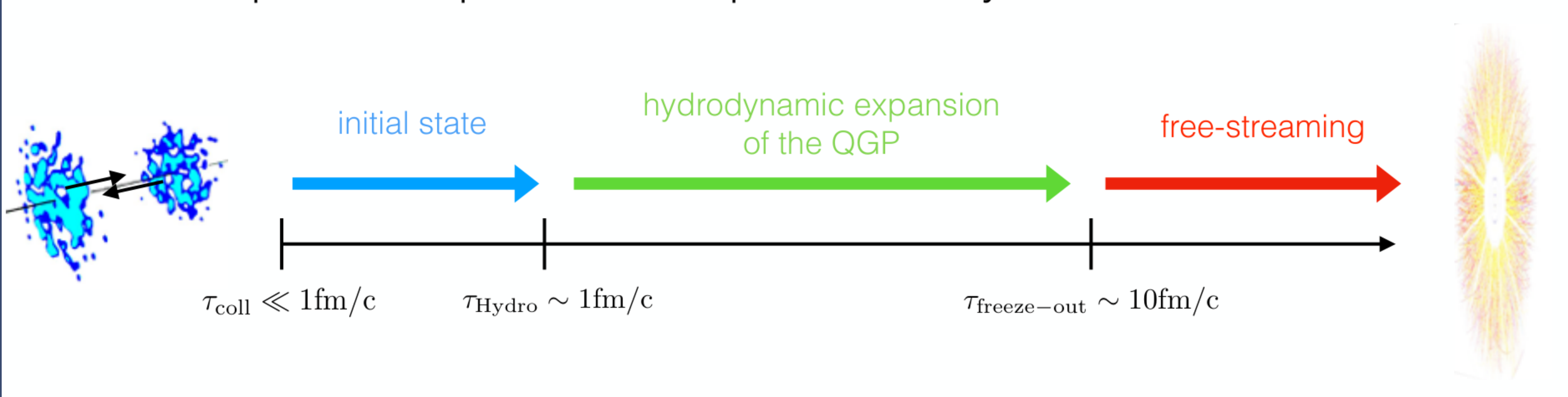
We develop comprehensive theoretical frameworks to model the entire spacetime evolution of ultrarelativistic heavy-ion collisions, tracing the system from the initial impact to the final freeze-out of hadrons. A core focus of our work is the "bottom-up" thermalization scenario, where we map how early-stage glasma fields transition into a chemically equilibrated Quark-Gluon Plasma. By connecting first-principles QCD dynamics with experimental observables, we also how to constrain the initial geometry and transport properties of the plasma in both large and small collision systems.
Review:
- S. Schlichting, D. Teaney Ann. Rev. Nucl. Part. Sci. 69 (2019) , 447--476
Further Reading:
- M. Coquet, M. Winn, X. Du, J. Ollitrault, S. Schlichting Phys. Rev. Lett. 132 (2024) 23, 232301
- A. Kurkela, A. Mazeliauskas, J. Paquet, S. Schlichting, D. Teaney Phys. Rev. Lett. 122 (2019) 12, 122302
Phase Transitions & Critical Dynamics


Strong interaction matter is expected to possess a critical point at finite net-baryon density, where it undergoes a second-order phase transition. Similarly, in the chiral limit of vanishing light-quark masses the transition between the hadronic phase with broken chiral symmetry and the chirally symmetric phase at vanishing net-baryon density in all likelihood also becomes of second order, which may have an imprint on the properties of real-world QCD, where the light quark masses are small. Near these critical points, static and dynamic properties of strong-interaction matter exhibit universal behavior, which can be characterized in terms of critical exponents and universal scaling functions.
Further Reading:
- J. Roth, Y. Ye, S. Schlichting, L. von Smekal Phys. Rev. D 111 (2025) 11, L111901
- L. Sieke, M. Harhoff, S. Schlichting, L. von Smekal Nucl. Phys. B 1011 (2025) , 116808
Gluon Saturation & High-Energy Scattering in QCD


We investigate high-energy scattering processes in Quantum Chromodynamics (QCD) across a wide range of collision systems, encompassing proton-proton (p+p), proton-nucleus (p+A), nucleus-nucleus (A+A), and electron-nucleus (e+A) collisions. Our focus is the regime where rapid gluon growth leads to non-linear recombination and gluon saturation. Using the Color Glass Condensate (CGC) effective field theory, we study how this saturated state sets the universal initial conditions for high-energy interactions. Our work explores the impact of non-linear QCD dynamics on key experimental observables, such as forward particle production and particle correlations, providing clean insights into the nuclear wave function that are vital for both current hadron colliders and future e+A programs. Furthermore, we develop advanced numerical and analytical frameworks to track how these highly occupied gluon fields decorrelate and evolve immediately after the initial impact, bridging the gap between saturation physics and pre-equilibrium plasma dynamics.
Review:
- O. Garcia-Montero, S. Schlichting Eur. Phys. J. A 61 (2025) 3, 54
Further Reading:
- O. Garcia-Montero, S. Schlichting, J. Zhu Phys. Rev. D 111 (2025) 7, 076029
- O. Garcia-Montero, Y. Hoffmann, S. Schlichting arXiv:2511.22763
QCD Jets
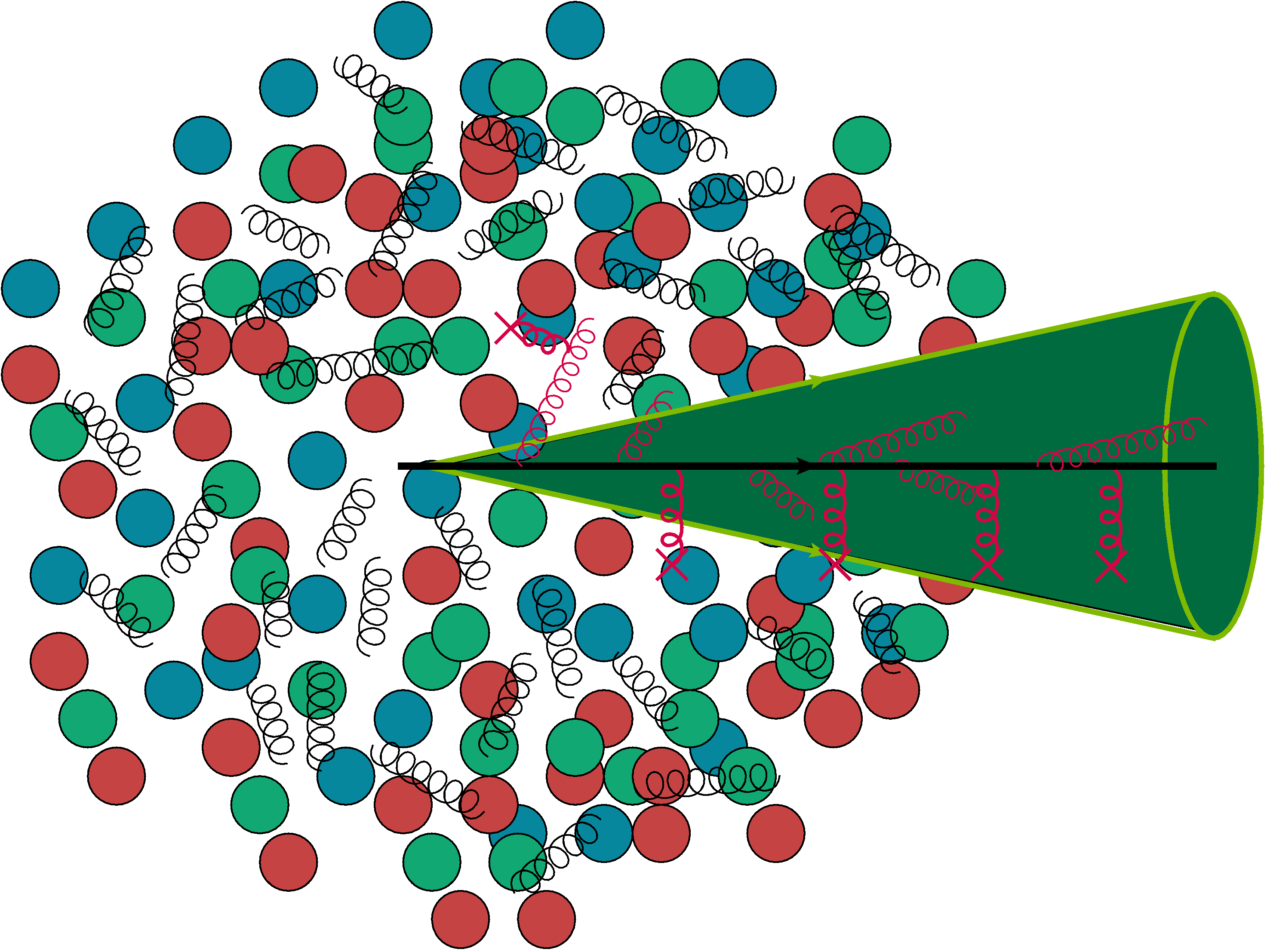
Highly energetic particles created at the early stages of heavy ion collisions act as tomographic probes of the QGP. These jets traverse the medium and lose energy through interactions, a phenomenon known as jet quenching, allowing us to extract fundamental properties such as transport coefficients.
Further Reading:
- Y. Mehtar-Tani, S. Schlichting, I. Soudi JHEP 05 (2023) , 091
- S. Schlichting, I. Soudi Phys. Rev. D 105 (2022) 7, 076002
Team
Prof. Dr. Sören Schlichting

sschlichting@physik.uni-bielefeld.de
- Telefon
- +49 521 106-6225
- Telefon Sekr.
- +49 521 106-6223
- Büro
- UHG E6-140
- Awards
-
Zimányi Medal (2022)
The medal is awarded to theoretical physicists who are under the age of 40 and whose research in the field of theoretical high-energy nuclear physics has achieved important international recognition and impact. The decision on awarding the medal is taken by an international committee.
Type: Verleihung Status: validiert Year: 2022 -
Zimányi Medal (2022)
The medal and prize money of 2000 US dollars are awarded to theoretical physicists who are under the age of 40 and whose research in the field of theoretical high-energy nuclear physics has achieved important international recognition and impact.
Type: Verleihung Status: validiert Year: 2022
-
- Publications (85)
-
Harhoff M, Riedel C, Roth J, Schlichting S. Regularization of stochastic fluid dynamics and non-perturbative renormalization of the shear viscosity of incompressible fluids. arXiv:2610.23442. 2026. (2026)
-
Harhoff M, Sieke LJ, Schlichting S, von Smekal L. Universal behavior of cumulants in non-equilibrium phase transitions - Kibble-Zurek scaling functions for trans-critical quenches. In: Proceedings of FAIR next generation scientists - 8th Edition Workshop — PoS(FAIRness2024). Trieste, Italy: Sissa Medialab; 2026: 014. (2026)
-
Roth JV, Ye Y, Schlichting S, von Smekal L. Effects of dissipation on phase diagram and bosonic excitations in the quark-meson model. Physical Review D. 2026;113(1): 016016. (2026)
-
Peng Y, Ambru VE, Werthmann C, Schlichting S, Heinz U, Song H. Extended applicability domain of viscous anisotropic hydrodynamics in (2+1)-D Bjorken flow with transverse expansion. Physical Review C . 2026;113(2): 024918. (2026)
-
Gavassino L, Niekamp P, Schlichting S, Denicol GS. Stationary Couette-type flows in relativistic fluids. Physical Review D . 2026;113(5): 054011. (2026)
-
Harhoff M, Schlichting S, von Smekal L. Numerical simulations of non-relativistic stochastic fluids via the Metropolis algorithm. Journal of Subatomic Particles and Cosmology. 2026: 100375. (2026)
-
Andronic A, Borghini N, Du X, et al. Constraining hot and cold nuclear matter properties from heavy-ion collisions and deep-inelastic scattering. Journal of High Energy Physics. 2026;2026(4): 185. (2026)
-
Du X, Schlichting S, Zhu J. ( 3 + 1 ) D event-by-event preequilibrium dynamics in heavy-ion collisions . Physical Review D. 2026;113(9): 096009. (2026)
-
García Montero OJ, Hoffmann Y, Schlichting S. Saturation effects in exclusive vector meson production in DIS. Physical Review D. 2026;114(5): 054017. (2026)
-
Coquet M, Faure T, Schlichting S, Spier M, Winn M. Charm quark production in heavy-ion collisions as a signature of pre-equilibrium. Physics Letters B. 2026;881: 140931. (2026)
-
- Projects (6)
-
Fokusbereich: Architektur der Natur: Elementare Bausteine und Entstehung neuer Strukturen
Status: laufend Time: Mar 2025 - Apr 2100 -
TRR 211/2, Teilprojekt B02: Kollektive Dynamik in Schwerionenkollisionen
Status: beendet Time: Jul 2021 - Jun 2025 -
TRR 211/2, Teilprojekt A06: Hadronische Anregungen und Spektralfunktionen im Medium
Status: beendet Time: Jul 2021 - Jun 2025 -
Run 3 von ALICE am LHC: Fluktuationen und Korrelationen erhaltener Ladungen und Teilchen in Schwerionenkollisionen
Status: beendet Time: Jul 2021 - Jun 2024 -
TRR 211/1, Teilprojekt A06: Hadronische Anregungen im Medium
Status: beendet Time: Jul 2017 - Jun 2021 -
TRR 211/1, Teilprojekt B02: Kollektive Dynamik in Kern-Kern-Kollisionen
Status: beendet Time: Jul 2017 - Jun 2021
-
- Akademischer Rat.

- Postdocs
Dr. Baochi Fu
- bfu@physik.uni-bielefeld.de
- Telefon
- +49 521 106-5315
- Telefon Sekr.
- +49 521 106-6224
- Büro
- UHG D6-136
Jie Zhu
- jzhu@physik.uni-bielefeld.de
- Telefon
- +49 521 106-5319
- Telefon Sekr.
- +49 521 106-6224
- Büro
- UHG D6-150
- PhD Students
Min An
- min.an@uni-bielefeld.de
- Telefon
- +49 521 106-5319
- Telefon Sekr.
- +49 521 106-6223
- Büro
- UHG D6-150
- Master Students
Jens Hügel
- jens.huegel@uni-bielefeld.de
- Telefon
- +49 521 106-6218
- Telefon Sekr.
- +49 521 106-6223
- Büro
- UHG E6-115
- Bachelor Students
- Alumni
PhD Theses (Doktorarbeiten)
- "Hydrodynamic and non-hydrodynamic excitations of the QGP" (Stephan Ochsenfeld, Winter 2020/21 – WS 2024/25)
- "Functional renormalization group (FRG) approach to dynamic critical behavior" (Yunxin Ye, WS 2021/22 – WS 2024/25)
- "Pre-equilibrium photon and dilepton production in Heavy-Ion collisions" (Philip Plaschke, WS 2020/21 – WS 2023/24)
- "Linearized QCD Kinetic description of small systems" (Clemens Werthmann, SS 2019 – WS 2022)
- "Early time dynamics & longitudinal structure of high-energy Heavy-Ion collisions" (Pragya Singh, WS 2018/19 – SS 2021)
- "Jet quenching & chemical equilibration of jets in the QGP" (Ismail Soudi, WS 2018/19 – SS 2021)
M.Sc. Theses
- "Saturation effects in exclusive vector meson production in DIS using a small-x hotspot proton model" (Yannik Hoffmann, WS 2024/25)
- "Functional Renormalization Group Approach to Real Time Correlation Functions of a Classical and Quantum Field Theory" (Sven Huelsmann, WS 2023/24)
- "Non-relativistic stochastic hydrodynamics" (Mattis Harhoff, WS 2023/24)
- "Flow Equations of Model A with N-Component Order Parameter Using the Real-Time FRG Approach" (Mika Sebastian Spier, SS 2023)
- "Critical dynamics of relativistic diffusion with the real-time functional renormalisation group" (Patrick Niekamp, SS 2023)
- "Evading the sign problem in real-time QFT" (Frederic Klette, WS 2021/22)
- "Effects of a QCD medium on the probability of high-energy gluon Bremsstrahlung" (Miriam Meier, WS 2020/21)
- "Exploring the pre-equilibrium dynamics of longitudinal fluctuations in high-energy Heavy-Ion collisions" (Stephan Ochsenfeld, SS 2020)
- "Non-equilibrium transport of conserved charges in high-energy Heavy-Ion collisions" (Philip Plaschke, SS 2020)
B.Sc. Theses
- "Evolution of perturbations of the energy-momentum tensor during the pre-equilibrium phase of heavy-ion collisions" (Lennart Weber, SS 2025)
- "Hydrodynamic Attractors in Scalar Kinetic Theory in Oscillating Space-Time" (Martin Vrdoljak, SS 2025)
- "Hydrodynamic Attractors in Yang-Mills Kinetic Theory in Oscillating Space-Time" (Simon Schneider, SS 2025)
- "Hydrodynamic attractors in oscillating space-time in kinetic theory in the relaxation time approximation" (Louis Onwuka, SS 2025)
- "Identification of the MOAT regime and inhomogeneous phase" (Cedric Riedel, SS 2024)
- "Monte-Carlo sampling of nucleon positions in the nuclear shell model for heavy-ion collisions" (Lisa Kroeger, SS 2024)
- "Validating the pre-equilibrium evolution of Heavy-Ion collisions in KoMPoST" (Jens Andreas Huegel, SS 2024)
- "Spectral functions from the real-time FRG approach for asymmetric potentials" (Mika Sebastian Spier, Summer 2020)
- "Solutions to the relativistic Couette flow" (Patrick Niekamp, Summer 2020)
- "Initial state energy deposition in heavy-ion collisions within a small-x TMD approach" (Yannik Hoffmann, Summer 2020)
- "Functional Renormalization Group Approach to Real Time Correlation Functions of the Anharmonic Oscillator" (Sven Huelsmann, Winter 2019/2020)

Funding
- CRC-TR211
CRC-TR211
Since July 2017, the CRC/TRR 211 has been investigating the most extreme states of matter in the Universe. The researchers explore what happens when ordinary matter is heated to extremely high temperatures and subjected to enormous pressure. Under such conditions, protons and neutrons dissolve into their constituents – quarks and gluons. These states occur in neutron-star mergers, in heavy-ion collisions at particle accelerators, and in the early Universe shortly after the Big Bang.