Sustainability Report 2025

Education & teaching
Integrating sustainability in education and teaching
In the university's Guiding Principle for Teaching, sustainability is featured as an overarching and defining characteristic. Sustainability is to be firmly integrated into teaching, thus allowing this topic to shape the development of new and existing programmes of study. The university sees itself as a place where the challenges of a globalised world are actively discussed and where thinking and action geared towards sustainability are fostered. Students thereby gain important insight into adopting their future roles in society with reflection and responsibility. Continuous development and interdisciplinary networking are included under the purview of quality management for the area of education and teaching: specifically, this takes place in biennial programme review meetings. The topic of sustainability is thus systematically incorporated into the continuous processes of programme development.
Many students at Bielefeld University have access to comprehensive offerings, within the scope of the individual complementary subjects, to attend modules or courses according to their own interests outside of their fixed curricula. This forecloses the opportunity, particularly at bachelor's level, to take modules on sustainability topics as part of their academic studies, even where these courses might not be included in their regular curricula. Since the 2024/25 winter semester, individual courses have also been listed and assigned in the course catalogue under the topic areas of the mission statement. This makes it easier for students to identify suitable courses, allowing them to develop a specialisation in topics addressed by the mission statement (including but not limited to sustainability).
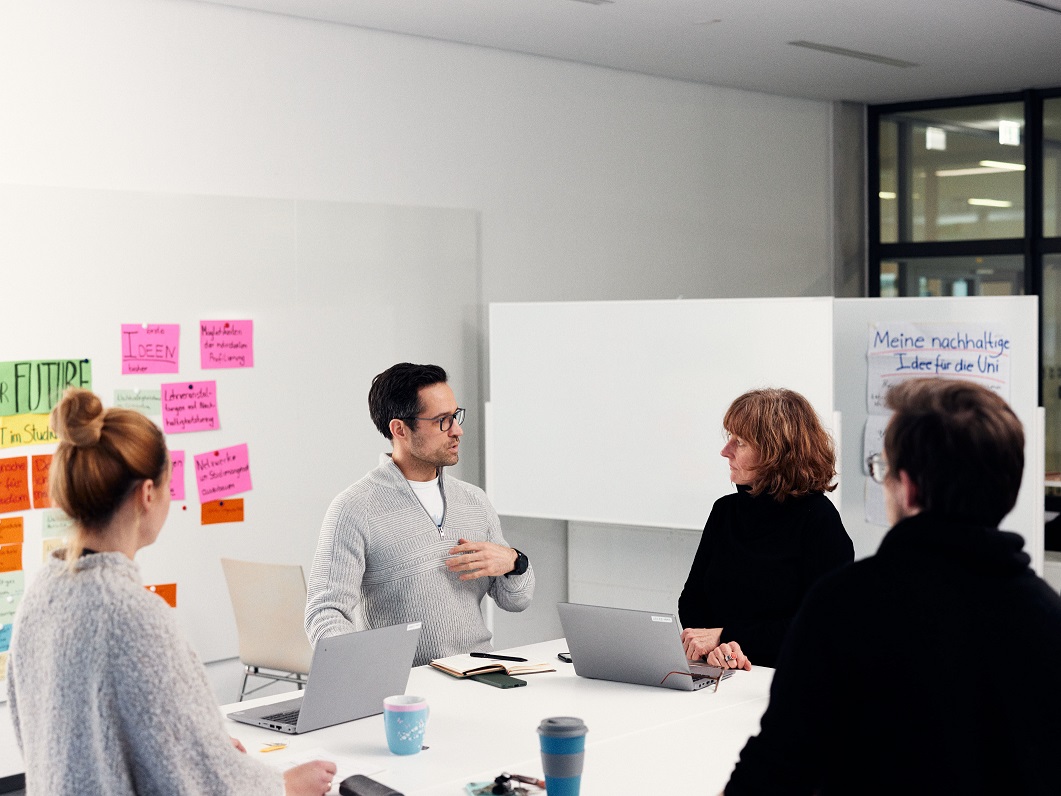
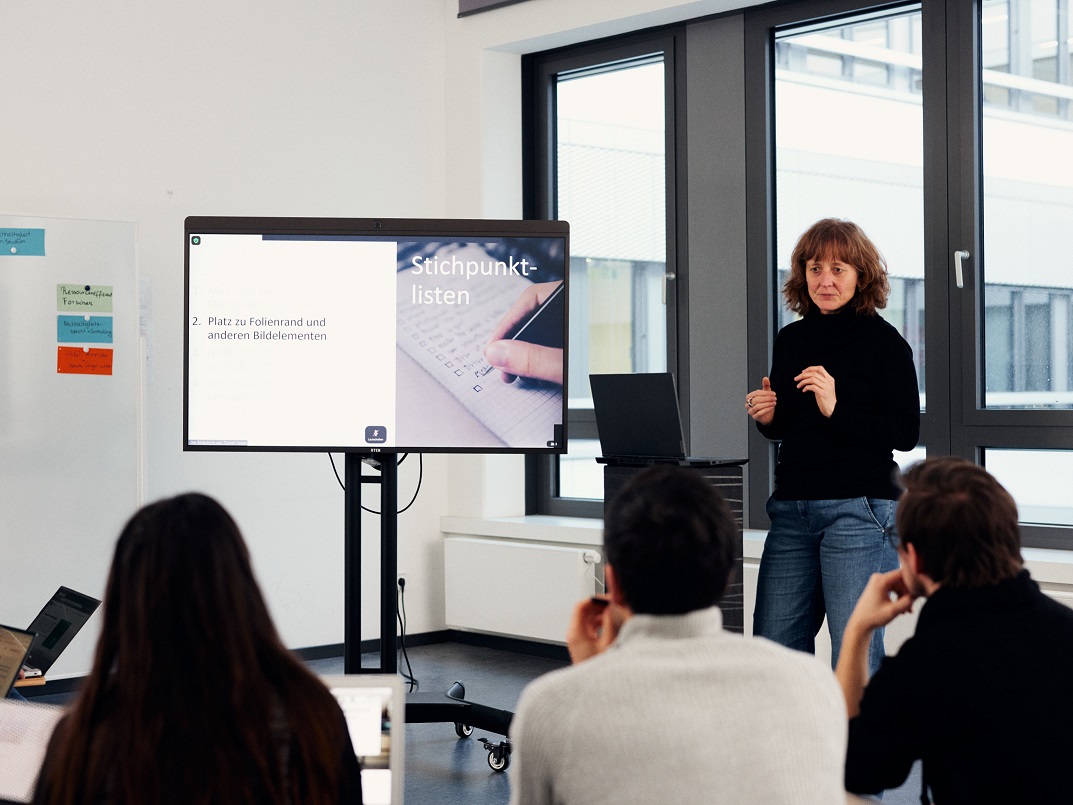
In addition, the Centre for Teaching and Learning (ZLL) provides various offerings to support teaching staff and institutions in designing forward-looking educational content. It also provides training for teaching staff and helps foster innovative cutting-edge teaching, studying, and assessment concepts. Here, students also have numerous opportunities to have their say in participatory processes. Already in 2021, for example, many teaching staff and students came together as part of BI.teach to exchange their views on sustainability in teaching. This exchange on sustainability was continued with the LehrBar Spezial, which has already been held twice.
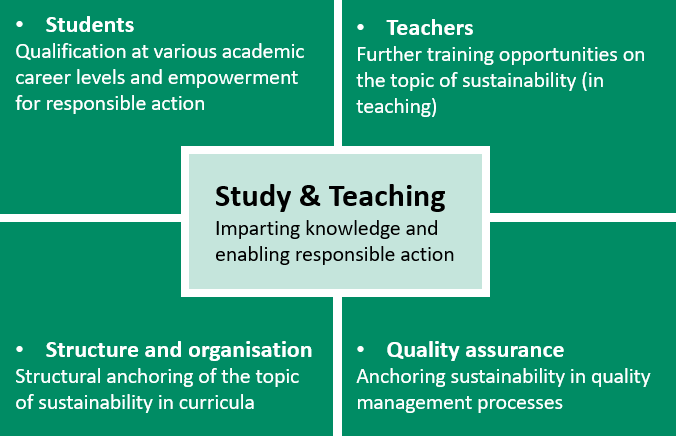
In order to honour the engagement of individual teaching staff and to set incentives for sustainability efforts, in 2022 the university first promoted the trialling of new teaching formats with a sustainability focus within the framework of the Quality Fund for Teaching. This funding initially targeted sustainability-related teaching innovations at the course level. Beyond this, a special call of the newly established Quality Fund Plus was launched in 2023, in cooperation with the Sustainability Office, to highlight modules and entire programmes of study and to encourage and ensure the integration of sustainability-related topics in curricula. The projects funded as part of this initiative are now being implemented in the participating faculties.
Development of new programmes of study: Faculty of Chemistry establishes two new programmes with a sustainability focus
For many of the urgent sustainability goals, promising solution-based strategies can only be developed on a sound disciplinary foundation. Chemistry is one of the key disciplines in this regard, which is why the Faculty of Chemistry at Bielefeld University is leading by way by establishing two new programmes of study with a sustainability focus, starting from the 2026/27 winter semester. The Bachelor's programme "Nachhaltige Chemie" (Sustainable Chemistry) and the English-language Master's programme "Sustainable Chemistry" address the manifold needs and opportunities formulated, for instance, in the United Nations Environment Programme (2021) From Pollution to Solution – A global assessment of marine litter and plastic pollution.
In the Bachelor's programme, the disciplinary foundations needed for reflective and well-informed engagement with the central questions of societal transformation towards a more sustainable way of life are taught. Topics covered include the basic principles of sustainability, the avoidance of waste and emissions, sustainable polymer materials, concepts of the circular economy, and catalysis and biocatalysis. In addition, ethical questions and the responsibility of chemistry in modern society are discussed in order to foster a comprehensive awareness of the challenges and opportunities entailed by chemistry in societal transformation.
In the English-language Master's programme, students acquire the disciplinary expertise that will enable them to develop well-founded, solution-oriented, and scientifically informed conceptions of sustainability. Many of the most pressing societal challenges (energy, climate, environment, nutrition) require sound expertise in chemistry in order to innovate sustainable solutions. The master's programme, building upon a previously completed bachelor's degree in the sciences, is therefore intended to focus on the urgent societal questions stemming from the transformation towards a more sustainable way of life and to address them from the perspective of chemistry. Accordingly, the modules planned will focus on specific sustainability goals, with the necessary disciplinary content tailored to support these aims.